KTX Refunds and Delay Compensation: The Real Numbers
There is a moment, somewhere around 17:40 on a Friday at Seoul Station, when a KTX ticket you paid ₩59,800 for refunds at ₩47,840. Nothing happened to the ticket. The clock just crossed a line.
Three hours before departure, to be exact. That line is written into Article 14(2) of Korail's passenger carriage terms, and since 28 May 2025 the weekend version of it costs twice what it used to. The English-language guides mostly stop at "cancel early and it's cheaper", which is true and useless. What you actually need is the table, the day-of-week switch, the point at which the app stops being able to help you, and the other half of the deal — the part where a late train owes you money from the twentieth minute.
So: the tables, with the article numbers attached in case you ever need to wave them at a counter. It took me an evening and two operators' terms pages to line them up.
Two tables, and the day of the train decides which one applies
Korea's high-speed operators, Korail (KTX) and SR (SRT), run identical cancellation scales. The scale you fall under depends on the day the train departs, not the day you press cancel. A ticket for a Friday train cancelled on Tuesday is a weekend ticket.
Weekday means Monday to Thursday. Weekend means Friday, Saturday, Sunday and public holidays. Both tables are on SRT's Korean terms page and, more or less, on its English one; the government's plain-language law portal reproduces the same figures for Korail under Article 14(2). Checked 30 August 2026.
Before departure:
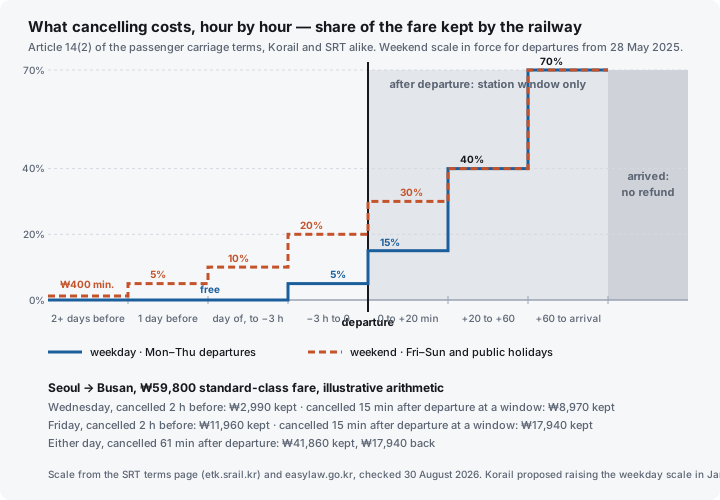
| When you cancel | Mon–Thu train | Fri–Sun, holiday train |
|---|---|---|
| 2 or more days before | Free | ₩400 minimum |
| 1 day before | Free | 5% |
| Day of, until 3 hours before | Free | 10% |
| Last 3 hours before departure | 5% | 20% |
After departure (station window only — more on that below):
| When you cancel | Mon–Thu train | Fri–Sun, holiday train |
|---|---|---|
| Up to 20 minutes after | 15% | 30% |
| 20 to 60 minutes after | 40% | 40% |
| 60 minutes after, until scheduled arrival | 70% | 70% |
| After scheduled arrival | No refund | No refund |
The ₩400 is a floor, not a fee for cheap tickets: if a percentage works out below ₩400, they take ₩400 instead. On a weekend ticket cancelled a week out, that is the whole cost. On a ₩8,400 Cheonan–Asan ticket the day before, 5% is ₩420, so you pay ₩420.
Put it on a Seoul–Busan standard-class fare of ₩59,800 (the standard adult fare the ministry used in its April 2025 announcement, and the fare Korail Talk was listing in August 2026 — check your own, KTX-Cheongryong and Sancheon trains price slightly differently; every won figure below is illustrative arithmetic on that one fare):
- Wednesday train, cancelled the morning of: nothing.
- Wednesday train, cancelled two hours before: ₩2,990.
- Friday train, cancelled two hours before: ₩11,960.
- Friday train, cancelled the day before: ₩2,990.
- Either train, cancelled 61 minutes after it left: ₩41,860 gone, ₩17,940 back.
The ₩11,960 figure is the one that made the news in April 2025. The Kyunghyang Shinmun reported the change as "Seoul–Busan last-minute cancellation fee rises from 6,000 to 12,000 won", and that is exactly what happened: the last-three-hours weekend rate went from 10% to 20%, and the day-before rate went from ₩400 to 5%. The stated reason was people block-booking Friday evening seats and dumping them at the platform.
Seollal and Chuseok
Buses have a third, harsher column for the two big holidays — we covered that in the intercity bus guide. Trains, as far as I can find, do not. SRT's page lists a separate 명절승차권 row, but its numbers are the weekend scale exactly: ₩400 until two days before, 5%, 10%, 20%, then 30/40/70 after departure. Korail's holiday tickets are sold through a separate advance-booking window with its own rules on how many you can hold, and I have not found a published Korail holiday column that differs from the weekend one. If you are cancelling a Chuseok ticket, assume the weekend table and double-check on the Korail Talk cancellation screen, which shows the exact won amount before you confirm.
The proposal you will read about but which has not happened
In January 2026 Korail's acting president told a parliamentary session that raising the weekday scale too would "help reduce no-shows", and asked for it. That is the Business Watch report (carried on Daum) you may have seen quoted as if the change were done. As of August 2026 it is a request, not a rule. The Monday–Thursday free window to three hours before departure is still in the published terms on both operators' sites. If that changes, it will show up on the SRT terms page first; that page is easier to read than Korail's.
The app stops at departure. Then it is a counter and a queue.
This is the bit that catches people, and it catches them at the worst moment.
Korail Talk and the Korail website take refunds up to the departure time printed on the ticket. After that the button is gone. The terms say refunds after departure are handled at a station — 역 창구 — until the scheduled arrival time, at the post-departure rates above. Some Korean-language write-ups claim Korail Talk gives KTX tickets a ten-minute grace period after departure if the system can tell you are not on the train; I have not found that on an official Korail page, so plan as though it does not exist.
SRT is honest about being inconsistent. Its Korean terms page says tickets bought in the SRT app can be refunded in the app "until ten minutes after departure". Its English page says "after 5 minutes after the train departure time, refund will only be available at the station". Two official pages, two numbers. Whichever is right on the day, five minutes is not enough time to notice you have missed a train, find the app, and get through the confirmation screens. Treat departure as the deadline.
So the practical sequence, if you are running late for a train you are going to miss:
- Cancel in the app before the departure time. Even on a Friday that is 20%, not 30%, and it takes fifteen seconds.
- If you missed that, go to a staffed ticket window at the departure station. The terms say 역 창구, a station counter, and I would not bet on a self-service kiosk doing this for you. Ask for 반환 (banhwan), which is the word on the counter screens; 환불 (hwanbul) works too.
- Watch the clock. The rate steps up at +20 and +60 minutes, and the queue at Seoul Station on a Friday evening can eat twenty minutes by itself.
- A Korail ticket goes to a Korail window, an SRT ticket to an SRT window — that is, a station the operator actually serves. SRT does not run into Seoul Station, and KTX does not use Suseo, so those two are single-operator by design. Busan, Daejeon, Dongdaegu and the other shared stops on the Gyeongbu line have both.
One thing worth knowing about the mechanics: the refund goes back to the original payment method. Card refunds post in a few business days depending on the issuer; a ticket paid in cash at a window is refunded in cash at a window, and a cash ticket cannot be refunded through the app at all. If you paid with a foreign card, the won amount is fixed at refund time and the exchange rate is whatever your bank applies that day, so a ₩47,840 refund can come back as a slightly different number than 80% of what you paid.
Changing the train instead of cancelling is often the better move. Korail Talk's 승차권 변경 (change) flow swaps the old ticket for the new one in a single step. Whether a fee attaches depends on where you are on the scale — the SRT terms list a change to an earlier train as fee-exempt, and neither operator publishes a separate change table, so treat a change as a cancel-and-rebook and let the confirmation screen tell you. It shows the fee line, in won, before you commit. On a Wednesday morning that line is zero.
Twenty minutes late and the railway owes you
Now the side of the ledger nobody advertises. Article 15(1) of the same terms sets out 지연배상 — delay compensation — and the numbers are more generous than most European schemes.
Measured at your destination, against the scheduled arrival, for delays the railway caused:
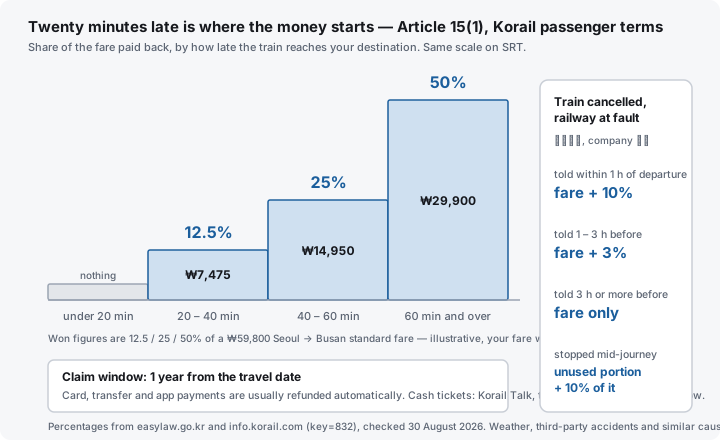
| Late by | You get back |
|---|---|
| Under 20 minutes | Nothing |
| 20 to 40 minutes | 12.5% of the fare |
| 40 to 60 minutes | 25% |
| 60 minutes or more | 50% |
Korail's own customer charter page confirms the 20-minute trigger for KTX and conventional trains (30 minutes for the last metro-style commuter service, 3 hours for freight), and the percentage steps are in the easylaw summary linked above. Checked 30 August 2026.
The catch is the word "caused". Delays down to weather, a trespasser on the line, a level-crossing accident or another operator's train are outside Article 15, and you get nothing. Delays down to a Korail fault — signalling, rolling stock, crew, a knock-on from an earlier Korail failure — pay out. The operator decides which bucket a delay goes in, and you can dispute it through the customer centre, but in practice the announcement on the train and the text message afterwards usually tell you which side you landed on.
How the money actually arrives
For most people it just arrives. Since Korail simplified the process in 2023, a ticket paid by card, bank transfer or one of the pay apps is refunded to the same method without a claim — Korean write-ups on Korail Talk usage put the automatic credit at around 05:00 the following morning, though that is a community source rather than Korail's own wording, so allow a few days before chasing it.
If nothing shows up, or you paid cash, there are three routes:
- Korail Talk: the menu item is 열차운행중지 및 지연배상 신청 (train suspension and delay compensation application). Enter a bank account and it is transferred.
- letskorail.com: under the ticket menu, 지연료 계좌반환 신청.
- Any Korail station window, with the ticket number.
You have one year from the travel date. That is a long window, and it is why the unpaid pile is embarrassing. The Business Watch piece linked above, citing Korail, put unclaimed delay compensation at ₩18 million for 2024 and ₩60 million for 2025, against roughly ₩4.6 billion actually paid out in 2025. Korail's explanation in the same report: cash tickets carry no account details, so they cannot be refunded automatically, and people do not bother claiming small amounts. Small against the total, but it is money sitting there with someone's name on it.
The old alternative — a voucher for 100% off a future ticket instead of cash — was dropped in the same 2023 overhaul, according to that Korail Talk write-up. If a counter offers you one anyway, ask for the transfer instead.
Cancelled outright
A train that does not run at all, where the railway is at fault, pays more than a late one. From the same Korail charter page:
- Cancellation announced within an hour of departure: full fare plus 10%.
- Announced one to three hours before: full fare plus 3%.
- Announced three or more hours before: full fare, no top-up.
- Stopped mid-journey: fare for the unfinished section, plus 10% of that section.
A delay of 20 minutes or more before the train has even left also entitles you to a full refund with no cancellation fee, if you decide not to travel — that is Article 15(3), and the easylaw page spells it out (여행을 시작하기 전에 20분 이상 지연되어 여행을 포기한 경우). SRT's terms list an operator-caused delay among the grounds for reducing or waiving the fee, too. Easy to forget while you are standing on the platform doing the maths on the delay scale.
What I would tell a friend on a Friday
Book the Friday train knowing it is a different product from the Wednesday one. If your plans are soft, buy the earlier, cheaper-to-cancel option: a ticket cancelled two days out costs ₩400 flat, so holding a placeholder for a weekend trip to Busan is nearly free right up to Wednesday night. The expensive mistake is not cancelling; it is waiting until the last three hours to decide.
Set an alarm for departure minus 3 hours and 10 minutes. Not for the train — for the fee line.
If you miss the train, do not walk out of the station. Go to the window first. The difference between a refund at +18 minutes and one at +22 minutes on a Friday is 30% versus 40% of the fare, and the difference between +55 and +65 is 40% versus 70%.
And when the train is late, look at the arrival time on the board, not the departure delay. Compensation is measured at the destination. A train that leaves 25 minutes late and makes up 8 en route arrives 17 minutes late and pays nothing.
Lastly, the ticket is the only thing that proves any of this. If you drop your phone on the KTX with the ticket in the app, the lost-and-found process is its own adventure, but the ticket record survives in your Korail account, and the compensation attaches to the account, not the device.
Fees, thresholds and the Seoul–Busan fare above were checked on 30 August 2026 against the SRT terms pages, the easylaw summary of Korail's carriage terms and Korail's customer charter. The weekend scale changed once in 2025 and a weekday change has been requested; if you are reading this much later, spend thirty seconds on the SRT terms page before trusting a number here.
Frequently asked questions
How much does it cost to cancel a KTX ticket?
It depends on the day the train runs, not the day you cancel. Monday to Thursday departures are free to cancel until three hours before, then 5% up to departure. Friday to Sunday and public-holiday departures cost a 400 won minimum until two days before, 5% the day before, 10% on the day, and 20% inside the last three hours. After departure the scale jumps to 15% (weekday) or 30% (weekend) for the first twenty minutes, 40% up to an hour, and 70% until arrival. Both Korail and SRT use the same table under Article 14(2) of the passenger carriage terms.
Can I refund a KTX ticket after the train has left?
Yes, until the scheduled arrival time, but not from your phone. Korail Talk and the website take refunds up to the departure time printed on the ticket; after that you need a station window. SRT's Korean page says its app keeps working for ten minutes after departure, its English page says five, so treat the app as closed once the train moves. Once the train has arrived, nothing is refundable.
How much compensation do I get if my KTX is late?
Nothing under 20 minutes. From 20 to 40 minutes late at your destination, 12.5% of the fare; 40 to 60 minutes, 25%; an hour or more, 50%. Only delays the railway caused count, so weather and third-party accidents pay zero. On a 59,800 won Seoul–Busan standard fare that is 7,475, 14,950 or 29,900 won. You have one year from the travel date to claim, and the old option of a 100% discount voucher for a future train is gone — it is cash or bank transfer now.
Are the fees the same on SRT as on KTX?
The percentages are. Both operators publish the same weekday and weekend scales, the same 400 won minimum and the same post-departure steps. What differs is the app behaviour after departure and which counter you go to: an SRT ticket is refunded at an SRT station, a Korail ticket at a Korail one, and Suseo has no Korail desk.