Lost Something in Korea: The 7-Day Clock and the Reward
A lost bag in Seoul does not sit still.
Within a day it has been logged into a police database. Within a week it has left the subway system altogether. At nine months, if nobody has claimed it, it stops belonging to anybody but the State.
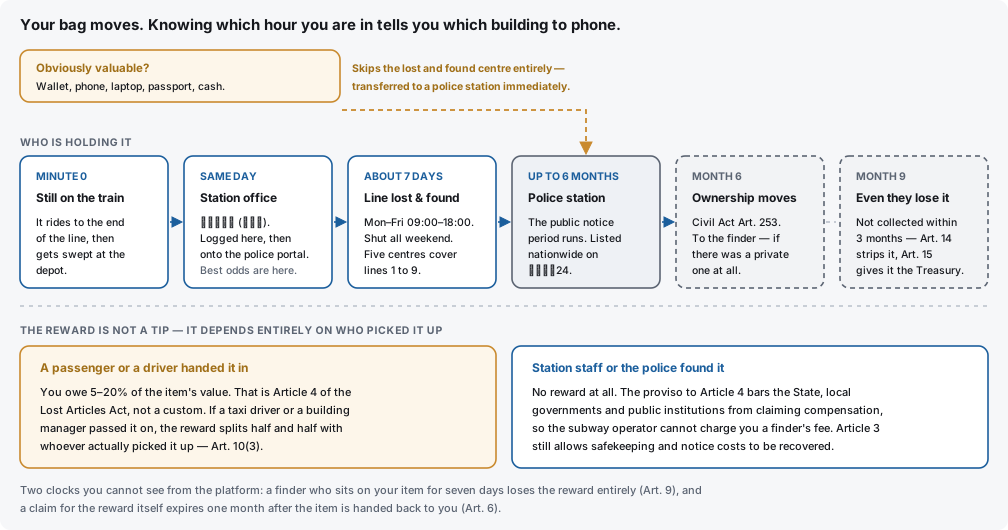
That sequence is not folklore. 서울도시철도엔지니어링, the Seoul Transportation Corporation subsidiary that staffs the lost and found centres, prints it as a five-box process chart: the station registers the item on the police portal, it moves to the line's lost and found centre the next day, sits there seven days, then a police station holds it for nine months before it becomes government property.
So the question that decides everything is not where to search. It is how many hours it has been. That number tells you which building to phone — and past a certain point, it tells you to stop phoning the subway at all.
Hour one: the clock you can still beat
Right now your bag is probably still on the train, riding to the end of the line. Nothing has been logged, so there is nothing yet to search for — which is good news, because this is the only hour in which one phone call solves the whole problem.
Go to the office beside the gates at whatever station you are standing in — signed 고객안전실 on newer signage, 역무실 on older — rather than travelling back to where you boarded. Staff can radio ahead to the terminal before the train turns around.
When the Seoul Transportation Corporation announced its delivery service in July 2026 it repeated the three things it wants from you, and they are not the three things people usually offer:
- The time you were on the train. Not "this morning" — the minute you got off, near enough.
- Where in the train you were sitting, which the corporation defines by the number on the platform screen door you got off through. That number is printed on the floor. Nobody looks at the floor.
- Where the item was left — overhead rack, seat, under the seat.
Seoul's city magazine, reporting from inside the Chungmuro centre, adds the pair that makes the radio call work: the train number and the platform number. With those two, staff at the next station can board the exact car and walk it.
Something dropped down the gap onto the track is a different job. Report it to 고객안전실 with the item and the platform position, and it gets retrieved after the last train — you collect it from the following day.
The subway call centre is 1577-1234, and Seoul's transport newsroom sets out the menu: press 2 for lost property, then the number of your line, and it connects straight to that line's centre. Press 3 instead and you get KORAIL's lines. It runs 24 hours and takes long text messages, photos and video included, which is genuinely useful if your Korean deserts you at 01:00. The workaround for the language is further down. If the network itself is still new to you, the Seoul subway walkthrough covers the platform-level basics.
Where the thing actually goes
Five centres cover the Seoul Transportation Corporation network, each inside a station. Both the corporation's own lost property page and the subsidiary's list them; both were checked in August 2026. The operator's site redirect-loops on HTTPS, so it opens only over plain http.
| Lines | Centre | Station | Phone |
|---|---|---|---|
| 1, 2 | 시청 (City Hall) | City Hall | 02-6110-1122 |
| 3, 4 | 충무로 (Chungmuro) | Chungmuro | 02-6110-3344 |
| 5, 8 | 왕십리 (Wangsimni) | Wangsimni | 02-6311-6765 / 6768 |
| 6, 7 | 태릉 (Taereung) | Taereung-ipgu | 02-6311-6766 / 6767 |
| 9 (Eonju–Jungang Bohun Hospital) | 종합운동장 (Sports Complex) | Sports Complex | 02-2656-0787 |
The Line 9 row is the one English guides get wrong. Only the eastern stretch, Eonju to Jungang Bohun Hospital, is run by the Seoul Transportation Corporation; the Gaehwa-to-Sinnonhyeon half belongs to Seoul Metro Line 9 Corporation, and the Shinbundang Line is a different company again. So 1577-1234 reaches the Sports Complex centre but will not help with anything left west of Eonju. The two official listings also disagree on that centre's number — 02-2656-0787 on the corporation's site, 02-2656-0930 on the subsidiary's. Try one, then the other.
Then the trap. Every centre opens 09:00 to 18:00 on weekdays and shuts for Saturdays, Sundays and public holidays. Lose a laptop bag on a Friday night and there is nobody to talk to until Monday, while the item ages through its holding period all weekend anyway. Outside those hours you collect through a paid transfer locker at the centre's station, which solves pickup and does nothing for questions.
The branch drawn above the timeline is what wastes people's afternoons. The corporation's procedure note reads: 물품의 종류와 관계없이 사회통념상 고가의 물품 등은 즉시 경찰서 이관 실시 — regardless of the type of item, anything high-value by ordinary standards goes to a police station immediately. It is filed under the table on handling food, an odd home for it, but the wording is deliberately general and the police portal says much the same. Phone the subway centre about a dropped wallet and you may be phoning a building that never had it.
The search page is the police portal now
Every English guide still points at Lost112. The operator does not.
서울도시철도엔지니어링's page links to 경찰민원24 at minwon24.police.go.kr as the police's integrated lost property service, and the corporation's July 2026 statement says items unclaimed on the day are registered there before the week of storage even begins. Meanwhile lost112.go.kr resolves to an IP address but returned nothing at all when I tried it from outside Korea in August 2026 — possibly a geographic restriction rather than a closure. Either way, the portal that answers is the police one.
What the police lost-item report page promises in its own service summary: online or in person, filed by you or by someone acting for you, no supporting documents and no fee, processed immediately — within three working hours. The interface runs in English and around forty other languages.
The wall is the online route, which needs a login, and a login in practice means a Korean identity credential. Same obstacle as everywhere else in Korean digital life, and the reason the Korean phone number guide is better read before you need it than after.
Two ways past it:
Go in person. Any police station, or the smaller 지구대 posted on most main streets. Passport or residence card. No certificate, no app, no verification loop, and the service page allows a proxy in as many words.
Borrow a voice. The 1330 Korea Travel Helpline, run by the Korea Tourism Organization, is a phone and live-chat service that will interpret for you. Dial 1330 inside Korea or +82-2-1330 from abroad; there is also chat over KakaoTalk, Line and Facebook, plus a free in-app voice call on Wi-Fi, all listed on the KTO's page. Which language desks are staffed at which hour is not published there, so if it is 04:00 that is worth a moment's thought. The police also run 182, the civil-affairs call centre Seoul's own guide gives as the number for reporting a loss — but whether an interpreter is on shift is a lottery.
Taxis, buses, and the desks nobody signposts
A taxi is the best case in this whole article, because you know who has it.
Booked through Kakao T? Open the app, find the ride in your history and use the contact-the-driver option before anything else — there is a record of exactly which car you were in, which is the thing every other route here is missing. A street-hailed taxi is harder: you need the plate number off your card statement, then the relevant taxi association's lost property desk.
Buses are the worst case. No ride record at all, so you need the route number and the stop, and the item travels to the operating company's garage before it reaches the bus association. Seoul's 120 Dasan line — dial 120, or 02-120 and 02-731-2120 in full, staffed every day of the year at ordinary call rates with no extra information charge — is where to start.
There is also a Seoul-run board almost nobody mentions: the 대중교통 분실물센터, where members of the public post things they have picked up on buses and trains. Not the police database, and not busy — roughly ten posts a month through mid-2026, things like a wallet from the 753 bus on 23 July and earbuds from the 3411 on 15 August. Ten posts is nothing. It also costs you ninety seconds.
Lost phone? handphone.or.kr, the 핸드폰찾기콜센터 run by the Korea Association for ICT Promotion, on 1566-4300. Separate pool from the police database, so check both. KTX, the airport railroad and Incheon Airport each keep their own desks as well — start with the operator, not the police, and the same goes for intercity coaches.
One thing not worth chasing: a dropped transit card. An unregistered T-money card is bearer cash, so write off the balance and buy another for ₩2,500 to ₩4,000 — the T-money guide covers which cards can be registered and which cannot. Spend the energy on the wallet it was sitting in.
The reward is a legal obligation, not a tip
Here is the part no English guide mentions, and the most useful thing to know before you make any of those calls.
Under Article 4 of the Lost Articles Act, a person to whom an article is returned "shall pay a finder compensation within the extent of not less than 5 percent but not more than 20 percent of the value". Not a custom. A statutory floor and ceiling, in the official English translation published by the Korea Legislation Research Institute. On a ₩900,000 phone that is somewhere between ₩45,000 and ₩180,000.
Then the proviso to the same article, where most of the anxiety dissolves: the State, local governments and other public institutions cannot claim compensation. Station staff, police officers — nothing owed, ever. Since most subway items are collected by staff or handed straight to the police, most people pay nothing at all. That covers the reward only, mind. Article 3 separately allows the costs of safekeeping and public notice to be recovered from you, and the after-hours locker and the courier are charged either way.
Where it does bite is Article 10. Leave something in a taxi, a shop or a managed building and the occupant or manager is deemed the finder. If a driver hands your bag to a dispatcher, the reward splits half and half between the occupant and whoever physically picked it up. Two people, one payment, and 20 percent of the value remains the ceiling on the whole thing.
Two limits worth carrying in your pocket. Article 6: no claim for expenses or compensation can be made once one month has passed since the item was returned, so a demand arriving in October about a bag you collected in August has no force. And Article 8 lets you waive your right to the item along with the duties attached to it — in plain terms, walk away from something whose reward costs more than the thing is worth to you.
The finder's side has a mirror of it, and that is largely why the reward comes up less often than the statute suggests: the police form asks whoever hands an item in whether they waive their rights, then warns that the answer cannot be changed later. Plenty of people tick the box. None of it is ever invoiced — a finder who wants the reward says so when the police ring them.
Three clocks, and the last one isn't yours
The seven-day figure people quote is doing double duty. Untangling it removes most of the confusion.
Seven days, the finder's clock. Article 9: anyone who fails to hand a found item over within seven days of finding it forfeits both the reward and any future claim to ownership. A rule about the finder's behaviour, nothing to do with storage.
Seven days, the storage clock. Separately — and, as far as I can tell, coincidentally — the subway centres hold items about a week before passing them on. The police portal attributes that period to the Enforcement Decree of the Lost Articles Act and adds the escape hatch in brackets: seven days, or immediately.
Six months. Once the police publish notice, Article 253 of the Civil Act gives the owner six months to assert their rights. Miss it and the finder acquires ownership outright. For an item found by station staff there is no private finder waiting in the wings, so the operator's chart skips this step and simply shows the police holding on for nine months.
Three months more. Article 14 then gives that new owner three months to physically collect the item from the police station. If they do not, they lose it as well, and Article 15 vests it in the National Treasury. Nine months from drop to forfeiture, whichever route you take to get there.
Getting it back when you can't get to the counter
Weekday-only hours are brutal for anyone with a job and worse for anyone who has already left Seoul. That changed in July 2026, and the change has not reached the English internet.
Since 20 July 2026 the Seoul Transportation Corporation has couriered items held at its centres to an address of your choosing. You phone the centre holding it, complete identity verification on the call, receive an application link, enter an address and pay the delivery fee by card. CJ Logistics carries it. Fees at launch, as reported by Newspim from the corporation's announcement: ₩5,000 under 2 kg, ₩6,000 for 2–10 kg, ₩7,000 for 10–20 kg, with the corporation noting that region and parcel size can move the price. Cash, securities, explosives and live animals or plants are excluded.
It is being used, if not heavily. The corporation's own follow-up release of 14 August 2026 reports 91 deliveries in the first three weeks — 6.1 a day — and says other rail operators have started asking how it works. A small number for a network this size, which tells you roughly how few people know the option is there.
The older route runs alongside it, through the 또타 app: have the item moved to a locker at a station you choose and collect it whenever suits you.
Neither helps from abroad, and the rules for sending someone in your place — what a letter of authorisation has to contain, whose ID is needed — are not published anywhere I could find for the subway centres. The police report allows a proxy explicitly; the centres say nothing either way. Ring and ask while you still have room to change your travel plans.
Legal provisions cited from the Korea Legislation Research Institute's official English translation of the Lost Articles Act (Act No. 717, last amended by Act No. 12210) and from Article 253 of the Civil Act. Centre locations, phone numbers and opening hours checked against Seoul Transportation Corporation and 서울도시철도엔지니어링 pages in August 2026. Delivery fees are as announced in July 2026 and the operator warns they vary by region and size — confirm with the centre holding your item before you pay. If a number here has stopped working, tell me and I'll fix it.
Frequently asked questions
Do I have to pay a reward to get my lost item back in Korea?
Only if a private person found it. Article 4 of the Lost Articles Act sets compensation at between 5 and 20 percent of the item's value, which makes it an entitlement rather than a gratuity. The proviso to the same article bars the State, local governments and public institutions from claiming it, so if station staff or the police picked your bag up there is no reward to pay.
How long does the Seoul subway hold a lost item before the police get it?
Seven days, according to the process chart published by the Seoul Transportation Corporation subsidiary that staffs the centres. The item is registered on the police portal the day it is found, spends a week at the line's lost and found centre, then moves to a police station. Anything treated as high-value is supposed to go to the police immediately instead.
Can I report a lost item in Korea without a Korean ID or phone number?
In person, yes. The police lost-item report on 경찰민원24 requires no supporting documents and no fee, and it can be filed by you or by someone acting for you at any police station or 지구대. Filing the same report online needs a login, which is the step most foreign residents and visitors cannot complete.
What happens if nobody ever claims a lost item in Korea?
Six months after the police publish notice, ownership passes to the finder under Article 253 of the Civil Act. The finder then has three months to collect it, and Article 14 of the Lost Articles Act strips them of it if they do not. Article 15 then vests the item in the National Treasury — nine months from drop to forfeiture.