Speed Camera Fines in Korea: Why the Rental Company Called
Three weeks after I flew back from Jeju, my phone buzzed with a message from the rental company. Not a review request. A bill.
If you have driven in Korea — especially a rental on Jeju, an island that runs on hire cars and unmanned cameras — there is a decent chance this message is in your future. The good news: it is almost certainly legitimate, the amount is fixed by law, and no, you are not getting arrested at the airport next time. The bad news: the system that produced it is documented almost entirely in Korean, and the official payment site will not even let you log in. Here is how the whole thing actually works, as of 2026.
Why the fine went to the rental company, not you
A speed camera photographs a licence plate, not a face. Korean law resolves this the blunt way: the fine is issued to the registered owner of the vehicle. For a rental car, that is the rental company. Always.
So the sequence behind your mystery text goes like this. Camera flashes. A few weeks later, a paper notice lands at the rental company's office. The company looks up who had the car at that timestamp, pays the fine or forwards it, and bills you under the clause you agreed to in the rental contract — the one nobody reads. Some companies add a handling fee on top of the fine itself. Whether they may, and how much, lives in your contract, so check it before you argue.
That lag is why the timing feels so off. The violation is instant; the paper chain is not. Two to four weeks is normal; six is not unheard of.
One practical consequence: ask for the actual notice before paying. A legitimate charge comes with a violation photo, a location, a date and time, and an amount that matches the official table below. A rental company that cannot produce that is padding.
Two fines for the same violation
Here is the part your rental company won't explain and most English-language guides skip. Korea has two parallel fine systems for the same violation, and which one you get depends entirely on who caught you.
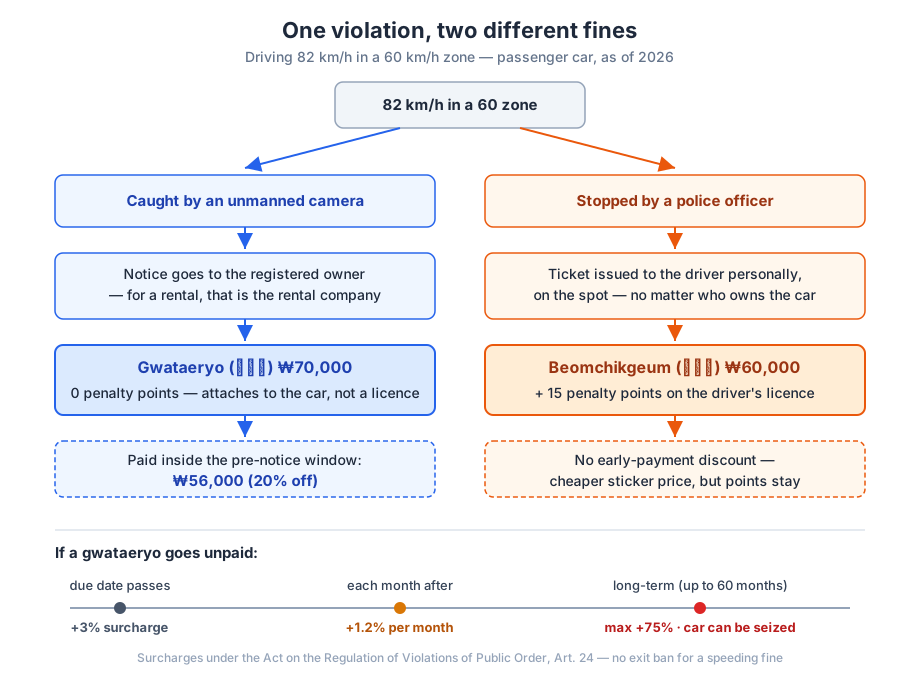
Gwataeryo (과태료) is an administrative fine. It goes to the car's owner because the camera cannot identify the driver. It carries zero penalty points — you cannot dock points from a licence when you do not know whose licence it is. This is what cameras issue, and it is what your rental bill traces back to.
Beomchikgeum (범칙금) is a traffic penalty issued to a person. When a police officer stops you at the roadside, the ticket is written against you, the driver, and it comes with penalty points on your licence. Accumulate 40 points within a year and your Korean licence gets suspended — a real concern for residents, irrelevant for tourists on an international permit but not something to collect anyway.
The odd result: the personal ticket has a lower sticker price than the camera fine. Run a red light and the camera fine is ₩70,000 (about $50) to the owner, while the in-person ticket is ₩60,000 — plus 15 points. The extra ₩10,000 on the camera version is, in effect, the price of anonymity. Residents who get a camera notice are sometimes offered the choice to convert it to the cheaper beomchikgeum by admitting they drove. Do the maths before you volunteer: saving ₩10,000 to take 15 points is a terrible trade.
The actual numbers
These are the passenger-car rates from the enforcement decree of the Road Traffic Act, as of 2026 (vans and trucks run slightly higher; school zones roughly double everything — verify those separately if they apply to you):
| Over the limit | Camera → owner (gwataeryo) | Police stop → driver (beomchikgeum) |
|---|---|---|
| 20 km/h or less | ₩40,000 · no points | ₩30,000 · no points |
| 20–40 km/h | ₩70,000 · no points | ₩60,000 + 15 points |
| 40–60 km/h | ₩100,000 · no points | ₩90,000 + 30 points |
| over 60 km/h | ₩130,000 · no points | ₩120,000 + 60 points |
Red light: ₩70,000 by camera, ₩60,000 + 15 points in person.
One threshold sits outside this table entirely: since a 2021 tightening of the law, going more than 80 km/h over the limit is a criminal matter — a court case, not a fine you transfer from your banking app. The table above is for ordinary speeding.
For scale: ₩70,000 is roughly $50. Annoying, not ruinous — unless you ignore it, which we will get to.
A note on tolerance. Drivers here swear the fixed cameras give you about 10 km/h of grace over the posted limit before triggering. That is folk knowledge, not published policy, and Jeju's cameras in particular have a reputation for being less forgiving than the mainland's. Treat the posted limit as the limit. The Korean legal text behind all of this is the Road Traffic Act, which has an official English translation at the Korea Legislation Research Institute if you want the source rather than a blog's word.
The 20% early-payment discount
Before a gwataeryo is formally imposed, the authority sends a pre-notice and gives you a window (at least 10 days) to respond. Pay voluntarily inside that window and the fine drops by 20%. A ₩40,000 minor speeding fine becomes ₩32,000. The ₩70,000 red-light fine becomes ₩56,000.
This matters more than it looks, because the window is where rental-company lag hurts you. The pre-notice goes to the company, and by the time the bill reaches you, the discount clock may already be running — or run out. If the company paid the discounted amount and billed you the full one, that is worth a polite email. If you receive the notice directly (you live here and own the car), pay in the window. There is no equivalent discount on a beomchikgeum; its due dates work differently, and missing them is worse — an unpaid beomchikgeum picks up a 20% surcharge, and after that the case goes to summary court, where it can reach 50% more.
Paying without a Korean identity — the efine wall
Korea has a slick official portal for exactly this: efine.go.kr, run by the National Police Agency. You can look up violations, see the camera photo, pay by card. If you can log in.
That last step is the wall. efine authenticates through Korean channels — a Korean mobile phone contract in your name, a Korean digital certificate, that ecosystem. Tourists have none of these. Even long-term residents with an ARC often bounce off, because their phone plan or certificate does not match the verification path the site expects that day.
What actually works:
The virtual account on the paper notice. Every fine notice carries a bank virtual account number (가상계좌) unique to that fine. Transfer the exact amount from any Korean bank account — or at a bank counter with cash — and the fine is settled. No login, no identity verification. If you have a Korean bank account, this is thirty seconds in your banking app.
The rental company as proxy. For tourists this is the realistic path, and it is why the company billing you is not (necessarily) a rip-off — it is the only bridge between you and a system that cannot see you. Pay them, keep the receipt and a copy of the original notice.
A police station, if you are still in the country and holding the notice. Bring your passport. It is not fast, but it works.
What does not work: foreign cards on efine (you never get past login), and hoping the fine evaporates when you leave. It does not — it sits against the vehicle and the rental company, who have your card details.
What happens if you ignore it
Unpaid gwataeryo fines grow on a schedule set by the Act on the Regulation of Violations of Public Order (Article 24). Miss the due date on the formal notice and 3% is added immediately. Then 1.2% per month, every month, for up to 60 months. Ceiling: an extra 75% of the original fine. A ₩70,000 fine left to rot becomes ₩122,500.
Beyond the arithmetic, the authority can seize assets — in practice, for traffic fines, that means the vehicle. Cars with large unpaid fine balances get their plates pulled or get booted in enforcement sweeps. This is the rental company's nightmare, not yours, which is precisely why their contract makes the fine your problem within days.
What Korea does not do for an ordinary traffic fine: ban you from leaving, or flag your passport at immigration. That fear surfaces in every expat forum thread on this topic, and for a speeding ticket it is misplaced. (Large accumulated tax or judgment debts are a different universe.) The realistic consequences are the surcharges, the rental company charging your card, and — for residents — trouble when you next register or transfer a vehicle, since unpaid fines surface there.
If the fine is wrong
You can contest a gwataeryo. The pre-notice stage is the cheap moment: submit an opinion (의견 제출) with your evidence — you were not the renter that day, the plate was misread, the timestamps do not line up. After the formal notice, you have 60 days to file a written objection, which sends the matter to a court review rather than a shrug.
Two honest caveats. First, camera evidence is camera evidence; "I do not think I was going that fast" loses to a calibrated photo every time. The disputes that succeed are identity disputes — wrong renter, wrong plate — and rental companies keep the handover logs that settle them, so ask for yours. Second, the process runs in Korean. For a ₩70,000 fine, weigh the hours. Korean agencies do pay out when the paperwork is right — the same clockwork that runs KTX delay compensation runs this in reverse — but the burden of assembling the file is on you, in a language that may not be yours.
What I'd do differently
Photograph the car's plate and the rental agreement at pickup — the same reflex that saves you when you leave something in a taxi saves you here, because every dispute starts with "which car, which dates, whose name". Ask the rental desk one question before driving off: "If there's a camera fine, how do you bill me, and is there a handling fee?" Thirty seconds, and the mystery text three weeks later becomes a line item you already understood.
And on Jeju's long, empty coastal roads, where 60 km/h feels like a suggestion: the cameras are why everyone around you brakes in unison at the same lamppost. Follow the locals. They know where the flashes live.
Frequently asked questions
I got a speeding fine weeks after returning my rental car in Korea. Is it a scam?
Probably not. Camera fines in Korea go to the car's registered owner — the rental company — which then bills you under your rental contract. Verify it by asking the company for the official notice (with the violation photo, location, and time) before paying anything.
Do camera speeding fines in Korea add points to my licence?
No. A camera fine is a gwataeryo (과태료), an owner-liability administrative fine with zero penalty points. Points only attach when a police officer stops you in person and issues a beomchikgeum (범칙금) in your name.
Can I pay a Korean traffic fine online as a foreigner?
Usually not through the official portal. efine.go.kr requires Korean identity verification that most foreigners and all tourists lack. In practice you pay through the bank virtual account printed on the paper notice, or the rental company pays and bills you.
What happens if I just ignore a Korean traffic fine?
A gwataeryo grows: 3% is added once the due date passes, then 1.2% per month for up to 60 months — a maximum of 75% on top. The authority can also seize the vehicle. There is no exit ban for an ordinary speeding fine, but rental companies can and do charge your card on file.