Can I Drive in Korea With a US License? Not On Its Own
The question usually arrives in the wrong order. People ask whether their state license "works" in Korea, get told yes, and book a car on Jeju. What they should have asked is which of two separate one-year deadlines runs out first, because that is the number that decides whether the drive is legal.
Your home license does not work in Korea on its own. It works as one third of a set, for a window that may be a good deal shorter than you think, and the two ways it comes apart have nothing to do with which treaty your country signed.
Korea takes both conventions, and that is not what stops you
There is a persistent fear in expat forums that Korea honors only one of the two road traffic conventions, and that arriving with the wrong flavor of permit means being turned away at the rental counter.
It is not true. Article 96 paragraph 1 of the Road Traffic Act (도로교통법 제96조) recognizes permits issued under the 1949 Geneva Convention, the 1968 Vienna Convention, and bilateral recognition arrangements Korea has signed separately. The Korea Road Traffic Authority puts a date on the Vienna half: permits from Vienna Convention states have been accepted since 1 January 2002.
So an American AAA permit, a German one, a Japanese one and an Australian one all clear the same first hurdle. What does not clear it is the booklet sold online by a company you have never heard of. The same KoROAD page says Korea reads only a permit issued by an authorized body, and points out that the imitations give themselves away on the cover, where they print "International Driving License" instead of Permit. Lotte's rental terms say the same thing in one line: permits issued by private entities are not accepted. Now here is where money and holidays actually get lost.
Two clocks, and the shorter one wins
Two documents each give you a window, and the two windows almost never line up.
The permit's own validity is set by the country that issued it. Korea does the same thing in reverse for its own permits, where Article 98 fixes validity at one year from the date of issue. Your permit carries an expiry date printed on it, and that date has nothing to do with Korea. Read it rather than assuming twelve months.
Korea's allowance is set by Article 96 paragraph 1, and it uses a completely different starting point: 국내에 입국한 날부터 1년, one year from the day you entered the country.
Those two windows only overlap in the middle, and you may drive only inside the overlap.
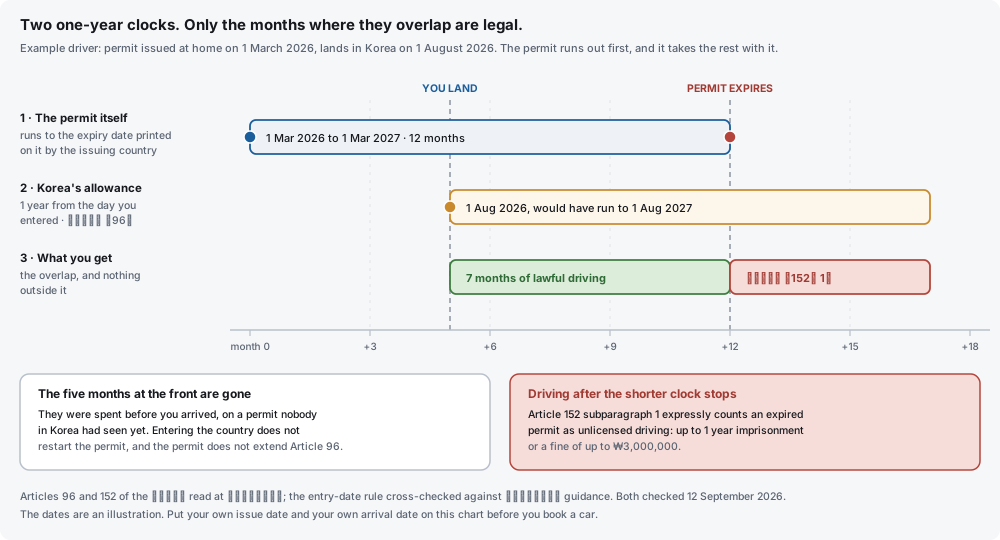
Work an ordinary example. You pick up a permit at home on 1 March because you are organized, then fly out on 1 August. The permit dies on 1 March the following year. Korea's year would have carried you to the following August, but it never gets the chance, because the shorter clock ends the whole thing. You planned for twelve months of driving and you have seven.
The reverse case is the one that catches people who stay. Get the permit the week before you fly, and the two clocks line up nicely, but they both stop at the same wall roughly twelve months after you land. There is no renewal counter in Korea. Permits are issued by the country that licensed you, so extending means going home or asking someone at home to help, and for most long-stay residents that is the moment the license exchange in the last section becomes the real answer.
What happens if you drive past the line is not a technicality. Article 152 subparagraph 1 of the Road Traffic Act lists driving without a license, and the statute expressly writes in the case where the validity period has passed. The penalty is up to one year of imprisonment or a fine of up to ₩3,000,000, and it is the same offense whether you are three days over or three months over.
One thing I could not pin down, and I would rather say so than guess: what happens to the entry-based year if you leave Korea and come back. The wording of Article 96 counts from the day you entered, which reads on its face like a fresh count on each arrival, but the Korea Road Traffic Authority guidance does not address re-entry at all and I found no published interpretation settling it. If your plan depends on a border run resetting the clock, that plan needs a phone call to a license test center, not a blog post.
Three documents, or you are driving unlicensed
The permit is not a license. It is a translation booklet, and it says so on the cover in several languages that most people never read.
That is why the official instruction names three documents rather than one. KoROAD's permit page is written for Koreans driving abroad, and it tells them to carry 국제운전면허증, 한국면허증, 여권 together, warning that turning up with the permit on its own can be punished as unlicensed driving. Hold that up to a mirror and you have the set a visitor needs here: the permit, the license it translates, and the passport that shows when the Korean year started.
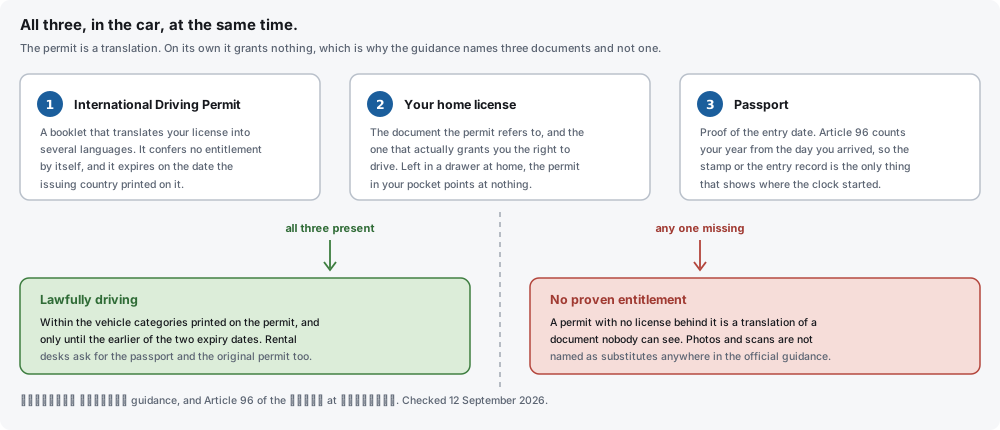
The failure mode is boring and common. Somebody photographs their home license, leaves the plastic in a drawer at home, and travels with the permit alone. The permit is then a translation of a document nobody can see. Nothing in the guidance treats a photo or a scan as a substitute.
The passport matters for a reason that is easy to miss. Since your driving window is measured from the day you entered Korea, the entry record is the only proof of where the clock started. An officer who cannot establish your arrival date cannot establish that you are inside your year.
What the permit actually lets you drive
The second sentence of Article 96 paragraph 1 limits the vehicle types you may drive to those recorded on the permit itself. This gets ignored because the permit looks like a blanket endorsement, and it is not.
Your permit carries a grid of vehicle categories, and only the ones stamped or ticked are live. Category A covers motorcycles. Category B is the ordinary car. If your home authority never endorsed you for motorcycles, the permit will not carry A, and hiring a scooter on a coastal road puts you outside your entitlement even though the permit in your bag is perfectly valid.
The same trap sits at the top of the size range, where groups book an eleven or fifteen seat van because it looks like an easy way to move six people and their luggage. Lotte says where the line falls: up to nine seats wants Class B or above, and the eleven seater wants Class D, the bus category. A license that never covered a bus at home cannot put a D on your permit, and nobody at the counter can add one. Check the grid before you book the big vehicle, because the staff there are checking availability, not your endorsements.
Rental cars are carved out of the commercial ban
Here is a rule that sounds alarming and then turns out to be fine.
Article 96 paragraph 2 says that a person driving on a foreign-issued permit may not drive a commercial vehicle under the Passenger Transport Service Act or the Trucking Transport Business Act. Read alone, that looks like it might swallow rental cars, since hire cars are registered under the passenger transport legislation.
The proviso is the whole point: 다만, 「여객자동차 운수사업법」에 따른 대여사업용 자동차를 임차하여 운전하는 경우에는 그러하지 아니하다. Hiring a vehicle from a rental business and driving it yourself is expressly excluded from the ban. That is exactly what you are doing at the Jeju airport rental desk.
What remains prohibited is working. You cannot drive a taxi, a bus, a delivery truck, or any other commercial service vehicle on a foreign permit, and no rental exception rescues that.
The rental companies then add their own conditions on top of the law, and those are contract terms rather than statute. Lotte Rent-a-Car's English FAQ sets a minimum age of 21 for international customers and asks for the passport and the original permit at the counter, with payment by debit or credit card. Both clocks are written into its terms as well: the service runs for one year from the date the driver arrived in Korea, and the rental has to end inside the permit's own validity (lotterentacar.net, checked 12 September 2026). Other operators set their own floors, and some ask for a minimum period since your license was issued. Read the conditions on the booking page you are actually using rather than assuming the industry is uniform.
If the driving ends up not happening, the intercity bus network covers more of the country than most visitors expect, and it is the fallback that makes a car-free trip workable rather than miserable.
If your license is not American
Most of the above applies unchanged to British, Australian, Canadian, Irish and other permits issued under either convention. The permit route works the same way and the same two clocks apply.
Two groups sit outside it.
Countries with bilateral recognition. Article 96 reaches past the two conventions to two kinds of bilateral deal: one that recognizes the other country's international permits, one that recognizes its licenses outright. The Ministry of Foreign Affairs publishes both lists, and as of August 2026 Taiwan and Vietnam are the only permit-recognition partners named on it. Where the second kind pays off is later, at the exchange, where a license from a recognized country needs only a physical examination instead of the written test. That roster is a police notice, last revised on 6 April 2026, and it moves, so check the notice and not a summary of it, this one included.
Countries that signed neither convention. Mainland China is the largest example. It is party to neither the Geneva nor the Vienna Convention, which means a permit issued there has no basis for recognition in Korea. Hong Kong and Macau are handled separately, and KoROAD does list their permits as recognized, which surprises people who assume the whole jurisdiction is treated as one. For anyone in the first position the route is not a permit at all. It is the exchange process below, or sitting the Korean test from scratch.
Past one year: what the swap costs, and what it takes from you
Once the shorter of your two clocks runs out, there is exactly one way to keep driving, and it is to convert your foreign license into a Korean one under Article 84 of the Road Traffic Act.
The mechanics are manageable. KoROAD handles the exchange at license test centers. If your license comes from a country Korea recognizes, you take a physical examination and skip the written test; if it does not, there is a written exam of forty multiple-choice questions available in Korean, English, Chinese and Vietnamese. The paperwork runs to the original foreign license, your passport showing entry and exit, your alien registration card, three photographs sized 3.5cm by 4.5cm, an embassy confirmation or apostille certification of the license, and an immigration record (KoROAD, checked 12 September 2026). What comes back is an ordinary Class 2 Korean license in almost every case.
On the fee, be careful with older English-language pages. Seoul Jung-gu's foreigner guide, cited below and otherwise sound, still prints ₩7,500. KoROAD's current page lists an issuance fee of ₩10,000 for the standard card and ₩15,000 for the mobile IC version, as of September 2026, with ₩10,000 for the written test if you have to sit it and a medical check billed separately at ₩7,000. The embassy confirmation or apostille is a cost on top of all of that, set by your own consulate rather than by Korea.
The part nobody warns you about is what you hand over. Article 84 requires a foreign applicant to surrender the foreign license, and you do not walk out with it. Seoul Jung-gu's English guidance describes the submitted license as being returned when the holder departs Korea or cancels the Korean license, and discarded if unclaimed ten years after the exchange (junggu.seoul.kr). For anyone who flies home twice a year and expects to rent a car there, that is a genuine decision and not a formality.
What the two rules tell you to do before you book
None of this needs a war story. Three conclusions fall straight out of the wording.
Buy the permit late. Korea's year starts on the day you land and the permit's own year started the day it was issued, so every week between the two is a week you paid for and cannot use. The document costs the same in March as it does in July. In July it is worth several more months.
Treat the permit as the least important of the three things in the glovebox. The license behind it is what grants the right to drive. The passport is what proves the year has not run out. The permit is only the page that lets a Korean officer read the other two.
And if you are staying past a year, start the exchange while you can still drive yourself to the test center. The embassy confirmation has to have been issued within the year before you apply, and the immigration record has to cover your whole life, so neither is a same-week errand.
If the driving does happen, the thing to read next is what occurs when a camera catches you, which works nothing like it does at home: the fine goes to the registered owner, which means the rental company calls you weeks later. And if the drive is on Jeju, where hire cars are close to compulsory, the island guide covers what to do with the car once you have it. Your arrival date is doing more work than you realize in all of this, which is worth remembering when you sort out entry paperwork.
Statutory references read at 국가법령정보센터 and cross-checked against 한국도로교통공단 guidance on 12 September 2026. Fees and document lists change. Confirm at a license test center before you travel, and tell me if you find a figure here has moved.
Frequently asked questions
Can I get an International Driving Permit after I arrive in Korea?
No. Article 98 of the Road Traffic Act lets Korean authorities issue permits only to people who already hold a Korean driver's license. If you arrived without one, there is no counter in the country that can sell you the missing document, and the permit has to come from whichever country licensed you.
My permit expired but I only have three days left in Korea. Can I finish the trip?
No. Article 152 subparagraph 1 of the Road Traffic Act expressly counts driving on a permit whose validity period has passed as unlicensed driving, punishable by up to one year of imprisonment or a fine of up to ₩3,000,000. Three days is the same offense as three months.
Can I drive a rental car in Korea on an International Driving Permit?
Yes. Article 96 paragraph 2 bars permit holders from driving commercial vehicles, but its proviso carves out cars hired from a vehicle rental business. Renting from Lotte, SK or a Jeju operator and driving it yourself is exactly what the exception covers.
Does my home license have to be in English?
Not for the permit route. The International Driving Permit is itself the translation, which is why officers and rental desks want to see the original license sitting behind it. Translation matters more for the separate process of exchanging your license for a Korean one, where an embassy confirmation or apostille is required.