Do I Need a K-ETA for Korea in 2026? Usually Not
Type K-ETA into a search bar and somebody will try to sell you one before you finish the first page of results. Most people flying to Korea this year do not need one.
The government has noticed the sellers, at least. Its own application page carries a warning about agencies and phishing sites "that charge high fees under the pretext of providing K-ETA application agency (or expedited) services", and the guide underneath adds that there is no expedited service — nothing anybody sells moves your application up the queue. The state charges ₩10,000, roughly US$7–8. Anyone charging forty dollars is charging thirty for the typing.
The part those sites do not lead with is the exemption. If you hold an American, British, Japanese, Australian or most Western European passport, the requirement has been suspended for you since April 2023 — and the suspension has just been rolled forward again, to the last day of this year.
What you need instead is free, takes about five minutes, and cannot be filed more than three days before you land. That last detail catches people, because it runs backwards to how every other travel document works.
So do I need one, or not?
The Ministry of Justice extended the temporary exemption in a notice the K-ETA portal published on 23 December 2025 and Korean embassies republished through January. The wording is short. The exemption runs from 1 January 2026 to 31 December 2026, Korean time, and "the countries/regions that are currently exempt from K-ETA are subject to this extension" — no new list, the same one as before, twelve more months on the clock. The Vienna embassy carries the identical text if you want it on letterhead.
Which countries, though? This is where the English-language internet falls apart. The Bern embassy notice, updated to run until 31 December 2026, covers "Switzerland, Liechtenstein, and the 23 countries/regions listed below": Japan, Taiwan, Hong Kong, Singapore and Macao; Canada, the US and Guam; the UK, Germany, France, Italy, the Netherlands, Spain, Poland, Sweden, Finland, Norway, Belgium, Denmark and Austria; Australia and New Zealand. The original 2023 announcement, in Korean, called the same group 22, because it counted Guam inside the United States and predated the two alpine additions.
So 22, 24 and 25 are all in circulation, all defensible, none of them wrong. You will also see 67, a figure I could not tie to any ministry page; it looks like the visa-free list wearing a disguise.
Rather than count, use the check the ministry itself points at. The extension notice says people covered by the exemption "will get a pop-up message when they scan a photo of their passport information page during the application". That pop-up is your answer, and reaching it costs nothing — payment is step six of seven.
Two traps run the other way. The list published on the K-ETA site under Eligible Countries is not the exemption list; it is the hundred-odd passports that may apply for a K-ETA at all, exempt ones included. If your country is missing from that page, your problem is a visa, not a K-ETA. And children under 17 and travellers over 65 from K-ETA countries are exempt from the authorisation too — a detail the arrival card portal states in one line and almost nobody repeats.
Worth keeping in mind either way: exempt from K-ETA does not mean waved through. A K-ETA is not a visa. If your passport does not get visa-free entry to Korea in the first place, none of this section applies to you, and no amount of ₩10,000 fixes it.
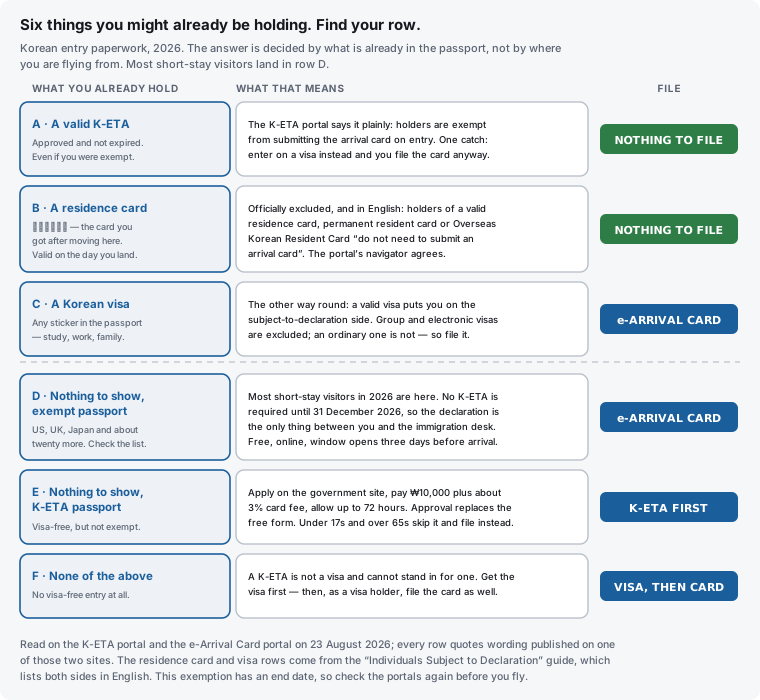
The free thing that replaced it
The e-Arrival Card is the digital version of the little white card cabin crew used to hand out somewhere over the Yellow Sea. You file it at e-arrivalcard.go.kr, in English, Korean, Chinese, Japanese, Vietnamese, Thai or Russian, and the guide settles the price question in one sentence: the e-Arrival Card for the Republic of Korea is free.
Five things to have open when you start:
- your passport
- a working email address
- your arrival date and flight number
- where you are staying
- your departure date and flight number, which is optional
That is the whole list, lifted off the portal's own "things to prepare". A group route handles two to a thousand people at once and is meant for travel agencies; on a phone the cap drops to nine, so a family is fine and a tour bus is not.
The issue number arrives at the email address you gave. You are not required to bring it — the portal says so outright — but it also says knowing the number "may be helpful", which is the sort of sentence that means screenshot it. If your stay address or departure date changes afterwards you can edit the declaration right up until inspection. The arrival date is the exception: correctable only within three days of the original submission.
The accommodation field is the one that stalls people, and it is worth doing on a laptop rather than on a phone in a taxi queue.
Three days at the front, three days at the back
Both government pages carry the same sentence: filing opens 대한민국 도착 3일 전부터, three days before arrival in Korea, Korean time. A fortnight out there is simply nothing to submit.
What almost no English guide mentions is the other end of it. A submitted e-Arrival Card loses its validity 72 hours after you send it, and it is spent the moment you clear immigration — re-enter Korea and you file a fresh one. Line those two up and the three-day window stops looking like bureaucratic whimsy. The card only lives for 72 hours, so opening the window 72 hours out is the only arrangement in which the thing you filed is still alive when you land.
Then there is a third 72, and it belongs to the other document entirely. K-ETA assessment "typically takes 72 hour or less" — the portal's own typo included — with a warning that it can run longer when applications spike. That number describes a queue of human reviewers, not a form's shelf life, and the arrival card portal is unusually blunt about the confusion: its system "is a separate system from the Korea Electronic Travel Authorization (K-ETA), please be sure to avoid any confusion."
Practically, then. Applying for a K-ETA? Do it the week you book the flight, not the week you fly, because 72 hours is a floor and not a ceiling. Filing the arrival card? Set a reminder for three days before departure and ignore it until then. Nothing else in trip planning works this way, which is exactly why people miss it — the instinct that has you sorting out when to visit six months ahead is useless here.
When ₩10,000 is still worth paying
The exemption is not automatically the better deal, and the ministry says so itself.
Every version of the extension notice carries the same offer: people who are exempt may apply anyway "if they wish to receive the benefits associated with K-ETA approval, such as exemption from completing an arrival card upon entry". The K-ETA portal puts it from the other side — approved holders "will be exempt from submitting the arrival card when entering the Republic of Korea", and pass through immigration "more conveniently" as a result.
So ₩10,000 buys three years of not filing that form. Three years, or until your passport expires, whichever comes first.
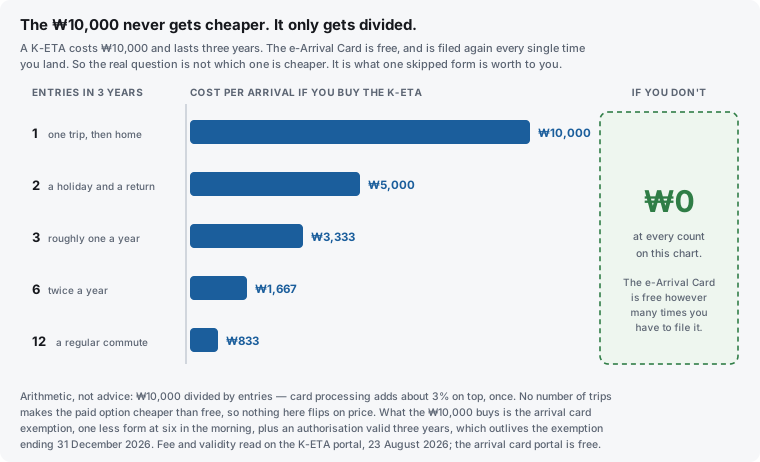
There is no break-even, and the chart is honest about that. Free stays free; the paid option only ever approaches it. What the money buys is the removal of a small recurring chore, and a document that keeps working after 31 December 2026 whatever the ministry decides about 2027.
For one holiday, a poor trade. For someone flying Tokyo–Seoul most months, or a consultant with a standing client in Gangnam, it stops looking silly.
Two things before you reach for a card. The ₩10,000 is not quite ₩10,000 — the fee page warns that online payment processing adds "generally about 3%" on top, and the whole lot is non-refundable regardless of the outcome. And an approved K-ETA "does not guarantee entry": the officer at the desk decides, same as ever.
Who files nothing at all
If you already live here, this is shorter than you think — and better documented than most guides admit.
The arrival card portal has an English page called Individuals Subject to Declaration that splits the world in two, and the second half is the one to read. Excluded from the declaration altogether: Korean citizens; holders of a valid residence card, permanent resident card or Overseas Korean Resident Card; K-ETA holders; holders of group or electronic visas issued through the visa portal; and foreign cabin crew on arriving aircraft. (A sixth category covers visa-free group tourists at Yangyang and Muan, though the portal's own footnote gives that one end dates in May 2025 and March 2026, both of which have passed.)
So the 외국인등록증 in your wallet does the job on its own. The navigator on the same site says it in one sentence — those with a valid residence card "do not need to submit an arrival card" — and it sits two clicks deep, which is presumably why the guides paraphrase each other instead of quoting it.
An ordinary visa is the opposite case, and this is the part that catches people out. Korean visa holders sit on the subject to declaration side: a valid visa means you file the card. So do K-ETA-exempt nationals, SOFA personnel, UN laissez-passer holders and ABTC holders. And underneath that, the trap in its own words: "individuals holding a K-ETA but entering with a visa must complete the e-Arrival card." Immigration processes you on the visa, so the K-ETA exemption does not travel with you. It is not a contradiction, just an order of precedence — the same order the K-ETA guide sets out for residence cards.
If you are still setting up a life here, that instinct carries: a Korean phone number and a T-money card both have their own quiet exceptions.
One more, briefly. Q-CODE, the pre-entry quarantine registration, belongs to a different agency altogether and replaces neither document here. Its status moves with public health conditions, so check qcode.kdca.go.kr before you travel rather than trusting a guide, including this one.
What happens if you land without having filed
Less than the forums imply, going by the government's own wording — and that qualifier is doing real work, so read what follows carefully.
The portal frames it as a choice, right there in a heading: "Select electronic/paper arrival card". Underneath, it says those who have submitted the e-Arrival Card "do not need to fill out a paper arrival card, as the e-Arrival Card holds the same validity as the paper arrival card." The paper form still exists; the online one stands in for it. Neither portal makes the electronic submission a condition of boarding, and neither describes a penalty for turning up without one. What both do warn about is false information, which carries penalties and possible entry restrictions — and applies just as much when somebody else fills the form in for you.
So the honest reading is that an arrival card is still an arrival card, completed either before you fly or at the desk, and that filing early is a convenience rather than a gate. How that plays out on the floor at Incheon at seven in the morning is a different question, and not one any portal answers.
The date this article expires
31 December 2026, Korean time.
The exemption began as a tourism measure tied to Visit Korea Year and has been rolled forward more than once, which is a pattern rather than a promise. As of August 2026 nothing has been announced about 2027. If it lapses, everyone in the exempt column moves to the K-ETA column, and every guide written this year goes confidently wrong overnight.
The useful habit is not memorising the answer. It is knowing which two addresses hold it — k-eta.go.kr and e-arrivalcard.go.kr — and that both end in .go.kr, a suffix reserved for Korean government bodies that no private company can register. Anything else asking for your passport number and a card is a business. Some are legitimate agents; none of them are the government, and since the portal itself says there is no expedited service, none of them can make your application go faster. Nor can we: there is nothing to buy here and nothing here that files anything for you.
Ten minutes, two portals, one pop-up when you scan your passport. Then read the notice with the date on it.
Fees, dates and exemption wording were read on the K-ETA portal, the e-Arrival Card portal and Ministry of Foreign Affairs embassy notices on 23 August 2026, and every figure here is sourced to one of those pages. The K-ETA exemption is a temporary measure with a stated end date, and Korean entry rules have changed at short notice before, so verify against the official sites before you travel. This is general information, not immigration advice: for a case-specific answer, the 1345 Immigration Contact Center answers in several languages, and HiKorea handles residence matters. See terms. Corrections via contact.
Frequently asked questions
Is the K-ETA exemption permanent?
No. It is a temporary measure that has been rolled forward a year at a time since April 2023, and the current extension runs from 1 January 2026 to 31 December 2026 Korean time. Nothing had been announced about 2027 as of August 2026, so if you are flying in January, check the K-ETA portal again rather than trusting a guide written this year.
Does the e-Arrival Card cost anything?
No. The government guide states in one line that the e-Arrival Card for the Republic of Korea is free, and the only place to file it is e-arrivalcard.go.kr. If a site is asking for a service fee to submit it for you, that fee is entirely its own.
I already paid ₩10,000 for a K-ETA and then found out I was exempt. Can I get a refund?
No. The Ministry of Justice notices say the fee is non-refundable and that an issued K-ETA can be used until its expiry date. That is less painful than it sounds: a K-ETA lasts three years, or until your passport runs out if that comes sooner, and holding one exempts you from filing an arrival card on every entry in the meantime.
Do I need both a K-ETA and an e-Arrival Card?
Normally no, and this is the single most common muddle. The K-ETA portal states that holders of an approved K-ETA are exempt from submitting the arrival card. The one exception is written into the arrival card portal: if you hold a K-ETA but enter on a visa, immigration processes you on the visa, and you file the card after all.