Hallasan Reservation for Foreigners: The 3-Month Ban
I sat with both versions of Hallasan's reservation page open, Korean on the left, English on the right, and read them against each other line by line. Most of it matches. The trail names, the cut-off tables, the warnings about weather.
Then there is one sentence on the Korean side with no counterpart on the English side, and it is the only sentence on the page that can stop you booking anything for three months.
Hallasan is not hard to book. It is hard to book correctly, because the version of the rules written for you is shorter than the version written for everyone else. If Jeju is a wider plan than one climb, the island overview covers the week. This is only the mountain, checked on 6 September 2026.
Not every Hallasan trail needs a booking
Before anything else: the reservation system probably does not apply to you.
Only two trails reach the summit crater, Baengnokdam, and only those two are gated. The park's trail list sets out seven routes and marks exactly two as reservation-required: Seongpanak (9.6 km) and Gwaneumsa (8.7 km). Eorimok is 6.8 km, Yeongsil 5.8 km, Donnaeko 7.0 km, Seokgulam 1.5 km, and Eoseungsaengak is a 1.3 km stroll you finish in half an hour. No QR code, no booking window, no penalties.
It goes further than that. A notice dated 23 April 2025 narrowed the booked zone to two upper sections — Jindallaebat to Baengnokdam, and Samgakbong to Baengnokdam — which moved the gate a long way up the mountain. The park's trail pages give the distances: Seongpanak is 9.6 km, 7.3 of them to Jindallaebat and 2.3 above it; Gwaneumsa is 8.7 km, 6 to Samgakbong and 2.7 above. So the honest question is not "do I need a Hallasan reservation" but "do I need the crater". Plenty of people spend a fine day on Yeongsil, see the Witsaeoreum plateau, and never touch the system.
If you do want the crater, read on. It gets specific.
Right now, only Seongpanak reaches the summit
As of September 2026 the Gwaneumsa route does not go to the top, and this is not a weather thing.
The park has closed the Samgakbong-to-Baengnokdam section from 1 August to 30 September 2026 to repair damaged rockfall barriers and replace decking. The notice is blunt about the consequence: during the works, the summit is reachable via Seongpanak only. The lower part of Gwaneumsa is unaffected — the entrance up to Samgakbong shelter is the non-reservation section and stays open — so you can still walk the prettier trail, you just cannot finish it. The classic up-Seongpanak, down-Gwaneumsa traverse is off the table until October.
Two footnotes to that closure. The notice is Korean-only: switch the site to English and the notice board still lists all 46 posts under their Korean titles, this one included. And the booking calendar has not been told either. Open the status page, pick the Gwaneumsa course, and every day in September shows 500 seats free — the full daily quota, untouched, for a route that cannot reach the crater. Nothing on that screen says why.
The end date is 30 September 2026. If you are reading this in October or later, open the notice board and check whether it was extended. Construction dates on mountains slip more often than they hold.
Bookings open on the first business day, at 9am
Here is discrepancy number one, and it is the kind that costs you a Saturday.
The English page says reservations open "on the 1st of every month". The Korean page says something more precise: 매월 첫 업무시작일 09시 — nine in the morning on the first business day. Weekends and national holidays do not count, though Jeju's own provincial holiday does. If the 1st lands on a Sunday, booking opens at 9am on the 2nd; a holiday weekend can push it to the 3rd. Somebody following the English wording turns up on the 1st, finds nothing, and assumes the site is broken. The window then covers the following month through to its last day.
The park has published what that morning looks like. You get put in a numbered queue. Dates showing as full can reopen while you wait, because people ahead of you abandon half-finished bookings. The status calendar is deliberately hidden on opening day, so you cannot scout seat counts before joining the queue. And the whole system goes down for maintenance between 20:00 and 22:00 on both the day before and the day of opening — site, booking, lookups, certificates, everything.
What you are booking is not only a date. Since 1 December 2025 there are two entry windows, 05:00 to 08:00 and 08:01 to 11:30. One booking covers up to four people, and one person may hold one booking per hiking week — scanning your QR resets that, so a Monday climb frees you to book again for Tuesday.
Be at the keyboard at 08:55 on the first working day of the month, and do not plan to prepare at nine the previous evening.
Book on the English page, not the Korean one
The Korean booking flow starts with Korean real-name verification, which needs a resident registration number or a phone contract that maps to one. Most foreign visitors have neither. The verification screen says what to do about it, in Korean:
실명인증이 불가한 외국인은 외국어 페이지 이메일 인증을 이용하세요. (이메일 인증은 전화번호가 없는 경우만 이용 가능합니다)
Foreigners who cannot pass real-name verification should use email verification on the foreign-language page — and email verification is available only if you have no phone number. Notice which half of that survives translation: the English page carries the first sentence and drops the parenthesis. If you hold a Korean mobile line in your own name, the Korean text expects you to use it, and the Korean phone number walkthrough explains why that one item gates so much else here.
The form is the reason to switch languages. On the English login page the non-member box asks for a name and an email address, with a domain dropdown offering naver.com, daum.net, gmail.com and a fourth option still labelled 직접입력 — type your own. Then "Send verification code", then the code. The Korean page in the same position offers real-name verification and nothing else.
Social login is one button, not six. Kakao works. Naver, Google, Baidu, Facebook and Line all sit in the page's HTML as finished buttons, wrapped in comment marks so they never render — worth knowing if somebody has told you to just use your Google account. One warning does appear on the visible page: if your Kakao nickname contains special characters, the booking can fail to complete at the end. Change it before you start, not at 09:04 on opening morning.
Whichever door you use, come back through the same one. A booking made under real-name verification does not show up when you log in with Kakao, and the reverse holds too; the lookup searches only the method you booked with.
Two small things before you close the tab. A booking left without its personal details filled in is cancelled automatically after a day. And on the QR codes themselves the park's own pages disagree: the reservation guide says the entry and descent codes go to the phone number you entered, while the April 2025 notice says they travel in the message sent by KakaoTalk, SMS or email, and the certificate FAQ lists those three in that order of priority. Email is in there. It is simply the last thing tried.
The three-month ban the English page never mentions
This is the sentence I opened with. On the Korean reservation page:
예약 후 취소 없이 탐방하지 않았을 경우는 1회는 3개월, 2회는 1년간 예약이 불가능 합니다.
Book a slot, fail to cancel, fail to show up: three months with no booking rights. Do it twice: one year. The park's Korean FAQ repeats it in the same numbers. I searched the English version of the same page for penalty, cancel and no-show and found none of them — the English text warns about damaging nature and says penalties follow under the relevant laws, which is a different subject entirely. So the reader most likely to no-show — the visitor whose flight moved, whose weather turned, who is reading the shorter page — is the one not told what it costs.
The deadline is later than you would guess. Cancellation stays open until the end of the entry window you booked, so on the 08:01–11:30 slot you have until 11:30 that morning, and scanning your QR in time counts as turning up. A seat you cancel goes back on the calendar. A seat you abandon is simply gone, because there is no waiting list to hand it to — the Korean page says as much in a single line. On a Saturday that is somebody's whole trip.
The fix takes a minute, through the reservation lookup menu, logged in the way you booked.
Your QR has to match the ID in your pocket
Since 5 June 2026 the park has been checking identity documents at the gate, and the notice is unusually direct. If the personal details on your QR do not match your ID, entry is refused and a one-year ban follows. If a QR is found to have been traded, the booking is cancelled and the same one-year ban applies. Mobile ID works if you show it on screen.
That rewrites a piece of advice you will meet in every traveller forum: get a Korean friend to book it for you, since the Korean flow is easier. Under the June rules that is no longer a shortcut. It is a way to be turned around at the gate at six in the morning after paying for a taxi, with a year's ban on top. If your friend is booking, they must book you, spelled as your passport spells it.
The cut-off times decide your day, not your fitness
Gates open at 05:00. Everything after that is arithmetic, and the arithmetic is unforgiving because the park does not only limit when you can start — it limits when you must start down.
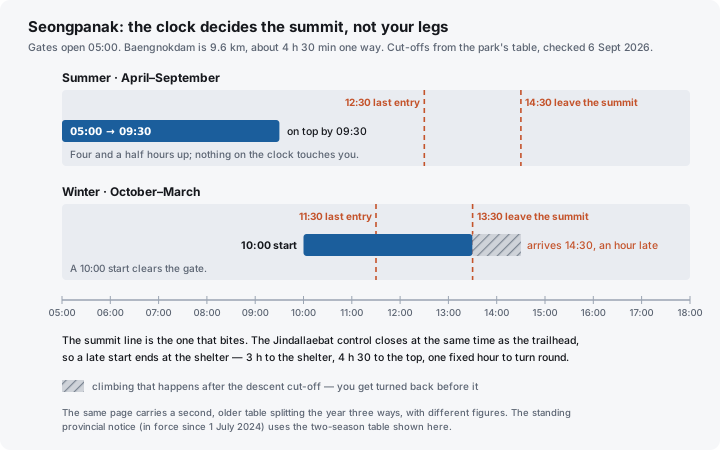
These are the times from the park's own table, checked 6 September 2026, and they match the standing provincial notice that has governed entry and descent since 1 July 2024:
| Checkpoint | Winter (Oct–Mar) | Summer (Apr–Sep) |
|---|---|---|
| Entry · Seongpanak trailhead and Jindallaebat control | 11:30 | 12:30 |
| Entry · Gwaneumsa trailhead and Samgakbong control | 11:30 | 12:30 |
| Entry · Eorimok and Yeongsil | 12:00 | 15:00 |
| Entry · Donnaeko | 10:00 | 11:00 |
| Descent · summit (Baengnokdam) | 13:30 | 14:30 |
| Descent · Jindallaebat and Samgakbong shelters | 15:30 | 16:30 |
| Descent · Witsaeoreum | 15:00 | 17:00 |
| Descent · Nambyeok junction | 14:00 | 15:00 |
Seongpanak is 9.6 km one way and the park puts it at 4 hours 30 minutes to the top, with Jindallaebat at three hours. Do the sum for a winter morning. Enter at 10:00, which is legal — the gate does not close until 11:30 — and you reach the summit at 14:30. But the summit cleared at 13:30. You will be stopped at Jindallaebat, having walked seven kilometres for a shelter. Start at 05:00 and you are on the crater rim around 09:30 with four hours of margin, which is why the car park fills before dawn.
The same page then contradicts itself, twice. It carries a second seasonal table below the first, splitting the year three ways — winter as January, February, November, December; spring and autumn as March, April, September, October; summer as May to August — with different figures. Under that one a September climb has a 12:30 entry and a 14:00 summit descent, an hour earlier than the table above. The provincial notice backs the two-season version, which is the one I have used; plan against the earlier of the two and you are covered either way. The other contradiction is about the start of the day: the Korean guide page lists seasonal opening times — 06:00 in deep winter, 05:30 in spring and autumn, 05:00 in summer — while the provincial notice, the trail pages and the English page all say a flat 05:00 year-round. For September that is 05:30 against 05:00, and the cost of being early is half an hour in the dark.
156 spaces, and 4.5 km where you cannot park
The Seongpanak car park holds 156 vehicles — 5 large, 131 standard, 5 accessible, 8 compact and 7 EV bays. In season it is full before the trail opens. Parking runs ₩1,000 for the first hour in a small car, ₩500 per additional 20 minutes, capped at ₩13,000 a day, from the fee page as of 2026; a van or a truck pays ₩2,000, ₩800 and ₩20,000.
The roadside is not the answer. Enforcement zones run roughly 4.5 km on the Jeju City side of the trailhead and 2.3 km on the Seogwipo side, and they are enforced, because that road is the 5.16 mountain highway. The official overflow is a free 199-space park-and-ride near Jeju International University, further down the same road, linked by the 281 bus.
Buses are the sane option anyway. The 281 leaves Jeju Bus Terminal from 06:00, every 10 to 14 minutes, and the park puts that ride at about 45 minutes; coming up from Seogwipo it runs every 11 to 17 minutes and takes about 50. The 181 starts at 06:10 and takes roughly 35 minutes from the airport; the 182 is its mirror image on the Seogwipo side. Paying for any of it without a Korean card follows the same logic as everywhere else on the island — see intercity bus booking in Korea.
One thing the fee page does not tell you is the admission price. The 탐방요금 table exists on both the Korean and English versions, with rows for adults, for teenagers and soldiers, and for children, plus a full list of who qualifies for a discount — and every price cell is empty. I am not going to tell you Hallasan is free, because the park has not said so on the page that would say so. The only figures I can stand behind are the parking ones.
The summit certificate is a PDF now
Small change, genuinely useful. From 1 September 2026 the park issues the summit certificate as a PDF straight from the website — no kiosk queue, no app install. You reach the top, open the Community menu, enter your reservation number, pick the climber, upload a photo, submit; the PDF then downloads from the reservation lookup menu.
The old routes survive: the paid paper certificate from a kiosk, and the free version through the JEJU IoT app. But every method, the new one included, requires you to apply on the day you climbed and receive it the same day. There is no coming back on Tuesday for Sunday's certificate. Do it on the bus down.
What the seat calendar actually shows
English guides quote a daily cap of 3,000 climbers. The park's current numbers are lower, and they live somewhere else — in the December 2025 notice, which sets capacity per entry window: Seongpanak 800 in the early slot and 200 in the late one, Gwaneumsa 400 and 100. A thousand a day up the east side, five hundred up the north.
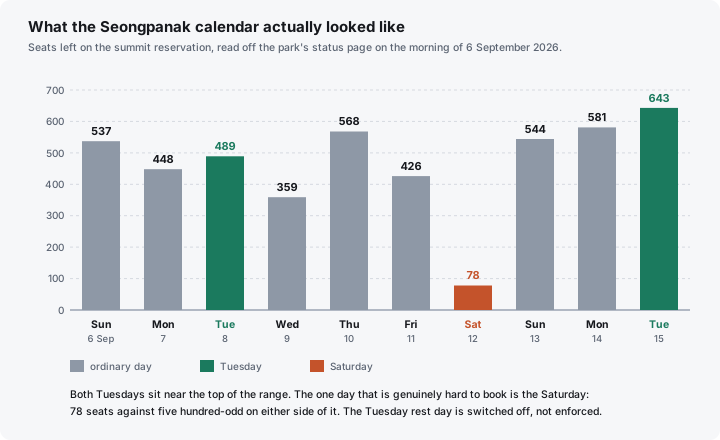
Those numbers come off the reservation status page on the morning of 6 September 2026 — the page warns that counts change constantly, and the Sunday figure moved by seven while I was reading it — and they say two things at once. The Saturday is the only genuinely tight day: 78 seats against five hundred-odd on the days either side of it. And both Tuesdays sit near the top of the range, at 489 and 643, which brings me to the last thing the English-language internet gets wrong about this mountain.
You will read that Hallasan closes on Tuesdays, and that 3,000 people a day may climb it. Both come from one sentence, and that sentence is still on the park's guide page: 탐방인원 : 1일 3000명 … 단, 화요일은 휴식의 날 운영, with its English twin, "Visitors: 3000 people per day (Open during weekdays and holidays. Except, Tuesdays are closed)". Both are wrapped in comment marks in the HTML, which is why you have never seen either on screen. Switched off rather than deleted, in two languages at once, while the capacity notice and the calendar carry on saying something different. Nobody sells 643 seats for a day the mountain is shut. If a Tuesday climb is the whole trip, ring 064-713-9953 before you count on it. Otherwise, stop passing the rule on.
Which is the exercise in one line. The rules are published, just published in two languages of different lengths, two tables that disagree, and a comment block nobody reads. Read the Korean page even if you have to paste it into a translator. That is where the three months lives.
Frequently asked questions
Do I need a reservation to hike Hallasan?
Only if you want the crater at the top. The summit sections of the Seongpanak and Gwaneumsa trails need a booked QR code. Eorimok, Yeongsil, Eoseungsaengak, Donnaeko and Seokgulam do not, and neither do the lower stretches of Seongpanak and Gwaneumsa. Eorimok and Yeongsil both reach the Witsaeoreum plateau at around 1,700 m with no booking at all.
What happens if I book a Hallasan slot and do not show up?
The Korean reservation pages state that failing to visit without cancelling costs you three months of booking rights the first time and a full year the second. That sentence appears nowhere on the English version of the same page. You can cancel right up to the end of the entry window you booked, and it costs nothing.
Can I book Hallasan without a Korean phone number or ID?
Yes. The Korean booking flow runs on Korean real-name verification, so the site tells foreigners who cannot pass it to use email verification on the foreign-language page — and that form sits on the English login page: name, email address, send code, enter code. The Korean page in the same position offers real-name verification only. Kakao login works on either; the Naver, Google, Baidu, Facebook and Line buttons are commented out of the page and never appear.
Is Hallasan closed on Tuesdays?
The booking calendar says no. A line reading 3,000 visitors a day, Tuesdays closed still sits in the HTML of both the Korean and English guide pages, but it is wrapped in comment marks, so no reader sees it and the current capacity notice says something else. On the morning of 6 September 2026 the two Tuesdays in the next ten days had 489 and 643 seats free, more than most other days. If your trip hangs on it, phone the park on 064-713-9953.