Busan in Two Days: Is It Worth the KTX Ticket?
Busan is the second city, on the south coast, two and a half hours from Seoul by KTX. It has beaches, mountains, the country's largest fish market, and a coastline that Seoul cannot offer at any price.
It is also a long way, and the question people actually need answered is whether the journey pays for itself. Here is the honest version.
When it is worth it, and when it is not
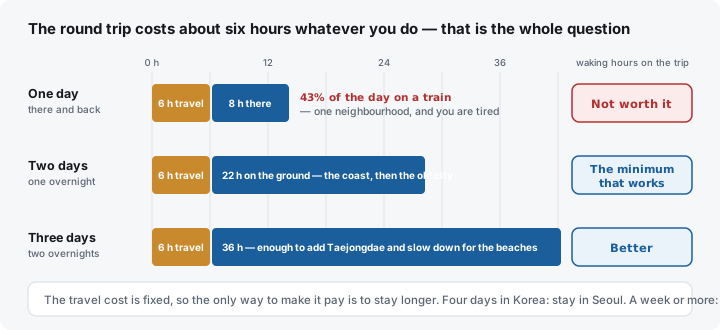
One day: no. The round trip eats five hours, plus getting to and from stations. You arrive mid-morning, leave late afternoon, and see one neighbourhood. You will have spent a lot of money to be tired.
Two days with an overnight: yes. This is the minimum that works. You get two full days on the ground, and Busan is different enough from Seoul that the contrast is the point.
Three days: better, especially in summer, when the beaches justify a slower pace.
Getting there
KTX from Seoul Station to Busan Station. Both are central and on the subway network, so there is no airport transfer at either end. Roughly two and a half hours on the fastest services.
Booking: weekdays you can generally buy on the day. Weekends, the summer peak, and the two big lunar holidays sell out — during Chuseok and Seollal, weeks ahead. If your dates overlap one of those, see when to visit Korea for why that matters beyond just the trains.
Flying is possible but rarely faster once you add airport transfers at both ends. Express buses are cheaper and take five to six hours.
Day 1 — The coast
Haeundae is the famous beach and the obvious starting point. In summer it is packed to the point of parody; out of season it is a wide, pleasant stretch of sand with a promenade.
The better walk is the Haeundae Blueline Park coastal path — a former railway line converted into a seaside route, with a small sightseeing train if you would rather ride than walk. The views are the reason to come to Busan rather than stay in Seoul.
Gwangalli Beach in the evening, for the bridge lit up over the water. Cafés and restaurants line the sand, and this is where the city feels most like a holiday.
Day 2 — The old city
Jagalchi Market, the country's largest seafood market. You choose from the tanks downstairs and the restaurants upstairs cook it. Go hungry, go early, and accept that some of what is on display will be unfamiliar.
Gamcheon Culture Village, a hillside neighbourhood of brightly painted houses stacked up a slope. It began as a refugee settlement during the Korean War and was later painted as an art project. It is beautiful and it is somebody's home — the same caution applies as in Seoul's Bukchon, and Korean etiquette covers why photographing residential streets needs care.
Busan Tower and Yongdusan Park if you want the overview, though the coastal views elsewhere are better.
If you have a third day, Taejongdae — cliffs and forest on a headland at the southern tip — is the best thing in the city and the most often skipped.
What Busan does better than Seoul
Seafood. Not close. Jagalchi and the smaller markets around it serve fish that arrived that morning.
Coastline. Seoul has a river. Busan has the sea, mountains behind it, and the two meeting in the middle of a city of three million.
Pace. Busan is noticeably slower and more relaxed. People who find Seoul intense often prefer it.
Dialect. Busan's accent — satoori — is strong enough that Korean learners notice immediately. Locals are cheerfully aware of it.
What Seoul does better
Public transport. Busan's subway is fine and far smaller. You will use taxis and buses more.
Museums and palaces. Seoul is where the historical sites are.
Range. Busan is a city with highlights. Seoul is a city you could spend a month in.
Practical notes
T-money works in Busan. The same card you use in Seoul works on Busan's subway and buses — see the T-money guide if you have not got one yet.
Distances are longer than they look. Busan sprawls along the coast, and Haeundae to Jagalchi is a real journey, not a short hop. Budget for it.
Summer is the peak, and it shows. Beach accommodation prices in August are a different thing entirely, and Haeundae in high season is shoulder to shoulder.
Typhoons. Busan gets them in late summer more than Seoul does. It rarely ruins a trip outright, but check the forecast — the Korea Meteorological Administration publishes warnings in English.
The verdict
If you have four days in Korea, stay in Seoul. If you have a week or more, two days in Busan is the single best use of the time — it is the clearest way to see that Korea is not just its capital.
Written August 2026. Train times, prices, and seasonal conditions change. Corrections welcome via contact.
Frequently asked questions
How long does the KTX take from Seoul to Busan?
Roughly two and a half hours on the fastest services, a little longer on trains with more stops. It runs from Seoul Station to Busan Station, both of which are central and on the subway network.
Is Busan worth visiting for one day?
Not really. Five hours of the day disappear into travel, which leaves you with one neighbourhood. Two days with an overnight is the minimum that makes the journey pay for itself.
Do I need to book KTX tickets in advance?
On weekdays you can usually turn up and buy. Weekends, holidays, and the summer peak sell out, and Chuseok and Seollal book out weeks ahead.
Is Busan cheaper than Seoul?
Accommodation and food are generally cheaper, sometimes noticeably so. Transport costs about the same. The saving does not usually cover the KTX fare on a short trip.