Korean Etiquette: Mistakes Foreigners Make
Most etiquette guides for Korea list thirty rules, of which about five matter and the rest are things nobody will notice you breaking. Foreigners are given a wide margin here, and no one expects a visitor to have absorbed a system of social hierarchy in a week.
So this is the short version: the handful that genuinely register, and the ones that are safely ignorable.
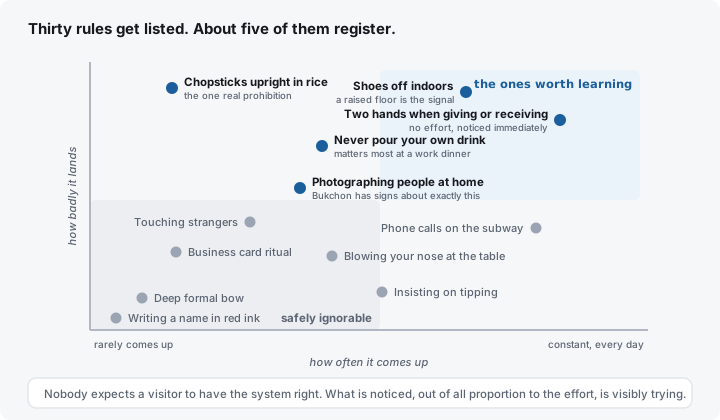
The ones that actually matter
Two hands
When giving or receiving anything from someone older or more senior — money, a business card, a drink, a document — use two hands, or support your right forearm with your left hand.
This is the highest-return thing on this page. It takes no effort, it is noticed immediately, and it works in every context from a shop counter to a business meeting.
Shoes off
Always in homes. Also in many traditional restaurants with raised floor seating, guesthouses, temples, some clinics, and clothing shop fitting rooms.
The signal is a raised floor, a shoe rack, or other people's shoes by the door. If you see any of those, take yours off. Wearing shoes into a Korean home is a genuine breach rather than a technicality.
Practical consequence: wear shoes you can remove without sitting down, and consider the state of your socks before you go out.
Age determines the interaction
Korean has different speech levels depending on the relative age and status of the people talking, which is why you will be asked your age or birth year very early in a conversation. This is not nosiness — the other person is working out how to address you.
Related conventions:
- Elders are served first and start eating first at a shared meal
- Priority seats on public transport stay empty, even when the carriage is full — see the Seoul subway guide
- Offering a seat to an older passenger is normal
Korean age and titles covers why the birth-year question comes up so fast and what the titles mean.
Drinking has rules
If you end up at a work dinner or drinking with a group, these matter more than any of the others:
- Do not pour your own drink. Pour for others; someone will pour for you.
- Hold the bottle with two hands when pouring for someone senior.
- Turn away slightly when drinking in front of someone significantly older.
- Accept the first drink even if you only touch it to your lips. Refusing outright reads as refusing the person.
The ones that are mostly ignorable
Bowing. A small nod is enough. Visitors who attempt a deep formal bow generally look uncomfortable rather than respectful.
Chopstick rules. Do not stand chopsticks upright in rice — that is a funerary image and the one real prohibition. Everything else is flexible.
Business card ritual. Relevant if you are working here, irrelevant otherwise. Two hands, read it before putting it away, do not write on it in front of the giver.
Wearing red ink for names. A superstition with historical roots. Nobody under sixty will react.
Things visitors do that actually land badly
Talking loudly on public transport. Not illegal, not enforced, and you will be the only person doing it. Texting is universal; phone calls are rare.
Physical contact with strangers. Back-slapping, arm-touching, and hugging read as intrusive. Note the asymmetry: being jostled without apology in a crowd is normal and carries no meaning at all.
Photographing people without asking. Particularly in residential areas. Bukchon, the traditional-house neighbourhood in Seoul, has signs asking visitors for quiet precisely because tourists treat a residential street as a set.
Blowing your nose at the table. Considered unpleasant in a way that quietly sniffing is not. Step away.
Insisting on tipping. Prices include service. Pressing money on a server creates confusion rather than gratitude — see how ordering works for the rest of the restaurant mechanics.
The thing worth understanding underneath all of it
Korean social interaction is organised around relative position — age, seniority, and how the two people are connected. That is what the age question, the two-handed passing, the drinking rules, and the speech levels are all expressions of. It is not formality for its own sake; it is a system for establishing who is where before proceeding.
As a foreigner, you sit outside it, and people know that. Nobody expects you to have it right. What is noticed, and appreciated out of proportion to the effort, is visibly trying — two hands, shoes off, a nod, "jal meogeotseumnida" on the way out of a restaurant.
The Korea Tourism Organization publishes an official English-language overview if you want the formal version.
Written August 2026. Social conventions vary by region, generation, and setting. Corrections and additions welcome via contact.
Frequently asked questions
Do I need to bow in Korea?
A small nod of the head is enough in almost every situation a visitor encounters. Deep formal bows belong to specific ceremonial contexts, and a visitor attempting one usually reads as awkward rather than respectful.
Is it rude to pour your own drink in Korea?
In a group, yes — mildly. The convention is to pour for others and let them pour for you, and to hold the bottle with two hands when pouring for someone older or more senior.
Should I take my shoes off in Korea?
Always in homes, and in many traditional restaurants, guesthouses, temples, and fitting rooms. If you see a raised floor, a shoe rack, or other people's shoes by the door, take yours off.
Is tipping rude in Korea?
Not rude, but not practised and slightly confusing for staff. Prices include service, and attempting to tip may result in the money being returned to you.