Korean Funerals: What to Do When a Coworker Loses a Parent
The message lands at 23:40 on a Tuesday. Forwarded image, all in Korean: your team leader's name, a hospital you've never heard of, two dates, and — the part that stops most foreigners cold — a bank account number.
Your first thought is that someone's been scammed.
Nothing is wrong. That account number is the most practical line in the message. By the time you're at your desk tomorrow you need three answers: are you going, how much, and whose name goes on it. The chrysanthemum and the two bows come later, and every English guide already covers those.
The 부고 message, and why there's an account number in it
부고 (bugo) means death notice. It usually arrives as a screenshot, forwarded into the team KakaoTalk room by whoever sits closest to the bereaved.
What's in it:
- 홍길동 부친상 — Hong Gil-dong's father has died. 모친상 is mother; 빙부상/빙모상, or the plainer 장인상/장모상, are the wife's parents.
- 빈소 (binso) — the hall and room number, e.g. 서울아산병원 장례식장 3호실. Screenshot this one.
- 발인 — the morning the coffin leaves, almost always day three, very early. Visiting is days one and two.
- 상주 (sangju) — the chief mourner. The person you're actually there for.
- The account, labelled 계좌 or 부의금 계좌. The money is 부의금 (buuigeum), also called 조의금.
The account is there because 부의금 isn't really a gift. A funeral runs three days in a rented hall, catering included, and the bills land fast. It's a mutual-aid ledger: you pay in when someone else's parent dies, and years later it comes back. Distance isn't a reason to opt out.
Do you actually have to go?
The line is drawn by your relationship with the living person, not the dead one. You never met the parent. Everyone knows that.
Go in person if you're on the same team and work with them most weeks, if they're your direct manager, or if you'd call them a friend.
Send money only if they're a different team, or you're out of the country. Not a lesser option — it's what most of the office does.
Do nothing if you've never spoken to them, or the 부고 came through a company-wide channel.
If the team leader goes, the team goes together, in one car, at one time — so say something in the chat before you plan your own trip. The same workplace hierarchy that decides who sits where at dinner decides this.
The test I use is selfish: if that person vanishing for three days would visibly change my week, I go.
How much, in 2026
₩50,000 is the working default. In December 2024 the Confucian body 성균관유도회 published funeral guidance saying flatly that ₩50,000 is enough — it's the largest note in circulation, and letting the amounts inflate hurts everyone.
| Who they are to you | Typical 2026 amount |
|---|---|
| Colleague, different team | ₩50,000 (about US$35) |
| Same team, weekly contact | ₩50,000–100,000 |
| Direct manager, or a real friend | ₩100,000 (about US$70) |
| Someone who reports to you | ₩100,000–200,000 |
Dollars at roughly ₩1,420 to the dollar, mid-August 2026. No official schedule exists — that table is what people around you quietly put in, not a rule you can look up.
Amounts run in odd units — 3, 5, 7 — then jump to 10, which counts as a whole unit. Never 4: 사 is a homophone for death. And unlike weddings, crisp new bills are slightly wrong — they imply you saw it coming.
Team pools are common: everyone drops ₩50,000 into one envelope and one person carries it. Two envelopes from the same team looks disorganised, so ask first.
The envelope — and why your name alone isn't enough
Blank envelopes (부의 봉투) sit in a free stack at the reception desk, preprinted 부의 or 謹弔.
The back is the part guides skip. Bottom left, vertically: your name, and your affiliation.
삼성전자 영업2팀 홍길동
The desk keeps a 장부 — a ledger. Every envelope is opened, counted and written down, because the family will reciprocate later, sometimes years later. A bare name is one they can't place, and there are three 김민수s in that book.
Being the only foreigner in the room doesn't help here. Whoever reads that ledger three weeks later wasn't at the desk. Write the team.
Roman letters are fine if your handwriting isn't. Get the name and title order roughly right and nobody will study it. Notes go in unfolded, facing the same way.
Inside the hall: the thirty minutes, step by step
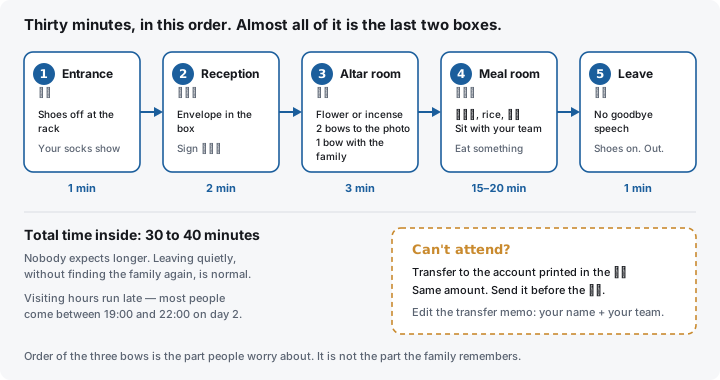
Shoes off at the entrance, into a rack that will be overflowing by 8pm. Reception desk just inside: hand over the envelope, sign the 방명록. Name and affiliation again.
Then the 빈소. A portrait on the altar table, white chrysanthemums on one side, an incense burner on the other. Take one flower or light one stick — either is correct. Copy whoever went in ahead of you.
Two deep bows to the portrait. Then turn to the 상주 at the side and exchange one bow. One, not two — two bows are for the dead. Christian families often don't bow at all; they bow their heads and stand. Watch the family for two seconds before you commit.
You don't have to say anything, which surprises people. 얼마나 상심이 크십니까 is the formal line, but plenty of Koreans say nothing and hold the bow a beat longer. Silence reads as respect here, not awkwardness.
Then the 접객실, a room of long low tables, where someone puts 육개장 (spicy beef soup), rice and 편육 (sliced pressed pork) in front of you. Eat it. Not eating is the closer thing to rudeness; the food is the family's hospitality. Fifteen or twenty minutes is right.
Then get up and go. No goodbye ritual, no need to find the 상주 again.
What to wear when you don't own a black suit
Plain dark suit, white shirt, dark tie is the template, and charcoal or navy counts.
But it's 9pm on a weeknight and half the room came straight from a desk. Muted is the whole requirement: darkest jacket you own, dark trousers or a skirt at the knee, nothing patterned, branded, denim or red.
And socks. Your shoes come off within ten seconds of arriving, so dark intact socks outrank most of that list.
Failing that, a white shirt and your plainest trousers will do. The wrong jacket beats not going, and most etiquette errors people worry about are invisible to a family that is exhausted and glad you came.
If you can't attend: the transfer, and Monday morning
Send what you'd have handed over, before the 발인 — after that the hall accounts close and the family is at the burial site.
The bit everyone misses is the memo field. Korean banking apps let you edit 받는분 통장 표시 — the line on the recipient's statement — which otherwise defaults to your account name. Put your name and team in it, no spaces; the field is short.
Then a short KakaoTalk message. 삼가 조의를 표합니다 is the standard line; English is fine if that's how you normally talk. A long apology for your absence hands the work of reassuring you to someone who is grieving.
Don't expect a reply for days.
When they're back at their desk, the greeting is a quiet 고생 많으셨습니다 — that was hard, you got through it. Then treat it as an ordinary working day. Don't ask how the funeral went. Quietly taking one of their meetings is worth more than any sentence.
When it's your own family: 경조휴가
There is no bereavement leave in the Labour Standards Act. 경조휴가 is 약정휴가 — agreed leave — so it exists only because your 취업규칙, contract or union agreement says it does. Read the document, not a colleague's summary. If the wording is ambiguous, the Ministry of Employment and Labour runs a counselling line on 1350.
The benchmark most companies copy is the civil service table, 국가공무원 복무규정 별표2, published by the Ministry of Personnel Management:
| Who died | Days (civil service) |
|---|---|
| Spouse; your parents or your spouse's parents | 5 |
| Grandparents, children, children's spouses, siblings | 3 |
Calendar days, weekends included — not five working days. Private employers often match it, sometimes with less for in-laws. Ask HR in writing on day one.
Money coming in sits in Article 35 of the Enforcement Decree of the Inheritance and Gift Tax Act, amended 27 February 2026, which lists 부의금 among items excluded from gift tax where the amount is customarily necessary. A judgement standard, not a fixed ceiling. If the sums are unusual, ask a 세무사 rather than a blog.
One bookmark: e하늘 장사정보시스템, the Ministry of Health and Welfare's directory of funeral facilities and prices.
The short answer, for tonight
Go if the person matters to your week. ₩50,000, or whatever the team chat lands on. Write your team on the back of the envelope. Two bows to the portrait, one to the 상주 — get that backwards and nobody will remember. Eat the soup. Leave after twenty minutes.
Then say almost nothing on Monday, and mean it.
Amounts, leave entitlements and the tax position checked August 2026 against the 성균관유도회 guidance reported by Seoul Shinmun, Ministry of Personnel Management leave tables, and Article 35 of the Enforcement Decree on law.go.kr. Customary amounts drift and company rules vary — confirm your own 취업규칙. Corrections via contact.
Frequently asked questions
How much condolence money do I give for a coworker's parent in Korea?
₩50,000 is the working default for a colleague you know by name, and ₩100,000 for your direct manager or someone you'd call a friend. Keep to odd units — 3, 5, 7 or 10 — and skip 4 entirely. Ask your team chat first, because teams very often pool into one envelope.
Do I have to attend a coworker's parent's funeral in Korea?
If you work with them weekly, or they are your direct manager, going in person is the expectation and it matters. For someone two teams away, sending money is perfectly normal and nobody thinks less of you. The family remembers who came, not who bowed correctly.
What do I wear to a Korean funeral if I don't have a black suit?
The darkest jacket you own over a plain white shirt, with dark trousers, is enough. Socks matter more than the jacket because your shoes come off at the door — dark and intact. Turning up in mismatched office clothes is normal at 9pm on a weeknight; not turning up is what people notice.
Can I send Korean condolence money by bank transfer instead of going?
Yes, and the account number in the 부고 message exists for exactly that. Send the same amount you'd have handed over, before the 발인 on the third morning, and edit the transfer memo so it shows your name and your team rather than just your account name.