Attending a Korean Wedding: Gift Money and Etiquette
The invitation arrives as a link.
Not an envelope, not a card — a KakaoTalk message opening into a scrolling mobile page: photos, a map, a D-day counter, and near the bottom, folded behind a button labelled 마음 전하실 곳 ("where to send your heart"), bank account numbers for the gift money. One for the groom's side, one for the bride's. Sometimes one for each parent too.
That page is the whole system in miniature. A Korean wedding, from the guest's side, is a short, loud, extremely efficient exchange: you bring money, they feed you, a ledger records both. Get the money part right and everything else is forgiving. Which is convenient, because everything else takes about ninety minutes including lunch.
How much: the 2026 numbers
The old rule of thumb — ₩50,000 for a colleague, ₩100,000 for a friend — is drifting upward, and the reason is buffet maths. Meals at ordinary wedding halls commonly run ₩60,000–80,000 a head, and hotel venues clear ₩100,000. Hand over ₩50,000 and eat, and you've technically cost the couple money. People have noticed.
So the amounts have moved. In a May 2025 Incruit survey of 844 workers, 61.8% named ₩100,000 as the right amount for a coworker's wedding; only 32.8% still said ₩50,000. That's the clearest snapshot there is, because none of this is written down anywhere official.
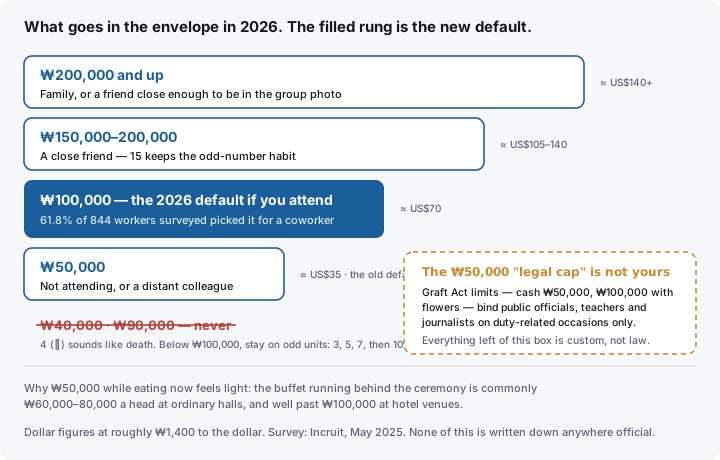
Where that leaves you, as of 2026:
| Relationship | Amount |
|---|---|
| Not attending, or a colleague you barely know | ₩50,000 (about US$35) |
| Attending — coworker, ordinary friend | ₩100,000 (about US$70) |
| Close friend | ₩150,000–200,000 |
| Family, or a friend who'd be in your own wedding photos | ₩200,000 and up |
Dollars at roughly ₩1,400 to the dollar, September 2026.
Two number rules. Below ₩100,000, amounts stay odd — 30, 50, 70 — because odd numbers are auspicious and even ones split cleanly, which is a bad omen for a marriage. And never, at any level, a 4: 사 is a homophone for death. ₩40,000 manages to break both rules at once, which is why you'll never see it. Once you reach ₩100,000, clean multiples of ten are fine — 10, 15, 20.
If you've read the funeral version of this guide, note the reversal: at funerals, crisp new bills quietly imply you saw the death coming. At weddings it's the reverse. New notes from the ATM are the polite choice — this event had a save-the-date.
The reception desk, step by step
You do all of this in the lobby, before the ceremony, in about four minutes.
Get cash. The lobby of most wedding halls has an ATM, and it's there because this trips up locals too. No card readers at the desk, no Kakao Pay QR. Cash.
Take an envelope. Plain white envelopes sit in a stack at the desk, usually preprinted with 축결혼 or 祝華婚. Free. Nobody brings their own decorated one; the funeral-style restraint applies here too, minus the black border.
Write your name on the back. Lower left, and add your affiliation — company and team, or "groom's university friend", whatever places you. The desk keeps a ledger (축의대장), every envelope gets opened and logged, and the family will read that ledger later to know who to repay at your events. A bare "Chris" is a row they can't use. Romanised is fine; if you know the Korean conventions for names and titles, a Korean-ordered version is a nice touch, but legible beats correct.
Pick the right desk. There are two — 신랑측 (groom's side) and 신부측 (bride's side) — and they keep separate ledgers, because the two families traditionally split costs by headcount. Handing your envelope to the wrong side files your money, and your meal, under the wrong family. If you can't read the signs, the desk staffed by people who greet you by name is yours.
Hand it over, sign the guest book, take the meal ticket. The 식권 is a small paper voucher — your envelope literally buys lunch, which is the whole exchange made visible. Don't lose it; the buffet door checks.
The ceremony: thirty minutes, and nobody is watching
This is the part that startles Western guests most, so calibrate now: a Korean wedding-hall ceremony is not a hushed church service. It is a booked slot, often one of several that day in the same building, and it runs about thirty minutes on rails — entrance, vows, a song from a friend, family bows, photos.
During which people talk. Arrive late, leave early, check phones, wave at colleagues across the room. Halls turn slots over every hour or two, so there's no time for reverence and nobody expects it. Some guests hand in the envelope, greet the parents, and go straight to the buffet without watching the ceremony at all. This is not rude. This is Tuesday.
Two things are worth actually doing. Before the ceremony, the bride receives guests in the 신부대기실, a small photo room off the lobby — stopping in for a photo and a short congratulation is warm and takes two minutes. And when the group photos are called at the end, go up if you're called: photos run by category (family, then colleagues, then friends), and a thin friends-photo is the thing couples actually remember.
The meal is a buffet, eaten whenever your side of the room drifts out. You may be eating while the ceremony is still running. The couple may come around the tables in their third outfit to thank people, or may not get to you. Total time from lobby to street: ninety minutes, less if you skip the ceremony.
What to wear: muted, and never white
The dress code is office-adjacent, not black-tie. A suit without a tie is fine for men; for women, roughly what you'd wear to a good client meeting. Guests dress noticeably down compared with Western weddings — the couple and both mothers are the show, and out-dressing them is the faux pas.
The one hard rule: no white, and no dress that photographs as white — cream, ivory, pale champagne all count in a group photo. That's the bride's colour, uncontested. Black is completely fine at Korean weddings (half the room wears it); loud florals and anything sequinned are the things to skip. Jeans will get you fed but noticed.
Can't go? Send it through the phone
Skipping a wedding is normal, expected, and covered by infrastructure. The accounts in the mobile invitation exist precisely for this, and Toss or KakaoTalk transfers — Kakao's even offers little congratulatory envelope skins — are how most absent money now travels.
₩50,000 is the standard non-attendance amount for a coworker or ordinary friend, sent any time before the wedding day. Make sure your name lands legibly: transfer apps default to your account name, which for foreigners is often a romanised string the family won't recognise. Edit the display-name field, and send a one-line KakaoTalk congratulation alongside so the transfer has a face. 결혼 축하해요 does the job; so does English, if English is how you two talk.
If your Korean bank app defeats you, handing cash to a mutual friend who is attending, to drop in the box under both your names, is old-fashioned and completely accepted.
The ₩50,000 "legal limit" is not about you
You'll run into articles saying Korean law caps wedding gifts at ₩50,000. It does — for a narrow slice of people, and mixing this up with the customs above is the most common factual mess in English write-ups.
The Improper Solicitation and Graft Act (청탁금지법, the "Kim Young-ran Act", administered by the Anti-Corruption and Civil Rights Commission) caps congratulatory and condolence money at ₩50,000 in cash, or ₩100,000 if flowers or a wreath make up the difference. But it binds only public officials, public-institution employees, private school teachers and staff, and journalists — and only where the occasion connects to their duties. A civil servant attending the wedding of a contractor's daughter is capped. The same civil servant at a university friend's wedding is not, and neither are you at your coworker's.
So: custom says ₩100,000, law says nothing, unless your job or the couple's puts you inside that perimeter — in which case the cap wins, everyone at the table knows why your envelope is thin, and no one blinks. The gift limit law has its own guide here, because it reaches further than weddings.
Mistakes foreigners actually make
Not the bowing. Nobody expects you to bow correctly, and the ceremony barely has audience participation anyway. The real ones:
- Bringing a wrapped gift. The desk has no procedure for a box. It sits on a table looking orphaned while the ledger goes unfed. Cash, envelope, done.
- Arriving with only a card. No ATM panic beats the quiet horror of realising the lobby machine is out of ₩50,000 notes at 12:40 on a Saturday. Get cash the day before.
- Wrong desk. Groom's money in the bride's ledger. Fixable, awkward.
- Wearing cream because "it's not technically white". The photos disagree.
- Waiting for a seated dinner and speeches. There is no seated dinner. The buffet is the reception, and it may be over before the couple changes outfits.
- Treating the mobile invitation as informal. It's the real invitation. RSVP through it if it asks, and screenshot the map — halls hide in office buildings.
The short version, for a Saturday morning: new notes from the ATM, ₩100,000 if you're eating, name and team on the back, correct desk, keep the 식권, skip the white. Talk during the ceremony if everyone else is. They will be.
Amounts checked September 2026 against the Incruit survey reported by ZDNet Korea (May 2025) and Graft Act limits against ACRC materials. Customary amounts are exactly that — customary — and drift with venue prices; the table is what people around you put in, not a rule you can look up. Corrections via contact.
Frequently asked questions
How much money do I give at a Korean wedding in 2026?
₩100,000 is the working default if you attend — a 2025 survey of 844 workers put 61.8% there for a coworker's wedding. ₩50,000 still works if you're sending money without attending, and close friends give ₩150,000–200,000 or more. Below ₩100,000, stick to odd units and never give ₩40,000.
Is it rude to skip a coworker's wedding in Korea?
No — sending money without attending is completely normal and probably what most of the office does. Transfer ₩50,000 to the account in the mobile invitation before the wedding day, with your name and team visible. The family's ledger records who gave, not who showed up.
Can I give a physical gift instead of cash at a Korean wedding?
Practically, no. The reception desk is built to receive envelopes, log amounts in a ledger and hand you a meal ticket — a wrapped box breaks every step of that machine. If you want to give an object, do it privately before or after the wedding, on top of a normal envelope, not instead of one.
What do I get in return for Korean wedding gift money?
The meal, mainly — that's the exchange, and it's why the amounts track buffet prices. Some families add a small return gift at the door, but don't expect one. The longer answer is the ledger: the couple's family records your amount and repays it at your own family's weddings and funerals, sometimes decades later.