Gyeongbokgung Free Admission: What Actually Counts as Hanbok
Stand near the ticket window at Gyeongbokgung on a Saturday morning and the queue moves briskly until it stops. What stops it is nearly always the same thing: someone in a rented hanbok top with jeans underneath, being told politely to buy a ticket. There is a short conversation. There is a phone held up with a photo of the rental receipt. Then a second, kinder no.
Nobody in that conversation is being scammed. They read that hanbok means free entry, which is true, and nobody told them the second half of the sentence.
The four ways in without paying
Adult admission to Gyeongbokgung is ₩3,000, as published by the Royal Palaces and Tombs Center. Changdeokgung's halls are the same ₩3,000. Changgyeonggung, Deoksugung and Jongmyo are ₩1,000 each, most Joseon royal tombs are ₩1,000, the Yeoju pair of Yeongneung and Nyeongneung are ₩500, and Yeongwol's Jangneung is ₩2,000, that last one managed by the county rather than the palace authority. Ten people or more counts as a group and drops the Gyeongbokgung fare to ₩2,400. None of this is a lot of money. What makes it worth understanding is that four separate exemptions sit behind those numbers, and each one has a rule people get wrong.
- Hanbok. No age limit, no nationality test. Strict about the garments and indifferent to nearly everything else.
- Age. Free at 만 24세 이하 and 만 65세 이상 for Korean nationals, but 만 18세 이하 and 만 65세 이상 for everyone else. That gap is not a typo.
- 문화가 있는 날. The last Wednesday of every month.
- Everything else. Pregnant visitors and one companion, registered disabled visitors and a carer, parents holding a 다둥이 card, serving soldiers in uniform, merit holders and a couple of dozen further categories, all listed on the fees and free admission page.
One condition is printed under that whole list and applies to all of it: 무료관람대상자는 반드시 관련 증빙을 제시하여야 함. Free admission requires proof. Hanbok is the one category where the proof is what you have on.
There is also a 통합관람권 at ₩6,000, a booklet of tear-off tickets covering the four main palaces and Jongmyo, one visit each, valid six months from purchase and sold at those same ticket offices. It excludes Changdeokgung's rear garden, and once any single ticket has been torn out the booklet cannot be refunded. Three sites or more over a stay and it pays for itself. If you are getting in free anyway, ignore it.
What the ticket window actually checks
The hanbok exemption has a written guideline behind it, in Korean and in English, and it is unusually specific for a tourism rule. Reading it takes four minutes and saves an argument.
The core requirement is both an upper and a lower garment: 상의(저고리)와 하의(치마, 바지)를 기본으로 함. Everything else in the document is a gloss on that sentence.
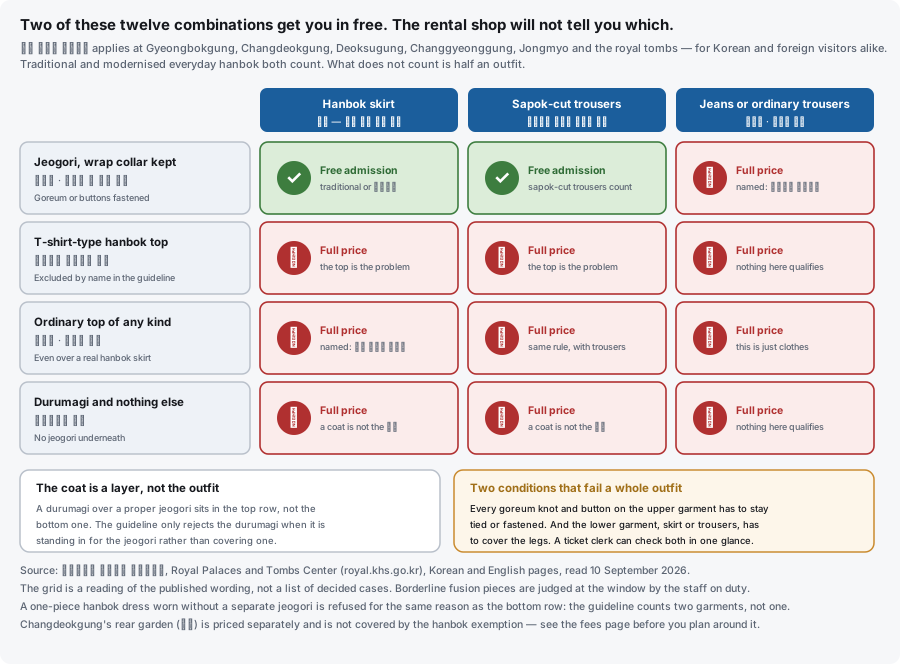
The two combinations named as failures
The Korean page leaves nothing to interpretation here. It says outright that 청바지에 저고리만 착용하거나, 한복 하의에 티셔츠를 입은 경우는 무료 관람 불가능합니다. Jeans with only a jeogori, or a hanbok lower garment with a T-shirt: neither one qualifies.
Those are the exact outfits that come out of a rushed rental. Forty minutes to spare, a shop near Anguk station, efficient staff, and a top goes on over what you are already wearing. It photographs beautifully. It does not get you through the gate.
The collar, and the knots
A jeogori has to keep its 여미는 깃, the wrap-front collar. How it closes is not the issue: 고름·매듭방식은 관계 없음, and the guideline's own Q&A confirms that a jeogori with no goreum at all is still a jeogori. What matters is that whatever closure exists is closed. The English page puts it as "All upper garment (jeogori) ribbon knots(goreum) and buttons should be fastened or tied at all times."
That is the line people trip over without knowing there is a line. Goreum work loose as you walk, and in August it is natural to let the jacket hang open. A clerk glancing down the queue is looking at exactly that.
A T-shirt-type top does not count, even when it is sold as 생활한복. The Q&A is blunt about it: 티셔츠처럼 입는 형태의 생활한복 저고리는 한복 저고리로 인정하지 않습니다. The collar decides it, not the price or the marketing.
The one-piece problem
The same Q&A answers the question that trips up fusion rentals. A 원피스형 한복, a one-piece hanbok dress worn without a separate jeogori, is not recognised: 여미는 깃의 저고리와 치마를 착용한 경우 한복으로 인정합니다. Two garments, or nothing.
A 허리치마, the short waist-tied skirt, is fine with a jeogori, on one condition the Q&A spells out: 저고리가 허리까지 내려와야 합니다. The jeogori has to reach the waist. That is the level of detail this guideline goes to, which is worth knowing before you argue with anyone about it.
Skirts, trousers, and the leg rule
Skirts get the loosest treatment in the whole document: 치마는 여밈이 없는 형태‧여밈이 있는 형태 등 형식 제한없음. Wrapped, sewn, anything.
Trousers are tighter. They need to be 사폭바지 형태에 준하는 바지, cut in or close to the sapok form, the traditional wide four-panel construction. The Q&A softens that a little: a zip waistband and no ankle ties are fine as long as the shape holds. Straight-leg trousers in hanbok fabric are a judgement call, and the judgement is made at the window, not by you.
Both get one extra condition from the English page: "All types of lower garments (skirt or pants) should cover the legs."
The durumagi trap
A 두루마기 is an overcoat. Wearing one over a proper jeogori is fine, because it is an extra layer and the jeogori underneath is still the upper garment being counted. Wearing one instead of a jeogori is not: "Simply wearing an overcoat (durumagi) is not recognized as Hanbok form; both upper and lower garments must be worn."
This catches people in winter, when a long coat over ordinary clothes reads as a full outfit in a mirror and reads as a coat over ordinary clothes at the gate.
Modernised hanbok is fine, and that is the whole point
Nothing above is a purity test. 전통한복·생활한복 모두 무료관람 대상 포함: traditional and everyday modern hanbok both qualify. The stated purpose of the exemption is 한복의 대중화 및 세계화, popularising hanbok and taking it international, and the guideline says explicitly that it applies 내·외국인에 관계없이, regardless of nationality.
There is one aesthetic condition, and it is about decorum rather than authenticity. The guideline recommends 궁궐의 품격에 어울리는 한복 착용 and rules out 과도한 노출, and the English page reserves the right to refuse entry to anyone dressed inappropriately. So the rule is not asking whether your outfit is authentic. It is asking whether it is a whole outfit.
The age bracket that is not the same for everyone
Here is the second way people lose ₩3,000, and it is quieter than the hanbok one because nobody gets stopped. They just pay when they didn't have to, or expect not to pay and then do.
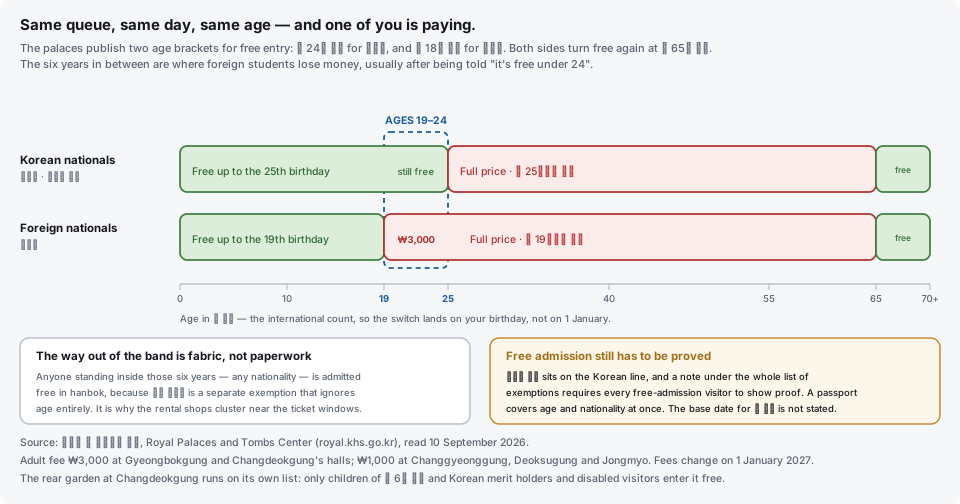
The fees page lists 만 24세 이하 및 만 65세 이상 내국인(신분증 지참) on one line and 만 18세 이하 및 만 65세 이상 외국인 on the next. The fee table states the same thing from the paying side: the adult band is 만 25세~만 64세 for Koreans and 만 19세~만 64세 for everyone else. Six years of difference, printed twice, explained nowhere.
A 22-year-old Korean undergraduate walks in free. A 22-year-old exchange student at the same university, standing behind them in the same queue, pays the adult fare. The version of this rule that circulates in student group chats is "it's free if you're under 24", which is true for roughly half the people reading it.
Bring the document either way. 신분증 지참 is attached to the Korean line, and the note under the whole list is broader than that: every free-admission visitor has to show proof. For a foreign visitor the thing that proves age and nationality in one go is a passport. What the page does not state is the base date for 만 나이, so if you are within days of a birthday, the answer is at the window rather than in the table. Korean age counting has its own traps, covered in the notes on Korean age and titles.
The way out of the band is the obvious one. Hanbok carries no age condition, so a 22-year-old in a complete outfit is free the same as anyone else.
문화가 있는 날: the last Wednesday
The fees page lists 매월 마지막 수요일 "문화가 있는 날" (창덕궁 후원 제외) among its free admissions. It is a national culture-day programme, far wider than the palaces, and the palaces and Jongmyo are free that day.
Two smaller things happen on the same Wednesday, both otherwise weekend-only: Changgyeonggung opens its Yulgok-ro gate, and Jongmyo runs as free walking rather than timed guided entry. Changdeokgung's rear garden is excluded, which is a pattern worth noticing early. The 후원 is excluded from almost everything.
Because the programme is national, the day is busy at museums and cinemas too. If your reason for going is photographs of empty courtyards, the last Wednesday is a bad choice even though it is a free one.
Closing days, and why they are staggered
The palaces do not all close on the same day, and this is the mistake that costs a morning rather than three thousand won.
| Closed Mondays | Closed Tuesdays |
|---|---|
| Changdeokgung, Changgyeonggung, Deoksugung, Joseon royal tombs, Sungnyemun | Gyeongbokgung, Jongmyo, Chilgung |
Gyeongbokgung and Jongmyo shut on Tuesday. Everything else in the central cluster shuts on Monday. It is a sensible arrangement, in that you can always see something, and it is completely invisible until you are standing at a closed gate.
One rule sits on top of the table: 정기휴일이 공휴일 및 대체공휴일과 겹칠 경우에는 개방하며, 그 다음의 첫 번째 비공휴일이 정기휴일임. If the regular closing day lands on a public holiday or a substitute holiday, the site opens, and the next non-holiday becomes the closed day instead. So a Tuesday holiday means Gyeongbokgung is open on Tuesday and shut on Wednesday. In a holiday week, read the hours and closing days page rather than working from the table above.
Hours move with the season. Gyeongbokgung runs 09:00–18:30 from June to August with last entry at 17:30, and 09:00–17:00 in January, February, November and December with last entry at 16:00, which is early enough to catch out anyone planning a palace as an after-work stop in December. Deoksugung and Changgyeonggung stay open until 21:00 with last entry at 20:00, and Deoksugung at night, lit, is a different building from Deoksugung at noon. Chilgung is the odd one out: free to enter, but online booking only, and you go round with a guide.
Free openings at Chuseok and Seollal turn up most years, but they arrive as individual notices on the 공지사항 board rather than as a standing rule, so check before building a trip around one.
Changdeokgung's rear garden runs on its own rules
The 후원 is the one place where all of this stops applying, so it is worth stating plainly.
The garden is a separate ₩5,000 ticket, and the fees page adds 후원관람 시 전각관람권도 필수로 구매요망: you buy the ₩3,000 hall ticket as well. So the garden is an ₩8,000 morning, not a ₩5,000 one. Its free list is short and specific: 만 6세 이하, 유공자(내국인), 장애인(내국인). Children of six and under, Korean merit holders, Korean visitors with disabilities. Ages 만 7 to 만 18 pay ₩2,500, and there is no senior rate at all. The 경로 line for the garden is ₩5,000, identical to the adult one.
Hanbok is not on that list. Neither is the age bracket, neither is 문화가 있는 날, and the ₩6,000 통합관람권 excludes it as well.
Access is capped at 100 people per session, split 50 online and 50 sold on the day. The online seats open at 10:00 six days before the visit and close the day before; the on-the-day 50 go on sale from 09:00. The fees page warns in plain language that both sell out very fast in April, May, October and November. Turning up in a full hanbok expecting the garden to be included is a specific, avoidable disappointment.
Jongmyo has its own wrinkle. On Mondays, Wednesdays, Thursdays and Fridays it runs as timed guided entry, 200 per session with half the places booked online and half sold at the gate, and the hours page marks those days 일반관람 불가. Saturdays, Sundays, public holidays and the last Wednesday are free walking. Whether a free-admission visitor still needs to hold a session slot is not something the hours page spells out, so book one for a weekday visit and treat the reservation as separate from the ticket.
Prices change on 1 January 2027
Palace and tomb admission has not moved since 2005. On 5 August 2026 the Korea Heritage Service told a government work briefing that it would publish a new 궁·능 관람료 기준 in November 2026 and apply it from 1 January 2027, as reported by Insight. That is a news report of a briefing, not a published notice.
As of 10 September 2026 the new amounts had not been published. Anyone quoting a 2027 price today is guessing. The same report restates the exemptions that exist now, including hanbok and the age brackets, but it says nothing about whether the revision touches them, and neither has anyone else. The November notice is what will settle it, and the fees page is where it will land.
What to ask in the rental shop
The whole thing comes down to one sentence before you pay. Point at the rack and ask 이 구성으로 궁 무료관람 되나요? Does this set get free palace entry. A shop near the palaces knows the answer immediately, because it is asked forty times a day. If the answer is anything other than yes, ask for a set with a proper wrap-collar 저고리 and a full lower garment, and tie the 고름 before you leave rather than in the queue.
Fusion sets are where it goes wrong. A one-piece dress and a T-shirt-cut top both look the part in a mirror and both fail at the window, and the failure arrives after you have already paid for the rental and walked twenty minutes in it.
Then check the day. Gyeongbokgung on a Tuesday is a wall, Changdeokgung on a Monday is another one, and the two are a twenty-minute walk apart, which makes the mistake feel worse than it is. Gyeongbokgung sits on top of Gyeongbokgung Station on Line 3, Changdeokgung is a short walk from Anguk Station on the same line, and the Seoul subway guide covers the exit-number system that decides whether you come up at the gate or behind it.
If a palace day is the anchor of a short trip, the four-day Seoul itinerary puts it where it belongs, on the first morning. And since you will be inside a working ceremonial site with staff, guides and a lot of other people's photographs, the notes on etiquette mistakes are worth a glance beforehand.
Fees, age brackets, garment rules and closing days read from the Royal Palaces and Tombs Center (royal.khs.go.kr) on 10 September 2026. Admission prices are scheduled to change on 1 January 2027, with figures due in November 2026. If you find something here has moved, tell me and I'll update it.
Frequently asked questions
Does wearing hanbok really get you into Gyeongbokgung for free?
Yes, and it applies to Korean and foreign visitors equally. The Royal Palaces and Tombs Center answers that question directly in its own guideline, saying the purpose of the exemption is popularising hanbok, so nationality is not part of the test. What matters is that you are wearing both an upper garment (저고리) and a lower garment (skirt or trousers) in recognisable hanbok form.
Is a jeogori with jeans enough for free entry?
No. The guideline names that exact combination as ineligible, along with a hanbok skirt or trousers worn with a T-shirt. A one-piece hanbok dress with no separate jeogori is refused for the same reason. Half an outfit is not an outfit, and a rental shop that only hands you a top has not got you free admission.
I'm 22 and a foreign student. Do I get in free?
Not on age. Free entry by age is 만 24세 이하 for Korean nationals but only 만 18세 이하 for foreign nationals, so anyone aged 19 to 24 on a foreign passport pays the adult fare. Every free-admission category also has to show proof, so carry the document. Wearing hanbok removes the problem, because that exemption ignores age.
Which palaces close on which day?
Gyeongbokgung, Jongmyo and Chilgung close on Tuesdays. Changdeokgung, Changgyeonggung, Deoksugung, the Joseon royal tombs and Sungnyemun close on Mondays. If a closing day falls on a public holiday or a substitute holiday the site opens instead, and the next non-holiday becomes the closed day.