Korea's Gift Limit Law: When ₩50,000 Is Actually Zero
An iced americano is ₩4,500. Hand one to your child's homeroom teacher at a Korean public school and you have not come in under a limit. You have gone past one, because for that particular pair of people the limit is nothing.
That is not what the English-language internet will tell you. Search Korea's gift limit law and you get the same three figures everywhere — meals ₩30,000, gifts ₩50,000, condolence money ₩100,000 — often labelled the 3-5-10 rule. It was a real rule. It stopped being the law on 17 January 2018, when condolence cash was cut to ₩50,000, and the meal figure moved again in August 2024. Two of the three numbers are out of date. And the framing behind all three — find the number, come in under it — is the part that gets people fined.
The statute is 청탁금지법, the Improper Solicitation and Graft Act, known to everyone here as the Kim Young-ran Act after the judge who drafted it. It does not open with a price list. It opens with a question about who you are dealing with, and a second about what they can do for you. The price list only appears when both answers come back a particular way.
First: is this person covered at all?
Article 2 draws a circle, wider than most foreigners assume and narrower than most Koreans assume. Inside it: national and local civil servants, staff of public institutions and government-affiliated bodies, the teaching and administrative staff of schools at every level — private schools included, through the 학교법인 under the Private School Act — and the officers and employees of press organisations. Then, crucially, the legally married spouse of any of them.
Non-regular and fixed-term staff are inside. People working in the same building under a service contract are not.
That distinction splits people who look identical. A university part-time lecturer, 시간강사, counts as teaching staff and is covered. The after-school instructor down the corridor works under a 위탁 contract and is not. A staff reporter is covered; the freelancer filing to the same desk is not, nor is an independent production company or the Seoul bureau of a foreign outlet. Teach at a public school on an EPIK or GET contract and you are inside the circle — one of several things the job ads leave out.
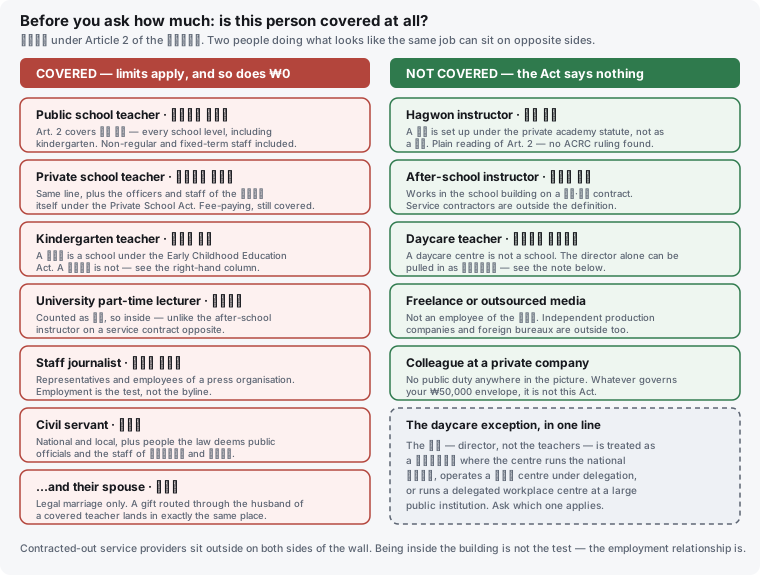
Hagwon instructors are the question people actually ask, and the honest answer is a shade weaker than the confident one. A 학원 is established under the private academy statute, not under the education Acts that Article 2 points at, so on the face of the text a hagwon teacher is not 공직자등. I could not find a published Commission ruling saying so in those words. Treat it as the plain reading — and note that plenty of hagwons ban gifts by internal policy regardless.
Then there is the group nobody expects to find in here: other parents. Take a seat on the 학교운영위원회, the school operating committee, or on a school violence response body, and for the length of that appointment you are a 공무수행사인 — a private citizen performing a public duty. The Act runs in both directions from there, gifts to the principal and to teachers included.
Four ceilings, and how they stack
The figures live in Annex 1 of the Enforcement Decree, not in the Act, which is why they move without anyone amending a law. As they stand on 21 August 2026, per the government's plain-language legal portal:
A meal eaten together — 음식물, meaning a meal, refreshments, drinks or alcohol shared by giver and official — is ₩50,000. It was ₩30,000 until the Cabinet approved the change on 19 August 2024, effective 27 August 2024. Food sent over rather than shared is not 음식물. It is a gift.
A gift is ₩50,000, except that farm and fishery produce, and processed products made from them, get ₩150,000, rising to ₩300,000 inside the holiday window.
Congratulation and condolence cash is ₩50,000. Not ₩100,000 — that is the separate allowance for a wreath, 화환 or 조화, left where it was in 2018 with the flower growers in mind.
Give two kinds at once and they are added. The total may not pass the higher of the two ceilings, and neither item may pass its own: ₩50,000 of dinner leaves ₩100,000 of a produce box, not ₩150,000. The funeral version of that sum is the one the Commission spelled out itself — ₩70,000 in condolence cash with a ₩30,000 wreath comes to ₩100,000 and is still a violation, because the cash on its own has gone past ₩50,000.
That ₩50,000 for condolence cash is a coincidence worth naming, because a different ₩50,000 turns up when a coworker at a normal company loses a parent. That one is custom, backed by a gift-tax exemption for amounts within social norms. This one is a statutory ceiling with a fine behind it. Same number, unrelated law.
Then the ceilings collapse
Here is the part almost nothing in English says.
Those amounts are not a general allowance. They sit inside Article 8(3)2, which excuses gifts given for 사교·의례 — social or ceremonial purposes. Where the relationship between giver and recipient is one of direct duty, the giving is not social or ceremonial in the first place, so Annex 1 never gets read. There is no figure to come in under.
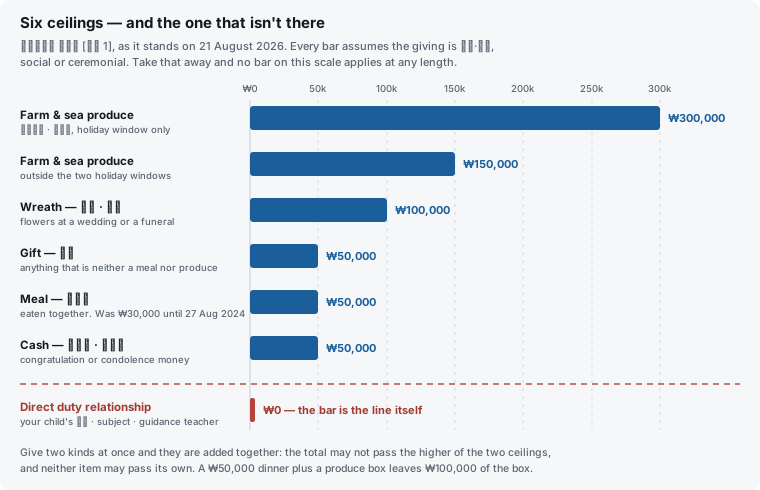
For a parent and a serving teacher, the Ministry of Education and the Anti-Corruption and Civil Rights Commission have said plainly that a direct conflict of interest is deemed to exist — not may exist, is deemed to — with the homeroom teacher, the subject teacher and the guidance teacher. Seoul Economic Daily set this out in English in May 2026: food, flowers, snacks, congratulation and condolence money, coffee and bread brought to a consultation. Gift vouchers are worse rather than better, which surprises people: a department store card or a 문화상품권 carries a face value, and a face value makes it 금액상품권 — securities, not a gift — barred at any amount and to anyone covered. A voucher good for one named item counts as the item, which for a serving teacher only lands it back on the same zero.
Which brings back the americano. The problem is not that ₩4,500 is a small breach of a ₩50,000 rule. It is that no ₩50,000 rule is in the room, so there is nothing for the cup to be under.
Teachers' Day, specifically
15 May is when all of this stops being a legal question and turns into a national argument. Three things about it, at least, are settled.
A carnation from an individual student is out, and the Commission's Teachers' Day Q&A says so in those words. A carnation presented by the class representative, in a public setting, on behalf of the whole class, is accepted under social norms. And a letter or a card the child wrote themselves is not a gift at all, so write as many as you like.
Which is more or less what the notices say. In the week before the 15th, kindergartens and daycare centres send a message home, and the sentence they keep arriving at is that a letter is enough. Daycare teachers are not even covered — a 어린이집 sits under the Infant Care Act rather than the education Acts — and the centres send it anyway.
The rule is unlovely, and it exists because the alternative was worse: a floor of small gifts that nobody can refuse and every other parent then has to match. Being disliked is not the same as being unclear, which is worth holding on to when Korean rules feel stiffer than they need to be.
The 30-day window: 1–30 September 2026
Twice a year the produce ceiling doubles. The window runs from 24 days before Seollal or Chuseok to 5 days after.
Chuseok 2026 falls on Friday 25 September. So the window opens 1 September 2026 and closes 30 September 2026, and inside it a box of Korean beef, dried fish, fruit or a processed product made from farm or fishery goods may go to ₩300,000 instead of ₩150,000. Non-produce gifts do not move. The ₩50,000 cap on a cosmetics set or a bottle of imported whisky is the same in September as in March.
Which is why department stores build a 5만원 이하 corner in August, print 청탁금지법 on the shelf tags, and put the produce sets in their own aisle.
The person handing it over is prosecuted too
This is the asymmetry foreigners miss. The Act does not only punish the official.
Article 22(1)1 puts a covered official who takes more than ₩1,000,000 on one occasion, or more than ₩3,000,000 across a fiscal year, at up to three years in prison or a ₩30,000,000 fine. Article 22(1)3 applies the same range to whoever provided it, or promised to. Below those thresholds, where the money is duty-related, Article 23(5) sets an administrative fine of two to five times the amount handed over — which is how a ₩4,500 coffee becomes a number with a decision attached to it.
The official has an escape hatch. Report it, return it, or refuse it, and Article 23(5) exempts them by its own terms. The giver has no equivalent line. Your gift being handed straight back does not undo the offering.
Graduation switches it off
The direct duty relationship ends with the school year, and the Act follows. Once your child has left, the former homeroom teacher is an ordinary covered official again: gifts up to ₩50,000, and up to ₩1,000,000 on one occasion or ₩3,000,000 a year before the criminal thresholds in Article 22 engage.
So the box you wanted to hand over in May is fine the following February, once the year's marks are in and the teacher has somebody else's class. Late, and legal.
Read on 21 August 2026: the Act and its Enforcement Decree via 찾기쉬운 생활법령정보 for the Article 2 coverage list and Article 8 for the exceptions and Annex 1 figures; full text at 국가법령정보센터. The 2024 meal change ran on a published track: the Commission announced it in July (the Korea Times carried the English write-up), the Cabinet cleared it on 19 August (Kim & Chang), and it was promulgated and in force on 27 August 2024 (Yonhap, filed that morning). For how far the old figure has spread, KOREATECH's own integrity page still printed ₩30,000 for meals when it was opened for this article. Nothing here is legal advice; a specific case goes to the Anti-Corruption and Civil Rights Commission or the compliance officer at the institution involved. Send a correction if a figure has moved since.
Frequently asked questions
Can I give a Korean public official a gift?
Only if the giving counts as social or ceremonial under Article 8(3)2 of the Improper Solicitation and Graft Act, and only up to the figures in Annex 1 of the Enforcement Decree: ₩50,000 for a gift, ₩50,000 for a meal you eat together, ₩150,000 for farm and fishery produce. If the official has direct authority over a matter of yours, none of those apply and the answer is no at any price.
Can I give my child's Korean teacher a gift?
No. The Ministry of Education and the Anti-Corruption and Civil Rights Commission treat a parent and a serving homeroom, subject or guidance teacher as having a direct duty relationship, so the ₩50,000 figure never comes into play. That covers coffee and bread brought to a consultation, a single carnation, and gift vouchers. A letter the child wrote is not a gift and is fine.
Does the Korean anti-graft law apply to hagwon teachers?
On the face of the statute, no. Article 2 reaches schools established under the education Acts, and a 학원 is set up under the separate private academy statute, so a hagwon instructor is not 공직자등. No published Commission ruling saying so in as many words turned up when this was checked in August 2026, so treat it as the plain reading rather than a settled answer. The hagwon's own policy may forbid gifts anyway.
What is the meal limit under Korea's anti-graft law in 2026?
₩50,000, not ₩30,000. Annex 1 of the Enforcement Decree was amended at the Cabinet meeting of 19 August 2024 and the new figure took effect on 27 August 2024. A great many English pages, and some Korean university integrity pages, still print the old ₩30,000. The limit covers a meal, refreshments, drinks or alcohol shared with the official — not food sent to them.