T-money Card in Korea: Where to Buy One and How to Use It
Walk up to a subway gate at Incheon Airport, tap a perfectly good foreign credit card on the reader, and you get a flat beep and a closed gate. Trying the other side of the card does not help. Neither does a different gate. Sooner or later a staff member says one word — "T-money" — and points at a convenience store.
That is the single most common first hour in Korea for anyone who has not read this in advance. So: you need a T-money card. Here is what to know before the beep.
What a T-money card actually is
T-money is a rechargeable contactless card used for public transport across Korea. You load cash onto it, tap in when you board, tap out when you leave, and the fare comes off the balance.
Two things about it are worth understanding up front, because they cause most of the confusion:
- It is prepaid, not linked to a bank account. Nothing is charged to you later. If the balance hits zero, the gate stops you.
- It is not only for transport. The same card pays at convenience stores, some vending machines, coin lockers, and taxis. This surprises people who assume it is a metro-only card.
The card itself is not free. Expect ₩2,500–₩4,000 for a blank one, more for character designs. That fee buys the physical card and is not refundable.
The system is run by Korea Smart Card, and the official T-money website is the authority on card types and refund rules — though be warned that its English section is much thinner than its Korean one.
Where to buy one
Convenience stores. This is the answer for almost everyone. CU, GS25, 7-Eleven, and Emart24 all sell T-money cards, and they are open at all hours in essentially every neighbourhood. Say "T-money card, please" (티머니 카드 주세요) or just point at the card display near the register.
Subway station machines. Every station has a machine that sells and recharges T-money. The machines have an English mode, though the button for it is sometimes small and in a corner.
Airport convenience stores. Both Incheon and Gimpo have convenience stores before you reach the transport connections. Buying the card here, before you go looking for the train, saves the detour back from a closed gate.
One thing to check at the airport: the store nearest arrivals sometimes runs out of the cheap blank cards during peak arrival hours and only has the expensive character editions left. The next store down the concourse usually still has them.
Loading money onto it
A new card is empty. You have to charge it before it works.
Charging is cash only at most machines and at convenience-store counters. This trips up travellers who arrive with cards and no won. Get some cash from an airport ATM before you try — a foreign-card-friendly ATM (look for "Global ATM" signage) will work.
To charge at a station machine:
- Choose the recharge option — usually the largest button, marked 충전.
- Place the card flat on the marked pad. Not tapped, not held above it. Flat, and left there.
- Feed in notes. The machine accepts ₩1,000, ₩5,000, ₩10,000 and ₩50,000 notes.
- Confirm, then take the card. The new balance appears on screen.
To charge at a convenience store, hand over the card and the cash and say the amount. The clerk does the rest.
How much to load? For a few days of normal city travel, ₩20,000 is plenty. Fares run roughly ₩1,400–₩1,600 for a typical subway trip, so ₩30,000 covers a week of ordinary travel without needing another thought.
Using it
Tap the card flat on the reader at the gate to enter. Tap again on the way out. This second tap matters more than people realise.
On buses, tap on the reader beside the driver when boarding, and tap the reader by the rear door when getting off.
The transfer discount — the thing worth learning
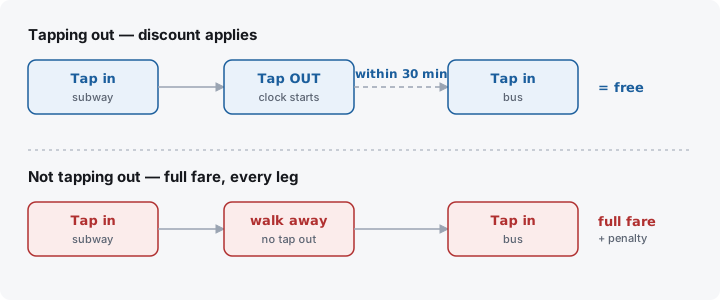
If you tap out and then tap in again on another bus or subway line within 30 minutes, the transfer is free or heavily discounted. This is the single biggest money-saver in the system, and it only works if you tap out properly every time.
New arrivals routinely lose this for weeks, simply because nothing at the gate explains it. Not tapping out on buses means paying full fare for every leg of every journey — a real, avoidable cost of a few thousand won a day.
What happens if you forget to tap out
The system charges you a penalty fare on your next tap — and you lose the transfer discount for that trip. Do it repeatedly on the same card and the fare adjustment gets bigger. It is not catastrophic, but it is pure waste.
Checking your balance
Three ways, in order of convenience:
- The gate reader shows your remaining balance for a second or two after each tap. Look at it.
- Any convenience store can check it at the register.
- Station recharge machines show it when you place the card on the pad.
There is no reliable way to check a plastic T-money balance from your phone unless you are using a mobile version of the card, so the habit of glancing at the gate display is worth building.
The alternatives, and when they're worth it
A plastic T-money card is the right answer for almost everyone, but there are three variations worth knowing about.
Mobile T-money. Android phones with a Korean carrier plan can run T-money directly through NFC, letting you top up from a bank account instead of hunting for cash. The catch is real: it needs a Korean phone number and, for most top-up methods, a Korean bank account. That makes it a second-month solution rather than a first-day one — see the guide to opening a Korean bank account for what that involves.
Transit-enabled debit and credit cards. Most Korean bank cards can be activated for transit, which merges your card and your transit pass into one piece of plastic. Again, this requires a Korean account first.
Single-journey tickets. You can buy a one-trip ticket at any subway station using a machine. It costs more per trip than T-money, requires a ₩500 refundable deposit, and means queuing at a machine every single time. It is a fallback, not a plan.
The Climate Card. Seoul offers an unlimited-ride pass sold in fixed-day increments. It only pays off if you are taking several trips a day within Seoul proper — for a typical visitor doing three or four journeys daily, ordinary T-money fares still work out cheaper once you factor in the transfer discount. Run the numbers against your actual itinerary rather than assuming unlimited is better.
Getting your money back before you leave
Unused balance is refundable, with conditions:
| Where | Limit | Fee |
|---|---|---|
| Convenience store | Under ₩20,000 | ₩500 |
| T-money customer centre | Any amount | ₩500 |
The ₩2,500 you paid for the card itself is not refunded. Keep that in mind before you load ₩100,000 "to be safe" the day before your flight.
What I'd do differently
The efficient version of a first hour in Korea goes like this: pull cash from the Global ATM in the arrivals hall, walk into the nearest convenience store, buy a plain T-money card, load ₩30,000 onto it at the counter, and then go find the train. Total time, about five minutes.
That is the whole thing. The card is cheap, it works everywhere, and the only real skill is remembering to tap out.
Prices and fees verified August 2026. Korean transit fares are adjusted periodically — if you find a figure here is out of date, tell me and I'll update it.
Frequently asked questions
Can I use a foreign credit card at the subway gate instead?
No. Korean subway and bus gates do not accept foreign Visa or Mastercard directly. You need either a T-money card, a Korean-issued transit-enabled card, or a single-journey ticket bought at the station.
How much does a T-money card cost?
The blank card itself costs ₩2,500 to ₩4,000 depending on the design. That fee is not refundable and is separate from the money you load onto it.
Can I get my remaining balance back before leaving Korea?
Yes. Any convenience store that sells T-money can refund a balance under ₩20,000, minus a ₩500 handling fee. Larger balances have to be refunded at a T-money customer centre.
Does one T-money card work in cities other than Seoul?
Yes. T-money is accepted on transit in Seoul, Busan, Daegu, Daejeon, Gwangju, Incheon, and most other cities, as well as on intercity buses and in taxis.