How to Open a Korean Bank Account as a Foreigner
Opening a bank account in Korea is not difficult. It is, however, extremely unforgiving about paperwork — and the thing that makes it frustrating is that different branches of the same bank will tell you different things. Being turned away at one branch and approved at another a few stops away, on the same afternoon with the same documents, is a common enough experience that it is worth planning around rather than treating as bad luck.
Here is what actually determines whether you walk out with an account.
Get these in order first
The single biggest mistake is going to the bank too early. Korean financial regulations tightened considerably after a wave of account-fraud cases, and banks now treat new foreign accounts cautiously. You want to arrive with your position already strong.
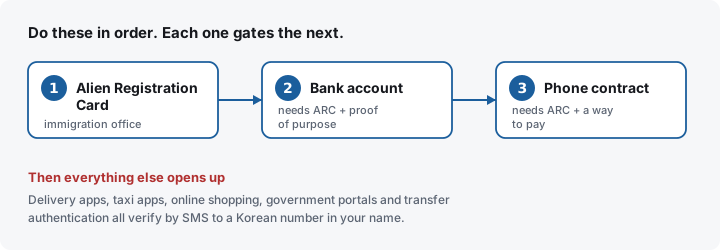
The order that works:
- Alien Registration Card (ARC) — the foundation. Everything else is easier with it.
- Korean mobile number — needed for the SMS authentication that online banking runs on.
- Proof of address or affiliation — a contract, an enrolment certificate, an employment letter.
- Then go to the bank.
Trying to do these in a different order is the source of most of the horror stories.
What to bring
Bring all of the following, even if the bank's website lists fewer. Excess documents cost you nothing; a missing one costs you a second trip.
| Document | Why they want it |
|---|---|
| Alien Registration Card | Proves legal residency and gives you a resident number |
| Passport | Secondary identity check |
| Korean phone number | SMS authentication for every subsequent transaction |
| Proof of purpose | Employment contract, enrolment certificate, or lease |
| Cash for the initial deposit | Often as little as ₩1,000, but bring more |
Proof of purpose is the one people underestimate. Under Korea's anti-money-laundering rules, a bank must establish why you need an account. "I live here" is not an answer that satisfies a compliance checklist. An employment contract, a university enrolment certificate, or a signed lease is.
Choosing a branch, not a bank
This matters more than which bank you pick.
A branch in a business district that processes ten foreign applications a year will treat yours as an unusual event, and unusual events get escalated to a manager who defaults to "no". A branch near a university, an industrial complex, or an area with a large foreign population processes these weekly, has the forms ready, and often has a staff member who speaks English.
If you have any choice at all, go to the second kind of branch.
Among the major banks, KEB Hana and Woori have the most developed foreign-customer operations. Kookmin and Shinhan work fine as well. The difference between banks is far smaller than the difference between branches.
Timing
Go mid-morning on a weekday, ideally Tuesday to Thursday. Korean banks close at 4pm — not 5pm, not 6pm. Monday mornings and the days around payday are congested. Arriving at 3:40pm with a non-standard application is how you get told to come back tomorrow.
What happens at the counter
The process is mechanical once you are sitting down:
- Take a number from the machine at the entrance. Choose the personal banking option.
- Present your documents. The teller will photocopy your ARC and passport.
- Fill in the application form. Your name must be written exactly as it appears on your ARC — same spelling, same order, same middle names. A mismatch here is the most common cause of a rejected application.
- Set a four-digit PIN. You will use this constantly. Do not improvise it at the counter.
- Make the initial deposit.
- Receive your bankbook and, usually, a debit card.
Expect 30 to 60 minutes.
The restrictions nobody warns you about
Here is the part that surprises people, and it is not a sign that anything went wrong.
New accounts — for Koreans and foreigners alike — are typically issued as limited accounts. This usually means a daily transfer cap in the region of ₩300,000 online and ₩1,000,000 at an ATM, and it stays that way for a period of months.
The limit lifts once you demonstrate normal use: salary deposits arriving, utility payments going out, time passing. You can also request an earlier lift by bringing your employment contract back to the branch and asking. It is a fraud-prevention measure, not a judgement about you.
Online banking and the certificate
Ask the teller to set up online and mobile banking during the same visit. Doing it later on your own is significantly harder.
You will be issued a joint certificate (공동인증서, formerly the 공인인증서) — a digital certificate that authenticates you for transfers and official services. Two things to know:
- It expires annually and must be renewed, and the renewal reminder will be in Korean.
- It can be exported from one device and imported to another. Do this deliberately, and back it up. Losing it means a return trip to the branch.
Install your bank's app before you leave the counter, while there is still someone there who can fix it.
Once the account works
The account is the key that unlocks most of the rest of daily life here — utility auto-payments, delivery apps, domestic transfers, and mobile payment services. It is also what makes the convenient version of transit possible: a Korean bank account lets you link a transit-enabled card or mobile T-money instead of feeding cash into recharge machines.
For the official regulatory position on financial services in Korea, the Financial Supervisory Service publishes English-language guidance, though it is written for institutions rather than individuals.
If you get turned away
It happens, and it is usually not final. Ask specifically which document was insufficient — not "why", which gets you a vague answer, but which one. Then either bring that document back, or try a branch of the type described above.
A refusal over a lease held in someone else's name, for instance, is often resolved by a one-line letter from that person — the same document that failed at one counter passes at another. The rules have more give in them than the first "no" suggests.
Requirements verified August 2026. Korean banking regulations change and individual branches interpret them differently. This is a description of the general process, not financial or legal advice — see the terms page. If a bank told you something different, let me know and I'll note it here.
Frequently asked questions
Can I open a Korean bank account without an alien registration card?
Sometimes, but the account will be heavily restricted. Without an ARC most banks will only issue a limited account with no online banking and a low daily transfer cap. Waiting until your ARC arrives is usually faster than fixing a restricted account later.
Which Korean bank is best for foreigners?
KEB Hana and Woori have the most developed foreign-customer services and the most English-speaking staff. Kookmin and Shinhan are fine too. What matters more than the brand is picking a branch near a university or a foreigner-heavy district, where staff handle these applications daily.
Do I need a Korean phone number to open an account?
In practice, yes. Online banking, transfer authentication, and card activation all depend on SMS verification to a Korean number. Get the phone number first.
How long does it take?
The branch visit itself takes 30 to 60 minutes and you walk out with an account. Online banking and a debit card may be activated the same day or take a few business days depending on the bank.