Where to Buy Trash Bags in Korea: Your Old Ones Still Work
Somewhere in a Korean kitchen cupboard there is a folded stack of bin bags with the wrong district's name printed on them. Somebody moved. The internet told them the bags were now worthless and they should be binned.
The internet is wrong, and it has been wrong since September 2019.
I spent a morning reading district waste pages against each other — Yeongdeungpo, Yangcheon, Geumcheon, Gangdong, Dobong, Anyang, Daegu's Buk-gu, Busan's Geumjeong-gu — because two things nobody writes down in English kept nagging at me: where you are actually supposed to buy these bags, and what happens to the ones you have left over when you move. Both answers turned out more generous than the English-language guides suggest, and the boundary everybody names is the wrong boundary.
Where do you actually buy them?
Not "anywhere". That is the first thing to unlearn.
Korea's volume-rate waste system, jongnyangje, runs on designated sellers, 종량제봉투 판매소. A shop has to be registered to stock your district's bags. Plenty of convenience stores are. Plenty of supermarkets are. So are a lot of tiny shops that look like they sell nothing at all. Some are not, and there is no sign on the door telling you which.
What you hand over at the till is not really the price of plastic. The Seoul Institute's policy write-up, last updated in June 2018, is blunt about it: collection, handling, manufacturing the bag and the shop's commission are all folded into the price, "making them a kind of marketable security". You are buying a pre-paid disposal ticket that happens to be shaped like a bin liner. Which is also why the bag from the next district over is not interchangeable by default — the money went to a different council.
Busan's English waste page says regulation bags "may be purchased at supermarkets or convenience stores in your neighborhood" and stops there, although it does carry one line no Seoul page bothers with: outside the cities you buy them at the local government office, or through the neighbourhood women's association, the 부녀회. Seoul's English policy page offers "convenience stores, grocery stores, laundromats and other designated establishments". Neither tells you how to find one, which is odd, because the government publishes exactly that.
The list sits on data.go.kr as the standard sellers dataset, refreshed quarterly and last touched on 4 September 2026. The fields are better than you would expect: shop name, road address, lot address, latitude and longitude, business registration number, phone, trading status, the date the shop was designated, the date it closed if it has, and 대형폐기물스티커판매여부 — a yes/no on whether that shop also sells large-item disposal stickers. Sort on that column before you try to get rid of a chair. One caveat the word "standard" hides: sixty local governments feed it, not all two-hundred-odd, so your area may simply not be in there.
If it isn't, go to the district. Guro-gu's file is a plain CSV, no login, 584 shops with the administrative dong beside each one, data as of 10 March 2026. Seoul's open data portal carries Gwangjin-gu's licensing list, rebuilt daily off the national business-licence feed, with a three-day lag it admits to on the page. Read the closure dates before you walk anywhere; a quarterly file has three months of shut shutters in it. Some districts skip the spreadsheet and give you a map instead. Geumcheon-gu's waste page has a seller search that shows each shop's last delivery date, which is the field you want at 9pm.
Wherever you go, convenience stores stock the sizes that sell. A 20ℓ bag, yes. The 75ℓ, or anything woven, almost never.
Which bag do you need?
Four bags and a form.
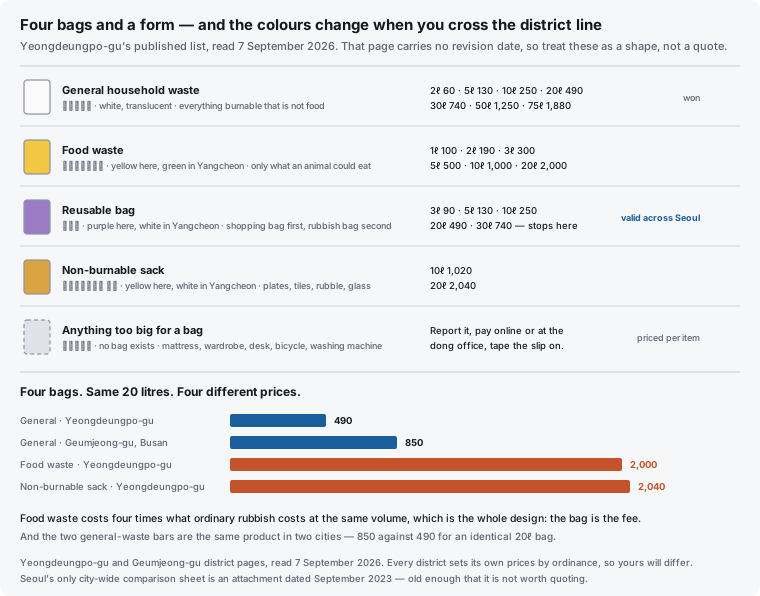
The white translucent one is general household waste and it is what you will use most days. The yellow one is food waste — except in Yangcheon-gu, where the same bag is green. The third is the reusable bag, 재사용, purple in Yeongdeungpo and white in Yangcheon, sold in fewer sizes than the others and priced identically. It is the one worth knowing about, and I will come back to it.
The woven sack is the one nobody explains. Yeongdeungpo calls it 특수생활폐기물 마대, Geumcheon calls it 건설마대; either way it exists because incinerators cannot burn crockery. Broken plates, tiles, ceramics, glass, rubble from a small bit of DIY: that goes in the sack, not the white bag. Yeongdeungpo prices it at ₩1,020 for 10ℓ and ₩2,040 for 20ℓ, four times the white bag, and you are paying for landfill rather than plastic. Geumcheon adds a trap worth reading twice — fill the sack there and you must also file a large-waste report before you put it out.
Colours are not standard, by the way. The sack is yellow in Yeongdeungpo and white in Yangcheon. Yangcheon also stopped making the 75ℓ general bag in July 2024, and its 20ℓ food waste bag the same year. Check your own district's table rather than the photograph in a guide.
How much, and why does it change three streets away?
Because there is no national price. Each local government sets its own by ordinance, and the ordinance follows what it costs that council to burn or bury a bag.
Yeongdeungpo-gu's list, read on 7 September 2026: ₩60 for 2ℓ, ₩130 for 5ℓ, ₩250 for 10ℓ, ₩490 for 20ℓ, ₩740 for 30ℓ, ₩1,250 for 50ℓ, ₩1,880 for 75ℓ. Food waste runs ₩100 for 1ℓ up to ₩2,000 for 20ℓ. The reusable bag stops at 30ℓ and matches the white bag at every size the two share. That page carries no revision date anywhere on it, only a department name, 청소과, so treat the figures as the current shape rather than a quotation, and ring the number on your own district's page if a few hundred won matters.
Geumcheon-gu's table, last edited 11 May 2026, is identical figure for figure, and Yangcheon's ₩490 for 20ℓ matches too. Cross a city line and it moves. Geumjeong-gu in Busan charges ₩850 for the same 20 litres and ₩3,080 for a 75ℓ; Daegu's Buk-gu sits between the two at ₩670. Same bag, same volume, ₩360 apart end to end.
Seoul does publish a district-by-district comparison, but the attachment is a HWPX file marked as of September 2023 — three years old, and in a format most people reading this cannot open. It is still the most-cited source in English write-ups of Korean bag prices.
One 2026 note, because you will meet the number. Since 1 January 2026 the capital region has been barred from landfilling untreated household waste. The ministry briefing of 5 December 2025 sets it out and narrows the exceptions to a short list — disasters, an incinerator going offline, islands and mountain districts where the rule cannot physically be met — and says acceptance fees at the metropolitan landfill will rise by the first half of 2026. Higher disposal costs push bag prices, so you will find articles saying Seoul is looking at ₩700-something for the 20ℓ bag. The city's own response to that figure, in May 2022, was that it was not reviewing an increase, and I could find nothing newer from the city itself. Until your district posts a notice, ₩490 is the number.
What counts as food waste
The rule is not "did it come from the kitchen". It is: could a farm animal eat this. Korean food waste is processed into livestock feed, which is why the boundary sits where it does — Busan's English page phrases the same test as removing "anything that cannot be eaten by livestock".
Yeongdeungpo's page names what goes in the white bag instead, and the list catches almost everyone out at least once: vegetable roots, hard shells and rinds, fruit stones and pits, egg shells, clam and other shellfish shells, fish bones, tea bags and used tea leaves.
Peach stone, white bag. Egg shells, white bag. The clam shells from your kalguksu, white bag. Onion skin is the one people argue about at dinner parties.
Flats with an RFID meter change the mechanics, not the rule. Namdong-gu in Incheon describes the flow: you tap a household card on the bin, the lid opens, the machine weighs what you drop in and reads the weight back at you aloud, the reading goes to a server at the Korea Environment Corporation, and the charge lands on your monthly management bill. Smaller buildings run it prepaid off a stored-value transit card instead. As of December 2024 Namdong had 228 complexes and 120,263 households on the system. Geumcheon-gu prices the metered route at ₩130 per kilogram, and for buildings sharing a communal food bin it sells a paid slip rather than a bag, from ₩1,400 for 10ℓ up to ₩16,800 for 120ℓ. Same money, different road. You cannot see any of it until the bill arrives, which is worth knowing before you sign for a place. What else hides on that bill is covered in the deposit and management-fee breakdown.
You moved. Do your old bags still work?
Here is the part the English-language internet gets backwards.
Nearly every guide says a bag is only valid in the district that printed it, and that leftovers are lost. The first half is broadly true as a default. The second half has not been true for years, and the line people draw sits in the wrong place. The boundary is the city or province, not the district.
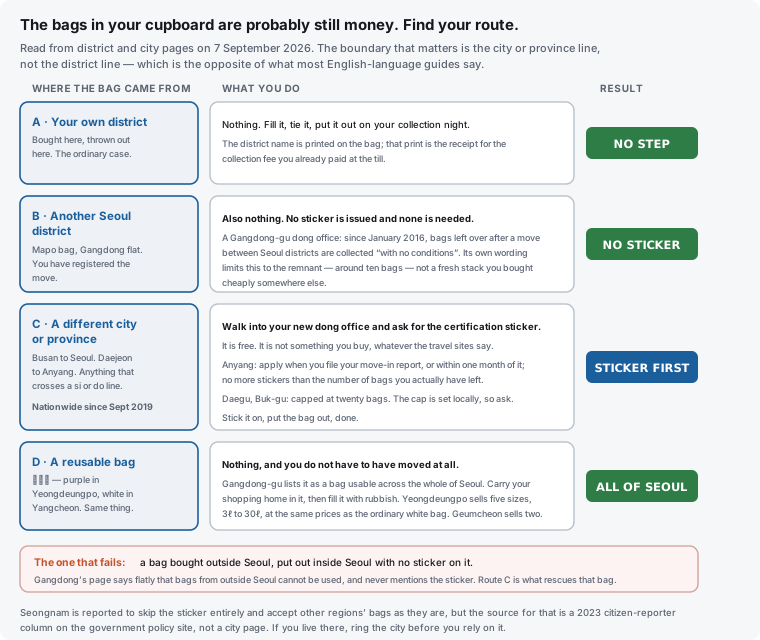
Moving inside Seoul. A Gangdong-gu dong office states it plainly: since January 2016, if you have transferred your residence between Seoul districts, bags left over from the old address are collected 조건없이, with no conditions. And in the same breath, 따로 스티커를 드리지 않습니다. No sticker is issued, because none is needed. The page limits it to the remnant, "around ten bags" — a sensible fence against somebody stockpiling in the cheap district.
An honest caveat. I found that sentence on Gangdong-gu pages and nowhere else. Other Seoul districts do not repeat it, and I am not going to tell you all 25 have it in writing. What I can say is that no Seoul district page I read contradicts it, while Geumjeong-gu in Busan states the opposite general rule for its own area: other districts' bags are not usable there, "excluding bags with a new-resident certification sticker attached". That exception is the next route.
Moving between cities or provinces. In April 2019 the government published a package of fifty small deregulations, and one line of it is this: 177 local governments already accepted other regions' bags, and from September that year the remaining 51 would too. That made it national. The mechanism is a free certification sticker you collect from the dong office in your new area and stick on the old bag.
Anyang's page is the clearest official description I found. The sticker comes from the dong office, you apply when you file your move-in report or within a month of it, and the number of stickers is capped at the number of leftover bags you actually have. Daegu's Buk-gu does it differently: twenty bags maximum, however many you are holding. You will see "up to 20" quoted as if it were a national rule. Buk-gu is one place it is true; the other place the number turns up is a 2023 citizen-reporter column on the government policy site, where a Hwaseong dong office gave the writer the same figure and told him the quantity varies by area. Ask, do not assume. That column also reports Seongnam skipping the sticker altogether and accepting other regions' bags as they are, which would be lovely if you live there, but the source is a citizen writer in January 2023 rather than a city page. Ring the city first.
Two more things off those pages. You will read that you can "purchase transfer stickers". You cannot, and you should not be charged. And Buk-gu is unusually generous about moves inside Daegu: old bags keep working as they are, Gunwi-gun excepted, and the shop that sold them will refund unused ones at the price you paid. No Seoul page offers that. It belongs on the same list as the utility deposits in what you get back when you move out.
The dong office window is the same one you use for the move-in report itself, so this is a five-minute add-on to a trip you are already making. The other half of that errand is the 30-day lease reporting deadline.
The bag that needs neither. The reusable one. Gangdong-gu lists it as 서울시 전지역 사용 가능봉투, usable across the whole of Seoul, no move required, no sticker. It exists so you can carry your shopping home in it and then fill it with rubbish, which is why the sizes stop where a shopping bag stops — 3ℓ to 30ℓ in Yeongdeungpo, 10ℓ and 20ℓ only in Geumcheon and Yangcheon. If you move often, buy these.
Anything too big for a bag
Mattress, wardrobe, desk, bicycle, washing machine. None of these has a bag, and none may be left at the collection point as it is.
The route is a 대형폐기물 신고필증, a disposal slip. Report the item on your district's website or at the dong office, pay the fee set for that item, print the slip and tape it to the thing before you put it out. If you cannot print, districts generally accept the slip number, item and date written out by hand. Busan's English page describes the same procedure and adds that the sticker can be bought "at your local dong Community Service Center or where you purchase your regulation bags", which loops back to that 대형폐기물스티커판매여부 column in the national dataset.
Fees are per item and set by each district, so I am not going to give you a number that could be wrong by half. Open your gu's large-waste page and find your item in its table. Check white goods separately, though, because you may not owe anything at all: a free national home-collection service will take a fridge, a washing machine or a television away for nothing, booked online or on 1599-0903. Paying a district fee for a washing machine is a common and avoidable mistake.
What actually gets you fined
The amounts are real and they are not small. Geumcheon-gu publishes its schedule, last edited 3 December 2025. Its table is written in units of 만원, ten thousand won; converted:
| What you did | 1st | 2nd | 3rd |
|---|---|---|---|
| Dropping litter you were carrying — cigarette ends, tissues | ₩50,000 | ₩50,000 | ₩50,000 |
| Putting waste out in an ordinary plastic bag or cloth instead of a proper one | ₩200,000 | ₩200,000 | ₩200,000 |
| Leaving picnic or day-trip rubbish behind | ₩200,000 | ₩200,000 | ₩200,000 |
| Burning household waste | ₩500,000 | ₩500,000 | ₩500,000 |
| Dumping using a vehicle or handcart | ₩500,000 | ₩500,000 | ₩500,000 |
| Mixing food or recyclables into the bag, or putting it out at the wrong time or place | ₩100,000 | ₩200,000 | ₩300,000 |
Note which one escalates and which does not. Using no bag is a flat ₩200,000 every time. Mixing your recycling into the bag starts at ₩100,000 and climbs to ₩300,000 by the third occasion, which tells you what the inspectors are actually looking for. Geumcheon cites articles 8 and 15 of the Wastes Control Act as its basis. Dobong-gu's list, updated 11 August 2026 and working from its own district ordinance, carries the same six amounts, though it prints them as single figures rather than an escalating ladder. Dobong also publishes the part nobody mentions: a resident who reports a cigarette-end dump is paid ₩20,000, and ₩80,000 for reporting the plastic-bag kind. Somebody is being paid to notice.
In practice you are far more likely to meet the soft version first: a warning sticker on the bag and the bag still sitting there in the morning. That is the system working. Somebody opened it, found something that should not be in it, and declined to take it. Reopen, re-sort, put it out again. No fine, just a wasted evening and a bag you have to re-tie in the dark.
If you take one thing from all of this, make it the boundary. Not the district line, the city line. And even that one has a free sticker sitting behind a counter, waiting for somebody to ask for it.
Frequently asked questions
Can I use a trash bag from a different district in Korea?
Inside Seoul, yes, if you have moved. A Gangdong-gu dong office page says that since January 2016 the bags left over from your old Seoul district are collected with no conditions and no sticker, and it limits that to the remnant, around ten bags. Crossing a city or province line is different: take the bags to your new dong office and ask for the free certification sticker, a route that has covered every local government since September 2019. Anyang issues no more stickers than you have leftover bags; Daegu's Buk-gu caps it at twenty.
Where can I buy Korean trash bags near me?
At a designated seller, which is a lot of convenience stores and supermarkets but not all of them, plus small shops that look like they sell nothing else. Rather than guessing, open the standard sellers dataset on data.go.kr — it lists shop name, address, coordinates, phone and whether the shop also sells large-item disposal stickers. Sixty local governments feed it, so check your district's own site too. Guro-gu publishes 584 shops as a plain CSV.
How much is a 20-litre trash bag in Seoul?
Yeongdeungpo-gu lists ₩490 for a 20ℓ general bag, checked 7 September 2026, roughly 35 US cents. Geumcheon-gu and Yangcheon-gu print the same figure. Food waste is the shock: ₩2,000 for the same 20 litres in Yeongdeungpo, four times the price. Prices are set district by district. Daegu's Buk-gu charges ₩670 for a 20ℓ bag and Busan's Geumjeong-gu ₩850.
What do I do with leftover bags when I leave Korea?
Two routes, depending on where you are going. Moving elsewhere in Korea, take them to your new dong office for a certification sticker and keep using them. Leaving the country, the reusable bag is the flexible one — Gangdong-gu lists it as valid across all of Seoul. Some places refund instead: Daegu's Buk-gu tells residents moving within Daegu that old bags still work as they are, and that the shop that sold them will refund unused ones. Seoul district pages do not offer this, so ask your gu office before you count on it.