Heating Bill in Korea: Why the First Winter Gas Bill Hurts
The first cold snap arrives in late November. You turn the dial on the little white controller in the hallway from 22 to 25, the floor goes from cool to warm over an afternoon, and you leave it there because it is the first time in weeks you have been comfortable at home. December's gas bill is unremarkable. Then a bill lands in January, or a KakaoTalk message from the gas company, and the number on it starts with a 2 and has five more digits after it.
Usually nothing went wrong. You were billed for what you burned, in a unit nobody explained, about a month after you burned it.
Below: what the bill is made of, when it arrives, who sends it (not always the gas company), and which boiler settings move it. Rates were read off the suppliers' own pages on 16 October 2026 and are linked where they appear.
What the gas bill is actually made of
Your meter counts cubic metres of gas. Your bill does not charge cubic metres. It charges megajoules (MJ), a unit of energy, and the conversion happens on the supplier's side.
Koone Energy Service, which supplies parts of Seoul and Gyeonggi, prints the formula under its rate table:
(usage × temperature-pressure correction factor) × average heat value × unit rate + base charge, plus 10% VAT
The correction factor (온압보정계수) adjusts the volume for gas temperature and pressure and is revised each March by local government notice, according to Koone. The average heat value (평균열량) is the monthly weighted average energy in a standard cubic metre of gas. You don't need either number to read your bill. They just explain why the m³ on the meter and the MJ on the bill never match, and why the same m³ can cost a little more or less from month to month.
Then the price. Seoul City Gas publishes a rate table with an effective date of 1 October 2026. For homes, cooking and heating are both 22.5268 won per MJ, unchanged from the previous table, and the residential base charge is 1,250 won a month, VAT excluded. Koone charges the same 22.5268 in its Seoul area but 22.6226 won per MJ across the border in Gyeonggi, same base charge. Retail rates are set region by region, so the figure depends on which company supplies your address and which province it is in. The supplier's name is at the top of the bill.
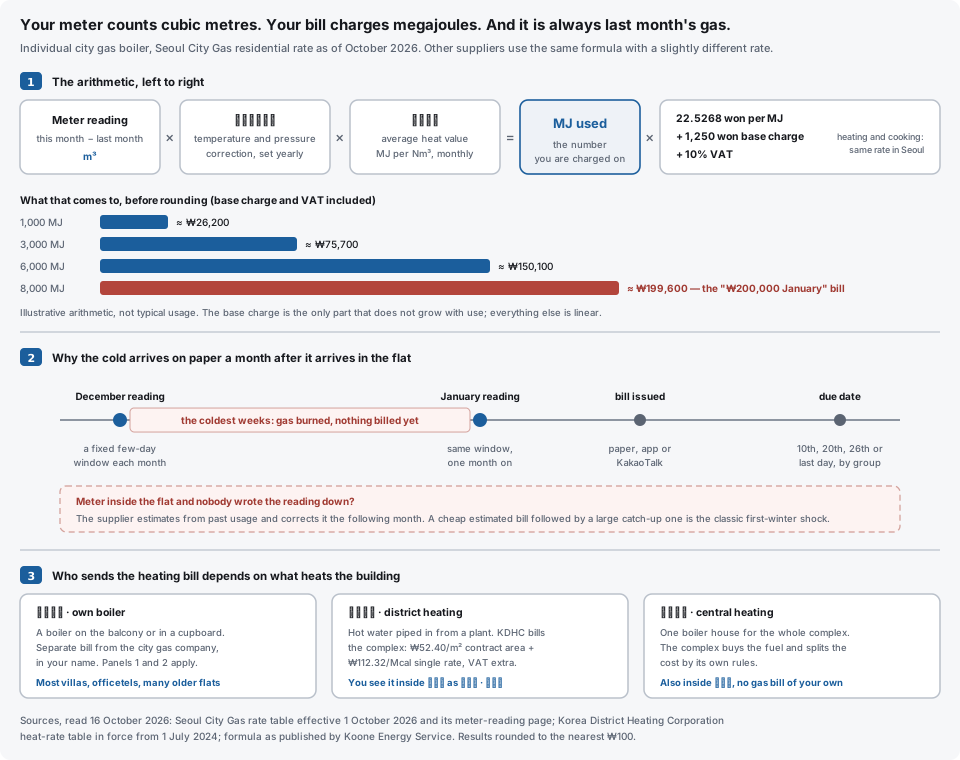
Run the Seoul rate through a few round numbers, base charge and 10% VAT included, rounded to the nearest ₩100 (the supplier's own rounding on the bill may differ by a few won):
| Gas used in a billing month | Approximate bill |
|---|---|
| 1,000 MJ | ₩26,200 |
| 3,000 MJ | ₩75,700 |
| 6,000 MJ | ₩150,100 |
| 8,000 MJ | ₩199,600 |
That's arithmetic, not a forecast of what your flat will burn. What it shows is the shape: apart from the ₩1,250 base charge, the bill grows in a straight line with use. On the Seoul residential rate there's no higher tier waiting at some threshold, which is how Korean household electricity is priced. So a ₩200,000 bill just means roughly 8,000 MJ went through the boiler, and the only real lever is burning less.
Why the shock lands a month late
The meter is read once a month inside a fixed window, and your bill covers the gas burned between two readings. Seoul City Gas explains this on its meter-reading page: customers are split into reading groups, and each group has its own payment deadline, which falls on the 10th, 20th, 26th or last day of the month.
So the cold you live through in December mostly shows up on the bill issued after the January reading, and the bill you open in a mild week of February may still be paying for the worst week of January. Most people compare it with the weather outside the day it arrives. Compare it with the weather four to six weeks earlier instead, and it tends to make more sense.
The second cause is less obvious and catches new tenants specifically. If the meter is inside your flat, you may be expected to read it yourself. The same Seoul City Gas page asks customers with an indoor meter to read it on the set dates and write the number on the self-reading card stuck by the front door, or enter it on the website during the reading window. Missed the date? Phone the number in to the call centre (1588-5788) while the window is still open. If no reading can be taken at all, Seoul City Gas says it bills on past usage and settles the difference the following month (인정고지).
That estimate is built on history, and in a flat you just moved into, the history is somebody else's. Koone's reading guide says its estimates use the same month of the previous year first, then the previous month, and that a reading phoned in within two days after the reading date gets a corrected bill. Say the last tenant spent last December abroad: your estimate comes out cheap, the next real reading catches up, and that bill carries the whole difference. One light bill, one painful one, and the total is still right.
The fix is dull but works. Find the meter in your first week, look for the card by the door, and take a photo of the dial on each reading day. When you register as the new user, ask about a reading for the changeover too; Seoul City Gas lists a change of user as one of the cases where it does a separate reading outside the normal schedule.
Your own boiler, district heating, or central heating
Who actually sends the heating bill depends on the building. There are three set-ups, and they bill through different channels.
개별난방, your own boiler. A gas boiler sits on the balcony, in the utility room or in a cupboard, and a separate gas bill comes in your name. It's common in villas, officetels and plenty of older apartments. Everything in the two sections above applies to you.
지역난방, district heating. Hot water is piped in from a heat plant. There is no boiler in your flat, only a manifold and valves. Korea District Heating Corporation bills the complex, not you. Its residential heat tariff, in force from 1 July 2024 and still the table shown when checked, charges 52.40 won per m² of contract area as a base, plus 112.32 won per Mcal on the single rate (VAT extra). A seasonal option prices winter, December to February, at 115.59 won per Mcal. You see your share inside the monthly maintenance bill as 난방비 and 급탕비, heating and hot water. Some new towns are served by other district heating companies with their own tables.
중앙난방, central heating. One boiler house for the whole complex, more common in older apartment blocks. The complex buys the fuel and divides the cost under its own rules, and again it arrives inside 관리비.
This is worth knowing before you sign anything. A flat on district or central heating has no gas bill for heating, so a maintenance fee that looks high at a viewing may already include the heating. A villa with its own boiler has a lower 관리비 and a separate winter bill the agent may not mention. Ask which one it is before you compare two places, along with the other questions in our guide to renting an apartment in Korea. It is also why the "utilities" line in our Seoul cost-of-living breakdown swings so much between winter and summer.
Boiler modes, and why the floor takes so long
The controller on the wall usually offers some version of these:
- 난방 / 실내 (room): you set an air temperature and the boiler runs until the sensor reaches it.
- 온돌 (floor): you set the temperature of the water going through the floor pipes, not the room.
- 온수 (hot water only): heating off, tap water still heated.
- 예약 (timer): runs for a set time at intervals you choose.
- 외출 (away): mainly there to keep the pipes from freezing while the flat is empty.
Labels and exact behaviour differ by maker and model. Some controllers have a quick guide under a flip cover; if yours doesn't, the model number on the side usually turns up the manual online.
Ondol is why Korean heating feels so different from radiators. Hot water runs through pipes laid in the floor, so the floor itself is the heater. A heavy slab has to warm up before the room does, which is why it can take hours to come up to temperature and why it keeps giving off heat after the boiler stops. It also means that switching off all day and then running it hard at night is not automatically the cheap option: once the slab has cooled right down you pay to heat it again. How much that matters depends a lot on insulation, which is the government's point below.
The government policy briefing site, korea.kr, ran a list of heating tips in February 2023, just as January's bills from a very cold month were arriving. These are the ones worth acting on:
- Use away mode when you go out, if the building is well insulated (단열 성능이 좋은 건물). The condition is the point. In a draughty top-floor villa, the flat may be cold by the time you get home.
- Close the distributor valves for rooms you do not use (분배기 밸브). The manifold, a row of small valves often near the boiler or under the kitchen sink, has one per room or zone.
- Keep the room at 18 to 20°C and dress for it. That is the Korea Energy Agency's recommended winter range, and the article quotes the agency saying it assumes you are wearing thermal underwear and indoor clothes, which it puts at worth 4 to 6°C.
- If you heat by floor-water temperature, set it to 55°C or above, per the same list.
The first-winter reflex worth breaking is leaving the dial at 25 all day because that first warm evening felt so good. Pick a room temperature you can live with, use the timer or a lower setting while you're out, and think of away mode as something for longer absences unless your flat holds heat well. One more thing: don't unplug the boiler or close its gas valve for the winter. On most models the freeze protection needs power, and gas to fire if it gets cold enough, and a burst pipe costs far more than a month of heating. Your boiler's manual will say what its own frost protection needs.
Paying it
Seoul City Gas lists its options on a payment methods page, and most of them work without a Korean credit card.
The one to set up first is bank auto-debit (자동이체) from your Korean account, because paying after the deadline adds a late charge. You can apply on the website, in the 가스앱 app, through the 가스톡 KakaoTalk channel, at your bank, or by calling 1588-5788. Until that is running, the paper bill has a QR code you can scan at the counter of a CU, GS25 or 7-Eleven, any hour, paying cash or with a debit card. The bill also prints a dedicated deposit account (입금전용계좌) just for you, so an ordinary bank transfer works; transfers between 23:00 and 01:00 may not go through. Bank and post office counters, ATMs and internet giro (which needs a certificate login) are the remaining options.
Credit cards work too, but only those issued by the Korean card companies the page lists (KB Kookmin, Shinhan, Hyundai, Lotte, Samsung, BC, Hana and a few others). Other suppliers have their own pages and a broadly similar menu.
If the bill is still in the previous tenant's name, change it. The move-in page says a change of user must be registered, tells new arrivals to check the meter and ask for any unpaid charges from the previous occupant to be settled, and covers getting the stove connected (for a fee). The other end of the tenancy, the final meter reading and the money you can claim back from the maintenance bill, is in moving out in Korea.
A first-winter checklist
- Find out the heating type before signing: own boiler, district or central.
- Find the gas meter and the reading card in week one. If it is inside, note your reading dates.
- Check whose name is on the gas bill, register the change with the supplier and ask about a changeover reading.
- Set up auto-debit, so the January bill does not also come with a late charge.
- Learn the controller: which button is room, floor, timer and away on your model.
- Close the valves for rooms you do not heat.
- Expect the bill a month late, and compare it with last month's weather, not today's.
Rates and procedures were checked on 16 October 2026 against Seoul City Gas, Koone Energy Service, Korea District Heating Corporation and the government policy briefing, all linked above. Gas rates are set regionally and can change more than once a year, so check your own supplier's current table before relying on any figure here. See terms. Corrections via contact.
Frequently asked questions
How is the city gas bill calculated in Korea?
The meter counts cubic metres. The supplier multiplies that by a temperature and pressure correction factor and by the month's average heat value to get megajoules, charges a per-MJ rate, adds a monthly base charge and then 10% VAT. In Seoul City Gas territory the residential rate is 22.5268 won per MJ with a 1,250 won base charge, as of October 2026.
Why is my January gas bill so much higher than December's?
Because the bill always covers the gas burned between two meter readings, so the coldest weeks land on the bill that arrives afterwards. If your meter is inside the flat and the reading was not recorded, the supplier estimates from past usage and corrects it the following month, which can turn one light bill into one very heavy one.
Should I use 외출 (away) mode on a Korean boiler when I go to work?
It depends on the building. The government's policy briefing advice is to use away mode when going out if the building is well insulated; on many controllers away mode mainly keeps the system from freezing, so a draughty flat can cool right down and cost a lot to reheat. For a normal working day, turning the room temperature down a few degrees or using the timer is the other option. Check your controller's manual for what its away mode actually does.
How do I pay the gas bill in Korea without a Korean credit card?
Seoul City Gas accepts bank auto-debit, a transfer to the dedicated deposit account printed on your bill, payment at a bank or post office counter, CD/ATM, internet giro, and cash or debit card at CU, GS25 and 7-Eleven by scanning the QR code on the paper bill. Other suppliers list similar options on their own payment pages, so check yours.