Moving Out in Korea: The Refund Hidden in Your Bills
Two weeks before you hand back the keys, a Korean friend sends you a link with three words of commentary: 장기수선충당금 꼭 받으세요. You skim the machine translation, work out that your landlord has been quietly holding money that belongs to you, multiply something by twenty-four months, and feel briefly clever about it.
Then you go to find the management office.
There isn't one. There is a landlord's mobile number, a metal cupboard by the stairs with the water meters in it, and a paper bill that somebody slides under your door around the eighth of the month.
That gap, between the advice and the building the advice assumes you live in, is the whole problem with how this subject gets written about in English. The refund is real. It is also attached to a specific category of building, and the flats most foreign residents rent are usually not in it.
Start with the building, not with the bill
The rule everyone quotes lives in Article 31 of the Enforcement Decree of the Housing Management Act (공동주택관리법 시행령). Paragraph 8 is one sentence long: where the occupant has paid the long-term repair reserve on the owner's behalf, the owner must give it back. You can read the decree in full on the government's National Law Information Centre, and the plain-language version aimed at tenants sits on the Easy Law portal. Both read on 23 August 2026.
Nothing in that sentence creates the reserve. It only says who has to hand it back once it exists.
It exists only where the building needed a long-term repair plan to begin with. Article 29(1) of the Act sets out which buildings those are, and the list is shorter than people assume: 300 units or more, or a lift, or central or district heating, or a building put up under a Building Act permit that mixes homes with other uses. Article 30(1) then tells the management body to collect the reserve from the owner in line with that plan, which is exactly why the decree makes the owner pay the tenant back.
Note what is not on that list: a minimum door count for the lift. A twelve-flat building with a lift is caught; a five-storey walk-up with thirty flats is not.
A second and separate test gets quoted as if it were the same one. 의무관리대상 — compulsory professional management — decides whether the building has a staffed management office at all, and that is where the 300 and 150 unit numbers live (Article 2(1)2 of the Act: the definition is on law.go.kr). The two tests overlap in most real apartment complexes, which is why nobody notices they are different. Where there is no management office, there is generally nobody collecting a reserve and nobody to issue paperwork about it, whatever Article 29 says on paper. So the question that settles the most cases is not either statute. It is what the bill in your hand actually says.
If you cannot lay hands on a bill, there is a shortcut worth knowing about. Since 25 October 2024, every complex of 100 units or more has had to publish its monthly 관리비 breakdown on K-apt, the government's apartment management information system, by the end of the following month. Search your complex, open a recent statement, and the 장기수선충당금 line is either sitting there or it is not. It will not tell you what you personally paid, which is what the 납부확인서 later does. It answers the only question that matters at this stage, in about a minute, without talking to anybody.
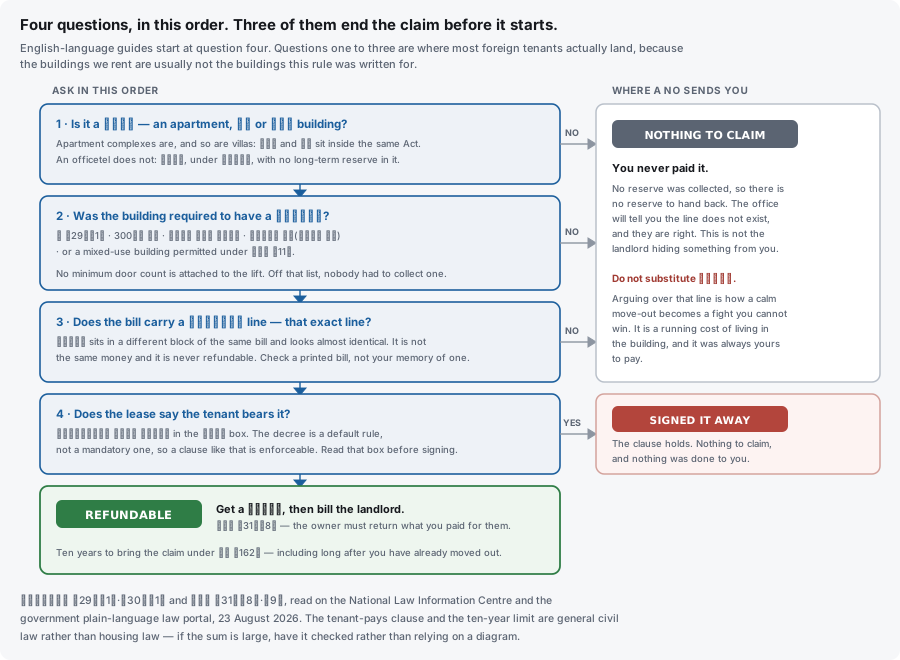
Officetels deserve their own paragraph, because so many foreign residents are in one and because the building looks like an apartment block from the inside. Legally it is not a 공동주택 at all. An officetel is 업무시설, governed by 집합건물법, the condominium ownership act, which contains no equivalent duty to accumulate a long-term reserve. A repair fund can exist there, but it comes from a resolution of the owners' body rather than from statute.
Which means two things. Your officetel may well have no reserve at all. And where it does, the right to get it back is not the clean statutory one. It depends on what that building's own management rules say, and it runs against the unit owner rather than against the management body. A Seoul Northern District Court decision reported in August 2024 threw out a tenant's unjust-enrichment claim against an officetel management body on exactly that reasoning: the money had genuinely been spent on repairs, and the tenant's route was to settle with the unit owner under the lease instead. The report carries no case number, so treat it as an illustration of where these disputes go rather than as a rule.
Villas are the case the English-language guides get backwards. A 다세대 or 연립 building is a 공동주택, sitting inside the same Act as an apartment complex, so no statute has excluded it. Article 29 simply never reaches it: no lift, nothing like 300 doors, a boiler in each flat rather than central heating. Same destination, different reason, and the reason starts to matter the day your villa turns out to have a lift in it.
수선유지비 is not it
Here is the mistake that turns a polite request into an argument.
There are two lines on a Korean maintenance bill with almost the same name. One is 수선유지비 — running repairs. The other is 장기수선충당금 — the long-term reserve. They sit in different blocks, they fund different things, and only one of them is coming back.
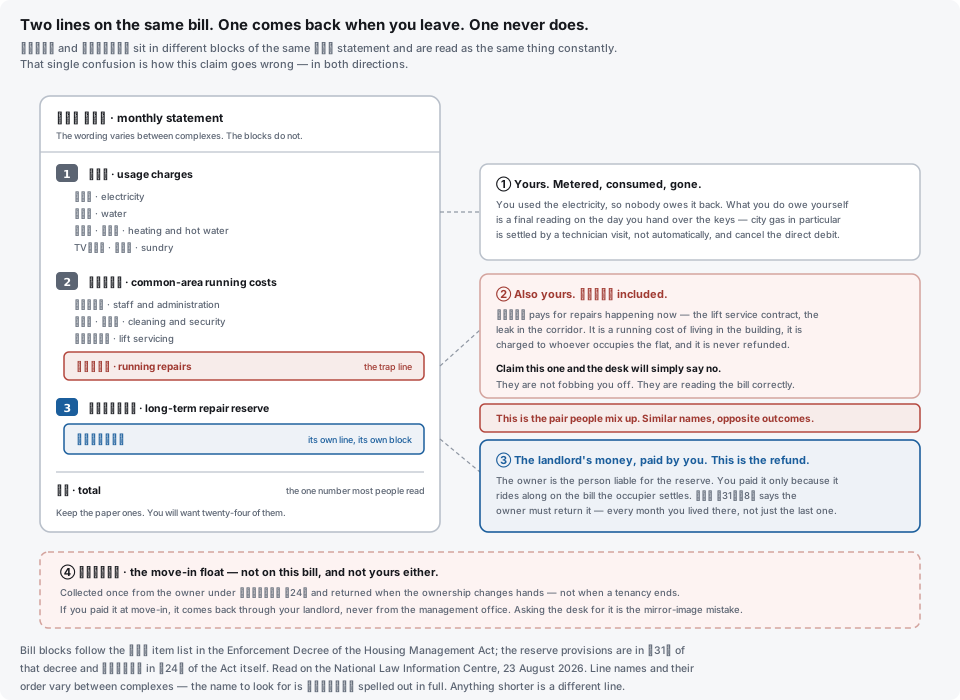
The distinction is not arbitrary. 수선유지비 covers work being done now and consumed now: the lift service contract, the leak in the third-floor corridor, the cleaning of the heating system. Whoever is living in the building at the time benefits from it and pays for it. 장기수선충당금 is money banked against major works years away: roof, façade, lift replacement. The person who owns the asset is the person who benefits, so the owner is the one legally liable, and you paid it only because it rides along on the bill the occupier settles each month.
Ask the office to refund your 수선유지비 and they will say no. They are not fobbing you off. They are reading the bill correctly.
Getting the paper, then getting the money
Assume you cleared all four gates. The sequence has four steps and most people only ever need the first two.
One: get the 납부확인서. This is a payment certificate from the 관리주체 — the management office — listing what you paid into the reserve and over what period. Paragraph 9 of the same Article 31 requires them to issue it without delay when an occupant asks. You are not requesting a favour; you are triggering a duty. Ask for it in the last week of the tenancy, once the final bill has been issued and the total is complete.
Two: send it to the landlord. Most of the time this is the entire process: a photo of the certificate on KakaoTalk, a transfer the same week. The amount is often modest enough that no sensible landlord argues about it, and the certificate removes any question about the figure.
Three: 내용증명. If the messages stop being answered, a content-certified letter through the post office puts a dated record in front of them. It has no magic legal force by itself, but it changes the tone, and it is the document a court will later want to see.
Four: 지급명령. A payment order is the small-claims-adjacent route: you file, the court issues an order without a hearing, and it becomes enforceable unless the other side objects. The filing fee is calculated at a tenth of the stamp duty for ordinary litigation, which at these sums is very small. The Easy Law guide to payment orders sets out the arithmetic. If the landlord objects, it converts into a normal action, and you should be honest with yourself about whether the amount justifies that.
The clock is generous. This is treated as an ordinary monetary claim, which puts it under the general ten-year period in Article 162 of the Civil Act rather than any shorter housing-law clock. Walking out of the building does not end it. If the old bills surface in a drawer eighteen months from now, the claim is still alive. For anything more than pocket change, the Korea Legal Aid Corporation runs free consultations and is the place to confirm that before you rely on it.
The one sentence in the contract that cancels all of it
Article 31(8) is a default rule, not a mandatory one. That matters more than it sounds like it does.
If your lease contains a 특약 — a special clause — saying 장기수선충당금은 임차인이 부담한다, the clause governs and the refund is gone. It is legal, it is not rare, and it usually sits in the 특약사항 box at the bottom of page two, which is the part of a Korean contract nobody translates because it is handwritten.
So the time to look at this is not on the way out. It is on the way in, alongside everything else you check before signing: the property register, the deposit protection, the whole deposit apparatus.
One narrower carve-out, easy to miss. The refund runs to the 사용자, and Article 2(1)6 of the Act defines that word as a person renting a home in a 공동주택 while expressly excluding tenants of registered rental housing (임대주택), which is run under its own rules.
There is also a live attempt to strengthen the rule. On 22 April 2026 an amendment to 공동주택관리법 was introduced in the National Assembly that would lift the refund duty out of the decree and write it into the Act itself, and require management bodies to tell tenants about it in writing. A companion amendment to the estate agents' act would make the agent explain the position before you sign. Both were reported at the time as newly introduced bills, which in the Korean legislature is a long way from law. Nothing in either of them changes what you can do today. If you want the current status rather than the introduction, the National Assembly bill tracker at likms.assembly.go.kr is the only source worth trusting on it.
What the landlord cannot take out of the deposit
The refund is one direction of the move-out settlement. The other direction is what gets deducted, and the two negotiations usually happen in the same phone call.
The principle Korean courts apply is 통상의 손모 — ordinary wear. In a much-cited Seoul Central District Court judgment of 31 May 2007 (2005가합100279, 2006가합62053), the court held that deterioration arising from normal use carries no fault on the tenant's part, so the cost of putting it right falls on the landlord unless there is a specific agreement otherwise. And "specific" was given teeth. A generic restore-to-original-condition line was not enough: the judgment says the scope of the wear the tenant is paying to put right has to be spelled out in the contract itself, or, if the contract is unclear, the landlord has to have explained it in terms the tenant clearly understood and agreed to.
In practice the argument is almost always about wallpaper and flooring. Sun-faded 도배 after two years is wear. A hole punched through the 장판 is damage. Two caveats before you quote it at anyone. It is a district court decision rather than a Supreme Court one, and the lease in front of that court was a commercial one, not a studio flat. Outcomes still turn on the wording of your own contract. But it is the reasoning most Korean tenants' advice is built on, and being able to name it changes how the conversation goes.
The refund you should not ask for
Now the mirror-image mistake, because this one gets foreign tenants into trouble in the other direction.
관리비예치금 — sometimes 선수관리비 — is a float held by the management office to cover the gap between spending money and collecting it. Article 24 of the Act says it is collected from the owner, and returned when the owner loses ownership, minus any arrears. The provision is here on law.go.kr.
Read that again: when ownership changes, not when a tenancy ends.
Some landlords do ask an incoming tenant to hand this over at move-in, and if yours did, you should get it back from the landlord, as part of the deposit settlement, and not from the management office. Turning up at the desk to demand it is the move that makes you look like someone who read one blog post and misunderstood it, which is exactly the impression you do not want while you are also asking them for a 납부확인서.
The rest of the last week
The refund is one item on a list that has an order to it.
Settle the utilities on the day, not after. City gas is the one that catches people, because it is not closed automatically. The supplier sends a technician to disconnect the hose and the meter is read at that visit. Seoul City Gas sets out the move-out procedure on its own site, including cancelling the direct debit before you go. Your supplier depends on the district, so check the one that bills you.
And do not move your registered address until the deposit is actually in your account. For a foreign resident that means the 체류지 변경신고 rather than 전입신고, and filing it early is a genuine way to lose the protection you spent your whole tenancy accumulating. The lease report and residence filing guide covers which clock does what.
If the deposit is going home with you, start the transfer conversation before the money lands, not after. Bank limits and documentation on sending money out of Korea have caught out more than one person holding a twenty-million-won balance and a flight in four days.
Do this in month one, not month twenty-three
Find the bill and look for the line now, while it costs you nothing.
It takes about ninety seconds. If there is a 장기수선충당금 line, note the monthly figure and set an expectation. At the kind of amounts that show up on an ordinary Seoul maintenance bill, two years of it is a real number and not a life-changing one. If there is no such line, you have saved yourself a fortnight of translated blog posts and one awkward conversation with a landlord who is, on this point, entirely in the right.
The failure worth avoiding is not missing the refund. It is spending the last week of a tenancy demanding money that was never collected, from people who cannot give it to you, while the deposit, the residence filing and the gas meter go unattended.
Statute text, thresholds and the introduced bill were checked on 23 August 2026 against the National Law Information Centre, the government's Easy Law portal and the sources linked above. Korean housing rules change, and the paragraph numbering inside the Enforcement Decree has shifted before now, so verify the current text before relying on a citation here. This is general information and not legal advice: for a specific dispute, use the Korea Legal Aid Corporation, or the 1345 immigration information line for anything touching your residence status. See terms. Corrections via contact.
Frequently asked questions
Can I claim the long-term repair reserve back from an officetel or villa?
The two cases are not the same. An officetel is not a 공동주택 at all, so 공동주택관리법 never applies to it and any repair fund there exists only because the owners' body voted for one. A villa is a 공동주택, but the reserve is compulsory only where the building needed a long-term repair plan under Article 29 of the Act: 300 units, a lift, or central or district heating. A walk-up villa has none of those, so there is usually no 장기수선충당금 line on the bill at all.
What is the difference between 수선유지비 and 장기수선충당금?
수선유지비 pays for repairs happening now and is a running cost of occupying the flat, so it is yours and it is never refunded. 장기수선충당금 is money set aside for future major works, it is legally the owner's liability, and that is the one you get back. They sit in different blocks of the same bill.
How long do I have to claim the repair reserve after I move out?
It is treated as an ordinary monetary claim, which carries the general ten-year limitation period in Article 162 of the Civil Act rather than any shorter housing-law period. In practice that means leaving without asking does not forfeit it; people do send the request months or years later, once the old bills turn up in a drawer. For a large sum, get it checked at the Korea Legal Aid Corporation rather than relying on the ten years.
Can my landlord deduct wallpaper and flooring from my deposit?
Not for ordinary wear. Korean courts have held that 통상의 손모 — deterioration from normal use — falls on the landlord unless the contract spells out specifically what the tenant is taking on. A generic 'restore to original condition' line has been held not to be specific enough; the contract has to name the damage the tenant is taking on, or the landlord has to have explained it clearly enough that the tenant knowingly agreed.