Korea Freelance Tax: Getting the 3.3% Back in May
There is a kind of pay statement that turns up in Korea with one deduction on it. 3.3%. No pension line, no health insurance line, no employment insurance, and in February, when the rest of the office is uploading card statements for year-end settlement, nobody asks you for anything. The money arrived every month with 3.3% missing and that appeared to be the end of the matter.
It isn't the end. It is the first half of a sum that only gets finished if you finish it, in May, and for most people paid this way the sum finishes in their favour.
It is September 2026 as this goes up, so the May window for the 2025 tax year has been shut for three months. That changes the instruction, not the outcome. If you were paid at 3.3% in 2025, or in any year back to 2021, the thing to do this week is log in to Hometax, run the NTS one-click refund check, and see what five years of unfiled returns are holding. Then put 1 May 2027 in the calendar, because the next one is worth doing on time.
What the 3.3% on your pay statement actually means
Two numbers are hiding inside 3.3. Three per cent is national income tax, withheld under Article 129(1)(3) of the Income Tax Act, which sets the rate for 원천징수대상 사업소득 at 100분의 3. The other 0.3 is local income tax, a ten per cent surcharge on the national figure that goes to the city or gu you live in rather than to the National Tax Service. On ₩1,000,000 that is ₩30,000 and ₩3,000. You get ₩967,000.
The word that matters in that article is 사업소득, business income. When a company pays you at 3.3% it has classified you as an independent supplier of a service, not an employee receiving wages. Whether that classification is honest is a labour-law question and sometimes a sore one. On the tax side the consequences are clean.
Nobody runs a 연말정산 for you in February. Year-end settlement is a mechanism for 근로소득, wage income, and a 3.3% payer has no wage to settle. The February exercise that produces refunds for salaried people, the one described in the guide to income tax for foreign workers, does not touch this money at all. Neither does the 19% flat rate some foreign employees elect; that is a wage-only option too.
The only place the 3.3% ever gets reconciled is a 종합소득세 return, comprehensive income tax, filed by you, in May. That sentence is the whole article. The withholding was taken against a liability nobody has calculated. May is when it gets calculated.
Why most people taxed at 3.3% are owed money
Withholding is taken from revenue. Tax is charged on income. The refund lives in the gap between those two words.
The 3% came off every won the client paid. Income tax, when it is finally worked out, is charged on what is left after expenses, minus personal deductions, and then at 6% on the first ₩14,000,000 of taxable base and 15% on the slice from there to ₩50,000,000, less a ₩1,260,000 progressive deduction in that second band, per the NTS rate table for the 2025 tax year. The basic personal deduction for yourself is ₩1,500,000, the figure the NTS uses in its own worked examples.
The expenses line is the one people assume they cannot fill in because they kept no receipts. They can. For small earners the NTS publishes an expense rate by occupation code, the 단순경비율, and you apply it to revenue without producing a single invoice. For personal-service earners, which is where most 3.3% work sits (occupation codes beginning 940), the simplified rate applies when the previous year's revenue was under ₩36,000,000. The NTS page on bookkeeping and expense-rate criteria is easy to misread here: its table lists the service-industry group at ₩24,000,000, and a footnote under the table moves 인적용역 사업자 into the ₩36,000,000 group for expense-rate purposes. The footnote wins. For the 2025 tax year the test is your 2024 revenue, and Hometax applies the right line during filing without asking. The percentage itself varies by code and is revised each year, so no figure for code 940909 appears here; the NTS's own worked example for a one-person media creator (code 940306) uses 64.1% for the 2023 tax year, which gives a sense of the range. Hometax shows yours.
So take an illustrative year. ₩20,000,000 paid across twelve months, all at 3.3%, so ₩600,000 withheld nationally and ₩60,000 locally. Assume, purely for the arithmetic, a simplified rate of 60%. Expenses ₩12,000,000, income ₩8,000,000, minus the ₩1,500,000 basic deduction, taxable base ₩6,500,000, tax at 6% of ₩390,000. The client already paid ₩600,000 to the tax office on your behalf. The difference, ₩210,000, comes back, plus roughly ₩21,000 of the local part. Small credits I have left out push the real figure a little higher. Change the assumed rate and the numbers move, but the shape does not: for a modest freelance year, 3% of revenue is more than 6% of what is left after expenses.
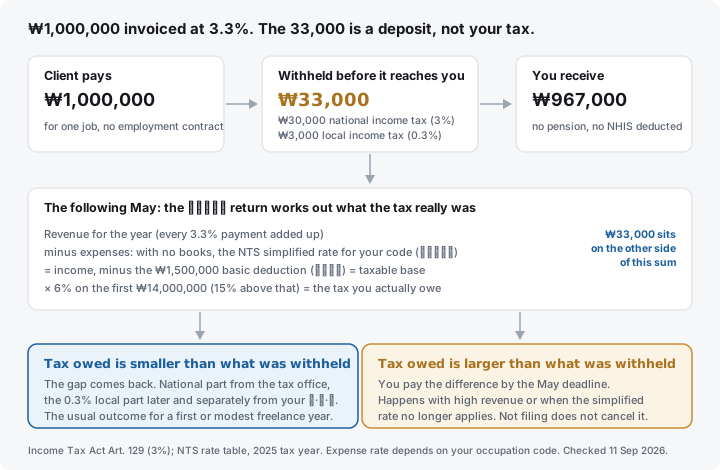
Two things push the other way. Revenue past the threshold moves you onto the 기준경비율, the standard rate, which is much lower and wants receipts for the big items. And a strong year that climbs into the 15% band can produce tax above the 3% that was withheld. Then May produces a bill rather than a refund, and not filing does not make the bill go away. It makes it bigger, as the penalty section below sets out.
The May window, and what 1 June 2026 meant
Comprehensive income tax for a calendar year is filed the following May. The NTS English site lists the window as 5/1~5/31 of the following year. When the 31st lands on a weekend or holiday the deadline moves to the next working day, which is why the Korean filing deadline page for the 2025 tax year says 2026년 6월 1일까지: 31 May 2026 was a Sunday. The government's policy notice of 30 April 2026 gave the same dates, 5.1.(금)부터 6.1.(월)까지. For 2026 income the window is 1 May to 31 May 2027, a Monday, so no roll-over next time.
For the 3.3% crowd the return is mostly pre-filled. Every payer who withheld 3.3% has already reported the payment to the NTS, so Hometax shows the year's revenue and the withholding before you type anything, and small earners get a 모두채움 notice with the tax already computed. The filing can take ten minutes. Not filing takes no time at all, which is the problem.
After you file, the tax office reviews it and pays any refund within 30 days of the refund decision, under Article 51(6) of the National Tax Basic Act. The NTS call centre's own answer to "when" is 신고 마감 후 약 1개월 뒤인 6월말~7월초쯤, per its published Q&A. The 0.3% local part does not arrive with it. The same answer says 지방소득세는 종합소득세 환급 후 약 4주이내 시군구청에서 지급됩니다: the city or gu pays that separately, up to four weeks after the national deposit. Two deposits, two dates, and the second one is small enough that people decide it never came.
Missed May? Two very different outcomes
Everything about a missed deadline depends on the sign of the number the return would have produced. The law is the same for both people. The consequences are not.
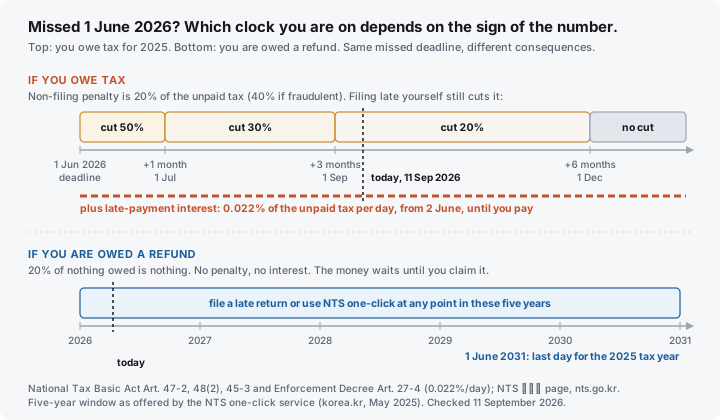
If the return would give you a refund, missing May cost you nothing except the delay. The non-filing penalty, 무신고가산세, is 20% of 무신고납부세액, the tax that went unpaid because you did not file, and 40% if the failure was fraudulent, per Article 47-2 of the National Tax Basic Act and the NTS penalty table for comprehensive income tax. Twenty per cent of nothing is nothing. Late-payment interest is charged on unpaid tax, also nothing. Article 45-3 lets anyone who missed the deadline file a 기한후신고, a late return, at any point before the tax office assesses the year itself, which for a refund year it has no reason to do. In practice the window is five years: that is how far back the NTS one-click service reaches, and it matches the five years from the filing deadline that Article 45-2 gives someone who did file and wants it corrected. For the 2025 tax year that runs to 1 June 2031. Filing in September 2026 costs you the ten minutes you did not spend in May.
If the return would give you a bill, the clock started on 2 June. The 20% penalty applies to whatever you owe, but Article 48(2) cuts it by 50% for a late return filed within one month of the deadline, 30% within three months and 20% within six. Alongside it runs 납부지연가산세, late-payment interest, which the same NTS table states as 미납·미달납부세액 × 경과일수 × 2.2/10,000, that is 0.022% a day, from the day after the statutory payment date until you pay. The daily figure is set by Article 27-4 of the Enforcement Decree as 1일 10만분의 22. On 11 September 2026 you are past three months and inside the six-month band, so the cut is 20% and it lasts until 1 December, while every day of waiting adds 0.022% to the unpaid amount. One wrinkle for anyone who has already been sent a bill: the Act as amended in December 2025 and the decree amended in February 2026 put the period after a tax notice's designated payment date onto a monthly rate instead, 월 1만분의 67, or 0.67% a month. The daily rate still governs someone who files and pays before any notice arrives. If a notice has already landed, check the arithmetic with the NTS rather than with this page.
If you genuinely do not know which side you are on, Hometax settles it before you commit. Fill in the return and it shows the result on screen. You do not have to submit it to see the number.
The NTS one-click refund
On 31 March 2025 the NTS opened 원클릭 환급신고 on Hometax and the Sontax app, and it was built for exactly the person this article is about. It lists every year in the last five for which the NTS thinks you are owed money, with the amount, and files the lot on one confirmation. There is no fee. A return submitted with the pre-filled amount unchanged is paid within a month; an edited one takes two to three, per the 정책브리핑 report on the service.
The same report, written in May 2025, carried the number that explains why this article exists. 3,110,000 people had been told by KakaoTalk message that they had refunds waiting. By late April, seventeen per cent of them had collected. ₩44.3 billion had gone out of the ₩290 billion sitting there. The money was real and most of it stayed where it was, which is what happens when a refund requires a form and the form is not in your language.
Three cautions before you click. The pre-filled figure uses the simplified expense method, so if you kept books and your real expenses run higher than the published rate, a full return may come out better. A one-click submission is legally a late return, so for any year where the sum goes against you it triggers the penalty arithmetic above rather than a refund; the screen makes the sign clear before you confirm. And check the bank account it proposes to pay into, because a closed account is the most common reason a confirmed refund does not show up.
Filing it as a foreigner
Hometax takes a 외국인등록번호 where a Korean would enter a resident registration number, and none of the NTS material on May filing or one-click carves out foreign nationals. The practical gate is not nationality. It is certificates. Logging in needs either a 공동인증서, the bank-issued certificate, or one of the 간편인증 options (a bank app, a telecom PASS app, KakaoTalk, Naver and the rest), and every one of those is issued only after a Korean phone number and a Korean bank account have verified who you are. If you have both, you usually have a route in. If you have neither, that is the first job, and the notes on opening a Korean bank account cover the paperwork.
The other snag is the name. Hometax, your bank and your phone carrier each hold your name as it was typed at the counter, and a foreign name in capitals can be stored with different spacing, a different order, or a middle name dropped. The 간편인증 handshake compares them, and a mismatch fails without saying why. The fix is at whichever counter holds the odd version, not at the NTS.
Help exists in English. The number on the front of the NTS English site is 1588-0560, and the government's January 2026 notice for foreign workers gives its hours as weekdays 9:00 to 18:00, closed 11:30 to 13:00. The general NTS line is 126. Every spring the NTS also posts an Individual Income Tax and Benefit Guide for Foreigners as a PDF; the 2026 edition, covering the 2025 tax year, went up on 30 April 2026.
The refund lands only in a Korean bank account in your name. If you are leaving the country, keep the account open until both deposits have arrived, and remember the local one trails the national one by up to four weeks.
What 3.3% also took away
The 3.3% arrangement is cheap for the payer for reasons that have nothing to do with the 3.3%.
No 4대보험 came out of your pay because none was paid in. On health insurance you are a 지역가입자, a self-paying regional member, billed by the NHIS directly on income and assets, and the piece on health insurance for foreigners explains what that bill looks like. On the national pension you carry the whole contribution yourself, where an employee splits it with the employer. There is no employment insurance and, in the ordinary reading, no severance accruing. If a 3.3% contract was in substance a job, fixed hours, a desk, a manager, labour law can look through the label, and the unpaid severance route exists, but that is a labour office question, not a tax one.
If the deduction on your statement was 20%, or 22% with the local part, rather than 3.3%, the payer treated you as a non-resident. Non-resident personal-service income is withheld at 100분의 20 under Article 156, usually because the payer believed you were in Korea for less than 183 days. That is a different regime with its own return, and if you were in fact living here all year the first conversation is with the payer, the second with the NTS helpline.
One paragraph on visas, because the tax label and the immigration rule are separate things. Being paid at 3.3% says nothing about whether you were allowed to do the work. F-5 and F-6 holders, and most F-2 holders, face no restriction on the kind of employment they take; most E-series and D-2 holders need a 체류자격외 활동허가, permission for activity outside their status, before working for anyone other than the sponsor. That is a summary of general guidance rather than a ruling on your case, so confirm your own status on HiKorea or on 1345 before the work, not after. The 3.3% payment sits in NTS records that immigration can ask to see at extension time.
What to do this week
Log in to Hometax, or Sontax on a phone, and open 원클릭 환급신고. If it lists years, read the sign on each one, confirm the bank account, and submit without editing unless you have books that beat the simplified rate. If it lists nothing and you were paid at 3.3% in 2025, run a 기한후신고 for that year yourself; the pre-filled revenue will be there. Then, if the result is a bill, file before 1 December 2026 while the 20% cut still applies, and pay the same day to stop the daily interest.
And write 1 May 2027 down somewhere. The next return is ten minutes, and it is ten minutes that pays.
Rates, thresholds and deadlines read from the National Tax Service (nts.go.kr, call.nts.go.kr), the National Law Information Center (law.go.kr) and 정책브리핑 (korea.kr) on 11 September 2026. The simplified expense rate used in the worked example is an assumption for arithmetic, not the published figure for any code. If you find something here has moved, tell me and I'll update it.
Frequently asked questions
What is the 3.3% tax on freelance income in Korea?
It is withholding on business income: 3% national income tax under Article 129 of the Income Tax Act plus 0.3% local income tax, taken by whoever pays you before the money arrives. It is a prepayment against a tax bill that has not been calculated yet, not the tax itself. The real figure is worked out when you file a comprehensive income tax return the following May.
Do I get the 3.3% back?
Usually some of it, often most of it. Tax is charged on income after expenses, from 6% on the first ₩14,000,000 of taxable base, and the NTS lets small earners deduct expenses at a published rate with no receipts. For a modest freelance year that produces a bill smaller than what was withheld, and the gap is refunded. Nothing comes back unless you file.
I missed the May deadline. Is there a penalty?
Only if you owed tax. The non-filing penalty is 20% of the unpaid amount, so if the return produces a refund the penalty is zero and you can still file late, for up to five years. If you do owe, filing within one, three or six months cuts the penalty by 50%, 30% or 20%, and late-payment interest of 0.022% a day runs until you pay.
Can a foreigner file on Hometax with an alien registration number?
Yes. Hometax and the Sontax app accept a 외국인등록번호 where a Korean would enter a resident number, and the refund is paid into a Korean bank account in your name. The NTS runs an English helpline on 1588-0560, weekdays 9:00 to 18:00 excluding 11:30 to 13:00, and publishes an English filing guide for foreigners each spring.