Korean Pension Refund: Your Passport Decides, Not Your Visa
There is a line on a Korean payslip that nobody explains to you until the month you leave.
국민연금. Take a worker whose 기준소득월액 — the standardised monthly income the deduction is actually calculated on, which is not quite the same thing as gross pay — sits at ₩3,000,000. In 2026 that is ₩142,500 a month out of the payslip, and the company quietly puts the same amount in beside it. Three years of that, plus interest, is a number with seven digits in it, sitting with an agency you have probably never visited, in a country you are about to leave.
Whether you ever see it again is decided by the passport in your bag. Not your visa. Not your contract. Not how long you paid in, not how good your Korean is, not whether your school was helpful about it. Your nationality.
With one exception. The exception is a visa, and it is the only thing in this article that beats the passport.
First, work out which money you're actually talking about
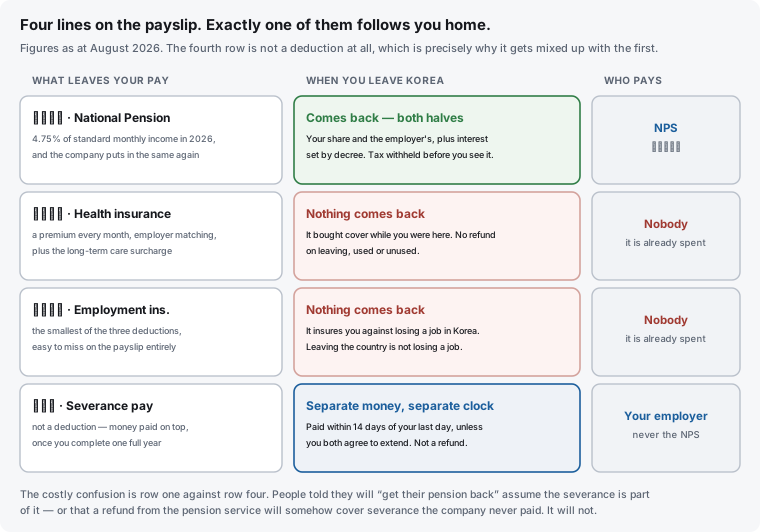
Three things get called "getting my money back" in the same conversation, and only one of them is this article.
The 반환일시금, the lump-sum refund, is what the National Pension Service hands back for the contributions made while you were insured. The wording that matters is one clause long. Article 77(2) of the National Pension Act sets the amount at the contributions paid by the insured person — and then, for anyone who was a workplace-based subscriber, adds in brackets 사용자의 부담금을 포함한다, the employer's share included — plus interest at a rate set by Presidential Decree. Both halves, in other words. The figure that comes back is roughly double the line you watched leave your payslip, which is why it surprises people, usually pleasantly. The clause is on the government's law portal in the full text of the Act if you want to read it in Korean rather than take my word for it.
퇴직금, severance, is different money from a different party. Your employer owes it after one full year of service and pays it directly, within fourteen days of your last day unless you both agree otherwise. The pension service has nothing to do with it and cannot help you chase it. If yours has not arrived, that is a labour office problem with its own clock, not an NPS one.
Health insurance and employment insurance are the ones nobody wants to hear about. They bought you something while you were here — cover, and a claim you were never going to make — and they do not come back.
Four lanes, and your passport picks one
The National Pension Service keeps a table in English headed Countries Paying Lump-sum Refund, restated most recently on 15 June 2026, and everything turns on whether your country is in it. There are two ways in.
One is a social security agreement. Korea has signed those with more than forty countries, and only twenty-four of them reach the refund: the United States, Canada, Germany, France, Australia, Austria, Belgium, Poland, Hungary, Czechia, Slovakia, Slovenia, Croatia, Bulgaria, Romania, Luxembourg, Brazil, Peru, Uruguay, Argentina, India, Türkiye, Switzerland — and the Philippines, which surprises people who assume this is a wealthy-country list. It is not.
The other is reciprocity: your country gives Koreans the equivalent, so Korea returns the favour. Twenty-six countries, including Indonesia, Thailand, Sri Lanka, Malaysia, Cambodia, Laos, Bhutan, Hong Kong, Kazakhstan, Kenya, Ghana, Colombia, El Salvador and Zimbabwe. Nine of the twenty-six carry a minimum insured period — six months for Belize, a full year for Bhutan, Cameroon, Grenada, Jordan, Laos, Saint Vincent and the Grenadines, Thailand and Zimbabwe — and the remaining seventeen pay however briefly you were covered. If you have been reading guides written for English teachers you will not have seen this list at all, because it mostly isn't their readership. It is a very large share of everyone else working here.
Then the two lanes that the English-language internet skips.
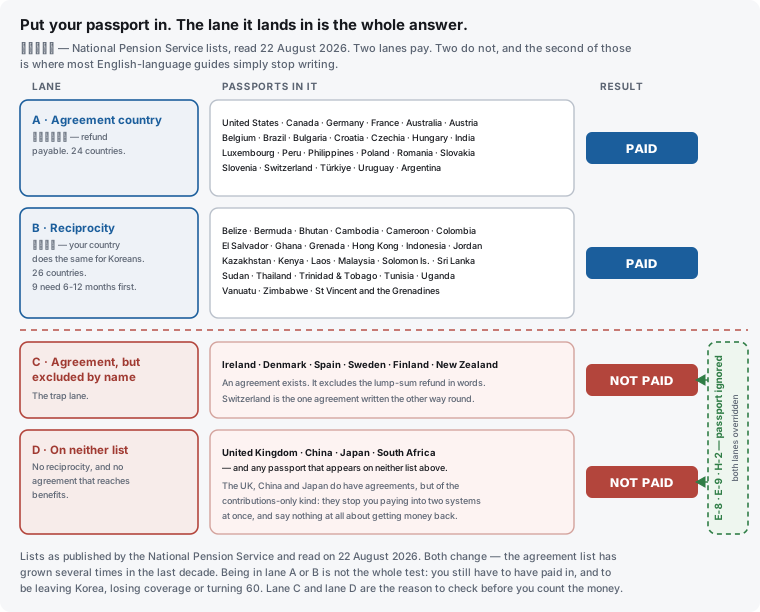
Lane D is the easier one to explain. Passport on neither list, no refund. That covers South Africa, and it covers the United Kingdom, China and Japan — which confuses people, because all three of those countries do have agreements with Korea. Theirs are what the NPS calls exemption agreements, and its own page on the subject is blunt about the limits: provisions on equal treatment and on payment of the lump-sum refund are generally not included. An agreement of that shape does one thing. It stops a posted worker paying into two pension systems at once. Getting money back at the end never comes up, so it doesn't happen.
There is one way out of either losing lane, and it is a visa. Where the insured period was worked on an E-8, E-9 or H-2, the NPS pays regardless of nationality. In manufacturing, agriculture, fishing and construction that exception swallows the rule — a Chinese national on an H-2 is paid, and the same person on an E-7 is not. Only those three visas, though, and only for the months actually spent on them.
Which leaves lane C: an agreement, on paper, that does its own nationals no good whatsoever.
The six countries with an agreement that doesn't help them
Here is the sentence that is hard to find in English anywhere except one page on the NPS site. On its social security agreement overview it states, flatly, that "the payment of the lump-sum refund to Irish, Danish, Spanish, Swedish, Finnish, and New Zealand nationals is not permitted."
Six countries. All six have an agreement with Korea. None of the six gets the refund.
Sit with how that looks from the inside. An Irish teacher on an E-2 spends two years in Daegu next to an American on the identical contract, at the identical school, paying the identical percentage of the identical salary. The American leaves with a seven-figure transfer. The Irish teacher leaves with a record of contributions and nothing in the account. Nobody at the school mentioned it, because nobody at the school knew — the staff who handle this see mostly American and Canadian paperwork and the answer has always been yes.
The same trap catches New Zealanders, who tend to assume they are in the same bucket as Australians. They are not. Australia is on the payable list. New Zealand is on the excluded one.
Switzerland is the mirror image and worth naming for anyone in that lane: the same NPS page says in as many words that payment to Swiss nationals is permitted.
The exclusion is written into each of those treaties rather than invented by a clerk in Jeonju, and the usual explanation given for it is symmetry — those countries do not hand contributions back to departing foreigners either, so Korea does not either. Whether that satisfies you or not, knowing it saves you three weeks of arguing with a branch that has no discretion in the matter.
What changed in 2026, and what it does to the number
For twenty-eight years the contribution rate did not move. Nine percent, set in 1998, and every guide written since could quote it without checking.
That ended this year. Under the 2025 pension reform the rate began climbing on a fixed schedule — 0.5 percentage points a year from 2026, reaching 13% in 2033. The Ministry of Health and Welfare release sets out the schedule; the NPS puts the 2026 figure at 9.5%, split evenly, so a salaried worker pays 4.75% and the employer pays 4.75%. Every year you stay from here, the deduction grows and so does the eventual refund. If you are leaving this year, almost all of your record sits at the old 9% and the change barely touches you. If you are arriving on a three-year contract, it does.
The other number moves every July, and it is the ceiling. Contributions are worked out on your 기준소득월액 — that standardised monthly income figure from the opening paragraph — which is capped at both ends. For 1 July 2026 to 30 June 2027 the cap is ₩6,590,000 and the floor ₩410,000, up from ₩6,370,000 and ₩400,000 the year before. Those come from a Ministry of Health and Welfare notification, number 2026-31, issued on 2 February 2026 and published in full on the law portal; the NPS repeats them on its notice board. Earn above the cap and you contribute on the cap, so high earners quietly pay a smaller share of what they make — and get a proportionally smaller refund at the end of it.
Every figure in this section was read on 22 August 2026. The rate changes each January until 2033 and the cap each July, which is a polite way of saying that a number in a blog post has a shelf life, this post included.
Claiming it: at a branch, at the airport, or from home
Before any of it, find out what the number actually is. Hardly anyone does, and so hardly anyone would notice if it came out wrong. Your payslips only ever showed your half, which means multiplying that deduction by the months you worked undershoots badly and leaves you with no sense of whether the figure you are handed is right. A branch, or the 1355 line, can tell you your insured months and the accumulated amount before you file anything. Do that early enough that a gap in the record — a month reported late, a first job that was never registered at all — is still fixable while you are in the country and the company still exists.
After that there are three ways to actually get it, and picking the wrong one costs you either an afternoon or a month.
The ordinary route is a branch visit in the month before you fly. The documents the NPS English page asks for are the application form, your passport, your alien registration card, a copy of your bank account details, and something proving you leave within a month of applying — a ticket does the job.
Flying home first costs you nothing either, whatever the staffroom says. The NPS lets an agent file on your behalf, or you can post the documents in yourself with an application for overseas remittance attached. The money lands in a foreign account, with its own fees and its own exchange rate, and the arithmetic of that is the same as any other transfer out of Korea. If you are going home to Mongolia, Uzbekistan, Thailand, Sri Lanka, Kyrgyzstan or Indonesia there is a third door worth knowing about: the NPS holds a memorandum with the social insurance body in each of those six countries, so the claim can go through them instead, and the notarisation and consular attestation that the postal route otherwise demands are waived.
Then the cash-at-Incheon route. Everybody has heard of this one and almost nobody has the order right, because the first step is not at the airport at all.
- At a branch, within one month of departure, claim the refund and tick airport payment on the form. You leave with a 접수증, an acceptance certificate. Skip this and there is nothing to collect — nobody claims from scratch at the airport. Give a bank account while you are there anyway; that is what gets used if the airport payment falls through, or if an adjustment turns up later.
- On the day you fly, the NPS Incheon Airport Center — Terminal 1, first floor, between exits 1 and 2, booths 7 and 8, 09:00 to 18:00. Everyone comes here, including passengers flying out of Terminal 2. Hand over the receipt and your passport, walk out with a 지급지시서, a direction for payment addressed to the bank.
- Woori Bank, before immigration. Under USD 10,000, the currency exchange desk on the third floor — near counter H in Terminal 1, counter A in Terminal 2, 09:00 to 21:00. USD 10,000 or more, the Woori branch on B1 in either terminal, which shuts at 16:00. What you get here is an exchange receipt, not the money.
- After immigration, the Woori booth inside the duty-free area: near boarding gate 11 in Terminal 1, gate 250 in Terminal 2, open until 21:00. That is where the cash is finally counted out.
Whether the route is open to you at all comes down to four conditions, and the NPS states them plainly. Your employer's loss-of-coverage report has to be filed by the day before you fly, which is something to ask HR to do rather than assume it has happened. The service is closed on Saturdays, Sundays, public holidays and the last business day of December. Your flight has to leave between 10:30 and midnight from Terminal 1, or between 11:00 and midnight from Terminal 2, on a weekday. And payment comes in one of sixteen foreign currencies, never in won.
Line those up and the practical shape of it appears. A Saturday flight, or a 07:20 departure, which between them describe most of the cheap ways out of Seoul, means the counter is shut and you are back to a bank transfer.
Interest, tax, and the five-year clock
Interest is added at a rate set by decree, pegged to three-year bank deposit rates over the period you were insured. Nobody is getting rich on it, but on both halves of three years of contributions it is not nothing either.
Tax comes off before you see the money. The refund is treated as retirement income and withheld accordingly, and the taxable part is generally what you paid in from 1 January 2002 onward plus the interest on it — that being the point from which those contributions started attracting a deduction on the way in. The effective rate depends on your service length and the amount, and I am not going to invent a percentage for you. Ask the branch to show you the withholding calculation when you claim; the National Tax Service English site is the place to check anything it raises, and there is more background in how Korea taxes foreign workers generally.
Then the clock, which is where money actually goes missing. Five years from the date the entitlement arises; miss it and extinctive prescription is complete and that claim pays nothing. The English page says so in one flat sentence, and then offers a way back in that almost nobody quotes: even after the five years have run, you may re-apply within ten years of turning 60, or your survivors within five years of your death. Five years feels long from the departure lounge. It is exactly long enough to forget.
If your passport is in the wrong lane
For a British, Chinese, Japanese, Irish or New Zealand national reading this and adding up three years of deductions: the money is not refundable, but the record is not deleted either. What Article 126(4) of the Act switches off for foreigners in your position is Articles 77 to 79 — the refund articles, and only those. The insured months themselves stay on file. Come back to Korea on another contract and they resume from where they stopped instead of restarting at zero, and if the total ever reaches the qualifying period for an old-age pension, that is an entitlement rather than a refund.
How much weight that will bear is a different question, and not one the statute answers on its own. How a pension would actually reach an account abroad, what the qualifying period looks like for someone who was here for three years at 26, whether a change of nationality changes the answer again — put those to the NPS, or to 1355, or to a branch, before you plan around any of it. A blog post is not where that gets settled, and neither is a staffroom.
And whatever your passport says, do the one thing that costs nothing: check the two lists before you book the flight, not after. Lane A and lane B mean a branch visit slots neatly into your last month. Lane C and lane D mean you were never going to get it, and finding that out in the departure hall with a receipt in your hand is a worse afternoon than finding it out now.
Everything above was checked on 22 August 2026. The country lists, the required documents, the airport steps and the five-year prescription come from the National Pension Service's lump-sum refund page for foreigners, whose country table is dated 15 June 2026; the six excluded nationalities and the Swiss exception from its social security agreement overview, and the exemption-agreement wording from Types of Agreement. Booth numbers and opening hours are corroborated by the NPS Korean guidance page. The 2026 rate is from the Ministry of Health and Welfare release on the 2025 reform and the NPS explainer; the income cap and floor from Ministry notification 2026-31. Articles 77(2) and 126(4) are quoted from the National Pension Act as in force on 1 January 2026. None of this is legal or financial advice, and none of it beats an answer with your own insured record in front of it — the 1355 line and any NPS branch will give you that. If something here has moved, tell me and I will fix it.
Frequently asked questions
Can I get my Korean national pension back when I leave?
It depends on the passport, not the visa or the contract. The National Pension Service pays a lump-sum refund where your country has a social security agreement that covers it, or grants Koreans the equivalent under reciprocity. Americans, Canadians, Germans, Australians, Filipinos, Indonesians, Thais and Sri Lankans are on those lists, though nine of the reciprocity countries require six or twelve months of contributions first. British, Chinese, Japanese and South African nationals are on neither list and are not paid.
Which nationalities cannot claim the Korean lump-sum refund?
Two groups. Passports on neither the agreement list nor the reciprocity list — the UK, China, Japan and South Africa among them. And six agreement countries where the NPS says the refund is excluded by name: Ireland, Denmark, Spain, Sweden, Finland and New Zealand. Switzerland is the one agreement country written the other way, and Swiss nationals are paid. The exception that beats all of this is the visa: an insured period on an E-8, E-9 or H-2 counts whatever the passport says.
How do I get the Korean pension refund in cash at Incheon Airport?
The first step is not at the airport. Claim at an NPS branch within one month of departure, tick airport payment, and keep the acceptance receipt. On the day you fly, take it and your passport to the NPS centre in Terminal 1, first floor, booths 7 and 8, open 09:00 to 18:00 — everyone goes to Terminal 1, including Terminal 2 passengers. A Woori Bank counter converts it before immigration, and the cash itself is handed over after immigration at the Woori booth near gate 11 in Terminal 1 or gate 250 in Terminal 2. It does not run on Saturdays, Sundays or public holidays, and only for flights leaving after 10:30.
How long do I have to claim my Korean pension refund after leaving?
Five years from the date the entitlement arises. After that extinctive prescription is complete and that claim pays nothing. The NPS English page adds one way back in: you may re-apply within ten years of turning 60, or your survivors within five years of your death. You do not have to be in Korea to file — an agent can apply for you, or you can post the documents in with an overseas remittance form.