Unpaid Severance in Korea: The 14 Days Before You Can File
Most people file too early.
Your last day was the 5th — the day the hagwon year ended and half the foreign staff walked out together. Nothing lands. Nobody answers the KakaoTalk. By the 12th you have printed your contract and three months of bank statements and walked into the district labour office.
You get sent home. Politely, with a date written down for you.
The Labour Standards Act gives an employer 14 days from the day the employment relationship ends to settle everything owed — final wages, unused leave pay, and severance (퇴직금). That is Article 36, and until day 15 there is nothing to report. You can agree in writing to extend the window; your employer cannot extend it alone. Both points are on the Ministry of Government Legislation's plain-language page, checked August 2026.
How much you are actually owed
Severance is one month's average pay for each year worked — thirty days' 평균임금 per year of continuous service, in the wording of Article 8 of the Employee Retirement Benefit Security Act. You qualify at one continuous year, provided your contracted hours averaged at least 15 a week (Article 4).
Average pay is your total earnings over the final three months divided by the days in that period, which is why a bonus or a run of overtime in the last quarter quietly raises the figure. The Ministry of Employment and Labour hosts a 퇴직금 calculator that produces the same number your employer's accountant is looking at, and the printout is what you hand across a desk later.
Behind all of it sits one deadline: the right to claim severance lapses three years after you leave, under Article 10 of the same act. Three years feels like forever in week two.
Day 15, and what waiting starts to cost them
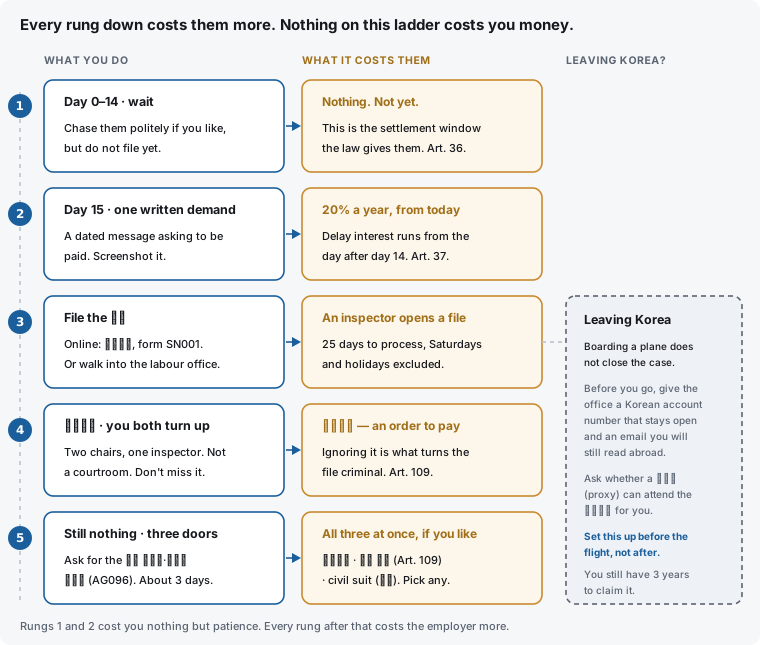
From the day after that deadline, the unpaid amount earns delay interest at 20% a year until it is actually paid. Article 37 lets the government set anything up to 40%; the enforcement decree currently sits at 20%, on the same page, checked the same day. On ₩3,000,000 held for six months that is about ₩300,000 on top. Not life-changing. Very annoying to a small business owner who assumed that waiting was free.
One narrow exception: the interest stops while the employer is in court-supervised rehabilitation, bankrupt, or formally recognised as insolvent (Enforcement Decree Article 18). If your school has genuinely collapsed, the substitute payment route below becomes the main one.
Send one message on day 15. Dated, written, in whatever channel you already use — a KakaoTalk screenshot is the sort of thing an inspector can read. Ask to be paid, state the amount, stop there. You are not drafting a legal letter; you are creating a timestamp.
Filing the 진정: the screen where foreigners get stuck
The complaint is a 진정 (jinjeong): free, not a lawsuit, and asking only that the money be paid. A 고소 asks that your employer be punished — the ministry's page sets out both. Almost everyone starts with the 진정.
Online it is form SN001, 임금체불 진정서 on the labour portal. Processing runs 25 days, Saturdays and public holidays excluded, extendable twice: once at the inspector's discretion, then only with your consent. Budget six to eight weeks, not one.
The wall is authentication. The portal wants a login or 간편인증, which runs off Korean carrier records and banking apps, and no official page I could find says it takes an 외국인등록번호. Assume it may not. Walking into the district labour office (지방고용노동관서) for your workplace's address gets the same form and the same inspector — bring your ARC, your contract, three months of payslips, and the calculator printout.
The ministry's counselling line, 1350, runs weekdays 09:00–18:00 and is charged as a normal call (centre's page, August 2026). Korean only.
The 출석조사 is two chairs and one inspector
A 근로감독관 — labour inspector — is assigned, calls both sides, and sets a date for you to attend together. People brace for this one. It is smaller than they imagine.
Not a hearing. No judge, no gallery, no lawyers unless somebody brought one — a public servant with a caseload works out what was agreed and what was paid. They are on nobody's side and they want the file closed.
Documents decide it, not fluency. A contract, payslips and bank records showing the deposits stop carry further than any argument in either language. Bring the calculator printout and let the arithmetic be the part nobody disputes.
Turn up, though: miss the interview twice and the ministry treats it as withdrawing the complaint and closes the file. You can lodge it again, weeks later.
Where the facts are clear, the outcome is a 시정지시, a corrective order with a deadline on it. An employer who ignores that has stopped stalling and started choosing the next rung, which is criminal.
반의사불벌: the paper only you can sign
Not paying wages or severance carries up to three years' imprisonment or a fine of up to ₩30,000,000 under Article 109(1) of the Labour Standards Act. Ignore the corrective order and the inspector opens a criminal case, then sends the file to the prosecutor — a stage the ministry budgets about two months for.
Then the second paragraph, which is the one that matters to you. Article 109(2) says prosecution cannot proceed against the express wishes of the victim — 피해자의 명시적인 의사와 다르게 공소를 제기할 수 없다, per CaseNote. Lawyers call it 반의사불벌죄.
Read that again. The only thing standing between your former boss and a criminal record is a document you alone can sign: a 처벌불원서, stating you don't want them punished. Employers who shrugged at a corrective order have a way of finding the money at this stage.
Two cautions. Don't sign it before the money is in your account; once given, you have spent the only card you hold. And don't wave it around in messages — it works in the background, which is where it belongs.
If they still don't pay: three doors, all of them open
Ask the district office for a 체불 임금등·사업주 확인서 (form AG096) — a certificate stating what the investigation found was owed. About three days, no fee, and it unlocks the rest.
간이대지급금 (substitute payment). The state pays you, then chases your employer. It covers your final three months of wages and final three years of retirement benefits, capped at ₩7,000,000 per category and ₩10,000,000 in total (government guide, August 2026). Two conditions catch people out: the business must have been running at least six months up to your last day, and the 진정 has to be filed within one year of that day — far tighter than the three-year limit on the claim itself. Claims go through 근로복지공단, on 1588-0075.
Criminal referral. The file goes to the prosecutor under Article 109, for the reasons above.
Civil suit. At the district court covering the workplace or your address. Slow, and worth it mainly for amounts above the substitute payment ceiling.
You fly out on Sunday
Almost everybody assumes the plane ends it. It doesn't — the three-year limit does not care where you are standing, and the case number stays open.
What breaks is contact and payment. Leave the office a Korean bank account that stays open — check how long yours survives without an active ARC, and read sending money out of Korea first. Give an email you will still read, not the school one. Then ask whether a 대리인 — a representative — can attend the 출석조사 for you, and what authorisation they need. Two missed interviews close the file, so settle that before the flight rather than after — and get the answer from your own inspector, not a forum.
Not filed yet, and leaving next week? File anyway. Twenty minutes now against three years of nothing later.
If you only remember one date
Day 15. Not day 12, not the week you resign. Wait out the fourteen days, send one dated message, then file.
Everything else is paper you already have: contract, payslips, calculator printout, a bank account that stays open. The job ad that got you here promised plenty; severance is the one thing the state will chase on your behalf, free, in a small room with two chairs.
One more thing while the file is open: severance is taxed under the retirement income rules, not as salary, so what lands will not match the calculator. The income tax guide covers that, and why leaving mid-year makes the year-end settlement urgent.
Deadlines, rates and caps checked 18 August 2026 against easylaw.go.kr for the 14-day rule and delay interest, the labour portal for processing periods and the substitute payment conditions, and Article 109 for penalties. A guide, not legal advice — for your own case call 1350 or the Ministry's English site. Corrections via contact.
Frequently asked questions
How long does my employer have to pay severance in Korea?
Fourteen days from the day the employment relationship ends, covering final wages and 퇴직금 together, under Article 36 of the Labour Standards Act. The two of you can agree in writing to extend it, but an employer cannot extend it unilaterally. From day 15 the unpaid amount accrues delay interest at 20% a year.
Can I file a labour complaint in Korea if I'm about to leave the country?
Yes, and leaving does not close the case. The practical problem is being reachable and being paid, so before you fly, give the labour office a Korean bank account that stays open and an email you will still read. Ask the assigned inspector in writing what they need from you once you are abroad.
What is 반의사불벌 and why does it matter for unpaid severance?
Article 109(2) of the Labour Standards Act says a prosecution for non-payment cannot go ahead against the victim's express wishes. So once the file reaches the prosecutor, a written statement that you do not want your employer punished is the thing they need from you — and you are the only person who can sign it.
What happens if my employer still won't pay after the labour office orders it?
You request a 체불 임금등·사업주 확인서 from the district office, issued in around three days and free. That certificate opens the substitute payment scheme through 근로복지공단, and the case can be referred to the prosecutor under Article 109. A civil suit runs in parallel if you want it.