How to Quit a Job in Korea: 30 Days Is Not the Rule
The exchange goes the same way most months. A resignation email goes out carrying a line borrowed from every English-language guide on the subject — please accept this as my thirty days' notice, with a final working day of 10 October — and the reply comes back before lunch, perfectly polite, naming 31 October instead.
Nobody is being difficult. HR is reading a different rule, and the thing the guides are quoting was never about resignation in the first place.
Search for how much notice you owe in Korea and "at least 30 days" comes back with total confidence from a dozen sites. Meanwhile the Ministry of Employment and Labour's own English Labour Standards page has no entry on resignation at all: no resign, no quit, no notice period, no 30. The single appearance of the words advance notice on that page is attached to dismissal — employer to worker, the opposite direction — and that is where the number lives. Article 26 of the Labour Standards Act says an employer who wants to dismiss you must give thirty days' notice, or thirty days of ordinary wage instead.
Somebody filled an empty box with the nearest number to hand. Everyone else copied it.
Korean labour law does not give you a notice period
The ministry does answer the question, in Korean, in a FAQ headed 퇴직의 효력발생일 — the effective date of resignation. The opening clause settles it:
퇴직에 관해서는 근로기준법에서 별도로 규정하고 있지 않으므로 민법이 적용되고, 기간의 약정이 없는 경우 근로자는 자유로이 근로계약을 해지할 수 있는 것이나…
Resignation is not separately regulated by the Labour Standards Act, so the Civil Act applies; where no period is fixed, the worker may end the contract freely.
The Labour Standards Act is the statute behind the 52-hour cap, the overtime premium and protection from dismissal. On you walking out, it is silent. The provision that governs instead sits in the general law of contract — Article 660 of the 민법, readable at 국가법령정보센터 — and it reads nothing like "30 days":
제660조(기간의 약정이 없는 고용의 해지통고) ①고용기간의 약정이 없는 때에는 당사자는 언제든지 계약해지의 통고를 할 수 있다. ②전항의 경우에는 상대방이 해지의 통고를 받은 날로부터 1월이 경과하면 해지의 효력이 생긴다. ③기간으로 보수를 정한 때에는 상대방이 해지의 통고를 받은 당기후의 일기를 경과함으로써 해지의 효력이 생긴다.
Either party may give notice at any time. Termination then takes effect one month after the day the other party received it. But where remuneration is fixed by period — a monthly salary, for most people reading this — it takes effect only once the pay period the notice landed in has run out and one further period after that has passed as well. The Korea Legislation Research Institute files the article, in its English text of the Civil Act, under Notice of Rescission for Future of Contract of Employment in which No Period has been Fixed, which is a fair indication of how much of the confusion here is translation. The Korean is the law.
Three outcomes come out of those three paragraphs. None of them is thirty days.
Three ways your last day gets decided
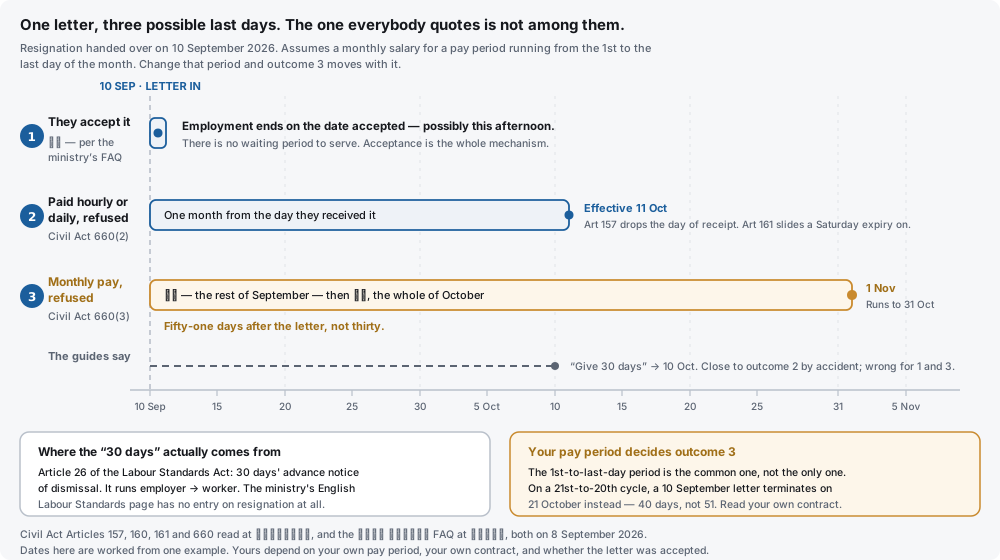
They accept it. The FAQ is blunt about this: 그 해지의 효력발생일은 … 사용자가 이를 수리한 날이 됨 — the effective date is the day the employer accepts the letter. There is no minimum to serve. If your manager reads your resignation on Tuesday and says fine, Friday, then Friday it is and no rule has been broken. This is how the large majority of resignations in Korea actually end, and it is why the 30-day story survives: it almost never gets tested.
A term in your contract or the work rules covers it. The FAQ's second paragraph: 다만 당사자 간에 계약종료시기에 관한 특약(단체협약, 취업규칙, 근로계약 등)이 있다면 그 시기에 계약해지의 효력이 발생할 것임. Where a collective agreement, the 취업규칙 or the employment contract fixes when the contract ends, that term governs. So the clause on page four saying 30일 전 서면 통보 is not decoration — it is where the number in your particular case usually comes from. Note what it can and cannot do. It can fix a date. It cannot conscript you.
They refuse, and there is no such term. Now Article 660 runs, and how it runs depends on how you are paid.
Take a letter handed over on 10 September 2026, with the common arrangement: a fixed monthly amount for a pay period running from the 1st to the last day of the month.
- Paid hourly or by the day, paragraph 2 applies. Article 157 of the Civil Act leaves the day of receipt out of the count, so the month runs from 11 September, and Article 160 ends it on the day before the matching date in the following month — the close of 10 October. Termination bites on 11 October. One wrinkle no chart carries for you: Article 161 pushes a period whose last day falls on a Saturday or a public holiday onto the next day, and 10 October 2026 is a Saturday.
- Paid a monthly salary, paragraph 3 applies, and this is the one that catches people. 당기 is the pay period the letter landed in, September. 일기 is one further period, October. The effect arises once both have gone, on 1 November, so the employment runs to 31 October. That is also a Saturday, so the last day anyone actually sees you is Friday the 30th.
Fifty-one days between the letter and the end of the contract.
Move the pay period and the answer moves with it — earlier as readily as later. On a 21st-to-20th cycle, that same 10 September letter arrives inside the period ending 20 September, runs through the period ending 20 October, and terminates on 21 October. Forty days rather than fifty-one, from identical facts. Anyone quoting you a fixed number has not asked when your pay period starts, which means they cannot know.
When your employer says no
"We haven't accepted it yet" is a real sentence people hear. It is technically true and mostly irrelevant.
Refusal does not trap you. Article 660(1) lets either party give notice whenever they like, and paragraphs 2 and 3 make the termination effective by the passage of time alone — no countersignature, no approval, no exit interview. What refusal does is take the date out of the employer's hands and give it to the statute, which will often hand them a later date than they would have picked themselves. That is the whole of their leverage.
It also means the day your notice was received now matters enormously, because every calculation above counts from it. That turns out to be a filing problem rather than a legal one. Korean contract law works on 도달주의 — a declaration of intent takes effect when it reaches the other party, not when you send it. So send it in a form that leaves a timestamp somebody else generated:
- Email to your manager and to HR, with the intended end date written out in full.
- A signed 사직서 handed over in person, photographed, and ideally stamped as received.
- If it has genuinely turned adversarial, 내용증명 — content-certified post through the post office, which produces an official record of what was sent and when it arrived. A few thousand won, and it ends the argument about dates for good.
What does not leave a usable record: saying it out loud in a meeting, and a KakaoTalk message to a manager who can delete the room.
What goes in the 사직서, and what date goes on it
A Korean 사직서 (or 사직원) is short. Five lines on a single sheet is normal. The only element doing legal work is the date you want to leave, 퇴직 희망일. Everything else is manners.
Keep the manners anyway. A resignation letter here is not the place to explain what went wrong; 일신상의 사유, personal reasons, is the standard formula and nobody expects more. The document circulates among people who will be asked about you later.
The date is where care pays. Name a specific day rather than a duration, because "30 days from today" invites both sides to count differently, and one of those ways of counting costs you three extra weeks. If you have somewhere to be on 1 November, write 10월 31일부로 퇴직하고자 합니다 and let them respond to a date they can accept or decline.
Write it in Korean, with an English version underneath if that helps you. The Korean text is the operative one. Keep a copy of what you actually submitted — the submitted version, not the draft — because the copy in the filing cabinet is the one that exists during a dispute.
Two things worth asking for in the same conversation, since they take one line each: confirmation in writing of the agreed last day, and the settlement date for your final pay.
Walking out: what it actually costs
The question underneath all of this is usually simpler than people admit. What if I just leave?
The realistic cost is not a lawsuit. It is arithmetic, and it lands on your severance.
Severance is calculated on 평균임금, average wage, and the ministry sets out the formula plainly: total wages paid over the three months before the triggering event, divided by the total number of calendar days in that period. Note what sits where. Wages on top, calendar days underneath. Days you did not work still count in the denominator, but the wages you did not earn drop out of the numerator.
Some periods come out of both halves. Article 2 of the Labour Standards Act Enforcement Decree lists them: a probation period, employer-caused shutdown, maternity leave, parental leave, industrial injury, industrial action, military obligations, and time off for non-work illness or injury taken with the employer's approval. Unauthorised absence is on none of those lines. So a month of 무단결근 at the end shrinks the top of the fraction while the bottom stays exactly where it was, and severance is thirty days of average wage for each year of service under Article 8(1) of the Employee Retirement Benefit Security Act. Leaving dramatically is a discount you hand your employer on the way out.
There is a floor under it, and it is the part missing from the English-language material. The same FAQ, citing Article 2 of the Labour Standards Act:
이러한 방법으로 산출된 평균임금액이 그 근로자의 통상임금보다 적으면 그 통상임금액을 평균임금으로 하여야 합니다.
Where the calculated average wage comes out below your 통상임금 — ordinary wage, the fixed regular amount for contractual work — ordinary wage is used as the average wage instead. Article 2(2) puts it in the statute in one sentence. The fraction cannot fall through that floor, so the damage from walking out has a bottom to it. "Bounded" and "zero" are still different words, and the gap between them is real money.
The other risk gets discussed more and materialises less. An employer can in principle sue for loss caused by an abrupt departure. Whether such a claim succeeds, and what would have to be proved about the loss, is not a question to settle from a blog post — if a company is threatening you with one, take it to a 공인노무사, or to the ministry's 1350 counselling line, with your contract in front of you. The line runs 09:00 to 18:00 on weekdays and the call is charged at the normal rate.
One more consequence, unglamorous and immediate: unauthorised absence gives an employer a reason to slow-walk the paperwork you need from them.
Severance does not depend on how much notice you gave
Severance comes from the Employee Retirement Benefit Security Act rather than the Labour Standards Act, and Article 4(1) turns it on two facts: one year of continuous service, and contractual hours averaging 15 a week or more across four weeks. Not why you left. Not whether the resignation was graceful. Not notice.
Article 9 sets the deadline. Payment within 14 days of the day the entitlement arises, which is the day you leave, extendable only by agreement between the parties where there are special circumstances. That deadline is the hinge for everything afterwards — the fourteen days that have to pass before a complaint about unpaid severance becomes a complaint about anything, plus the delay interest and the filing routes, are handled there rather than repeated here.
Attached to the same final settlement, and often missed because it arrives as a separate line: pay for annual leave you accrued and never took. Whether that money exists at all, and how many days it covers, turns on rules with almost nothing to do with resigning — the day 365 problem decides it before your notice does.
The other clocks: the ones immigration is counting
You can finish every labour-law step cleanly and still be out of compliance, because the immigration side counts its own days from its own starting points.
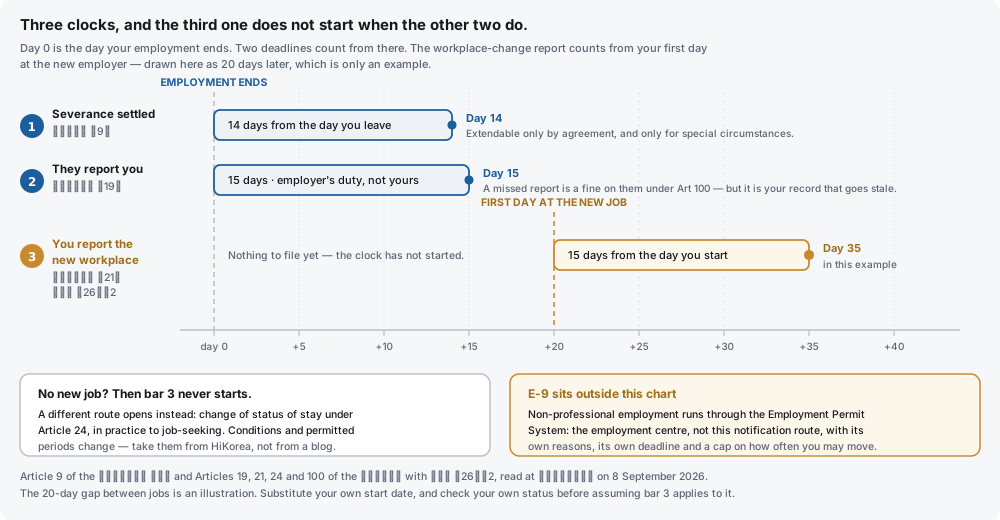
Your employer reports the end of the job — 15 days. Article 19 of the Immigration Act obliges anyone employing a foreign national with a work-permitting status to report a dismissal, resignation or death to the immigration office within fifteen days. Missing it draws an administrative fine under Article 100, which also covers the worker who misses the notification in the next paragraph; both ceilings sit in the statute and the schedule that applies it, so read the current figures at 국가법령정보센터 rather than trusting a number in an article. The practical point for you is a different one. Until that report goes in, immigration's record still shows you employed at a company you left, and that is exactly the discrepancy that surfaces at your next application. Asking HR once whether the 고용변동신고 has been filed is a reasonable question and a short email.
You report the new workplace — 15 days, from a different day. Article 21 requires prior permission to change or add a workplace, with an exception in the proviso: people with specialist knowledge, technology or skills, as defined by Presidential Decree, may instead notify within fifteen days of the day they changed or added it. Article 26-2 of the Enforcement Decree draws that circle around the E-1 to E-7 statuses, and adds a second condition most summaries drop: you have to meet the requirements published by the Minister of Justice as well. That clock does not start when you quit. It starts when you begin at the new employer, which is why the third bar in the chart sits somewhere else entirely, and why people who tidy everything up in the week after leaving still miss it three weeks later.
Which of the two routes — permission or notification — is yours depends on your status and, in some job categories, on restrictions attached to it. That distinction runs along the same fault line as everything else in Korean immigration: whether your right to be here is tied to an employer or held in your own name. The work visa breakdown covers which side of it each status sits on.
No next job. Then there is nothing to notify, and the question becomes whether your current status still has a basis. The route is a change of status of stay under Article 24 — in practice, to a job-seeking status, D-10 — and the conditions, the documents and the period granted are the sort of thing that has changed more than once in recent years. Take them from HiKorea or the 1345 immigration line, dated, before you plan around them.
E-9 is a separate system. Non-professional employment does not use the notification route above at all. Changing workplace runs through the Employment Permit System and the employment centre under the Act on the Employment of Foreign Workers, with its own permitted reasons, its own deadline running from the day the contract ends, and a cap on the number of moves. Miss that deadline and the consequence is departure rather than a fine, which is reason enough to read the current rules at 찾기쉬운 생활법령정보 on the day you need them. If that is your status, none of the fifteen-day arithmetic above is yours.
And if you are leaving Korea rather than changing jobs, there is a fourth clock nobody starts for you: the national pension lump-sum refund, which depends on your nationality rather than your visa and is far easier to arrange before you fly than after.
If you are quitting next week
Find out how you are paid before you write anything — fixed monthly salary or hourly, and the dates your pay period runs between. That single fact decides which paragraph of Article 660 is yours if it ever comes to that.
Then read the resignation clause in your contract, because in the overwhelming majority of cases that clause, and not the Civil Act, is what both sides will act on.
Then write a date, not a duration. Send it somewhere a timestamp lands. Ask for the agreed last day in writing, and the settlement date for final pay, in the same message.
And keep counting after your last day. Two of the three clocks are still running, and only one of them belongs to your old employer.
Article 660 and Articles 157, 160 and 161 of the 민법, Articles 2 and 26 of the 근로기준법 and Article 2 of its 시행령, Articles 4, 8 and 9 of the 근로자퇴직급여 보장법, and Articles 19, 21, 24 and 100 of the 출입국관리법 with Article 26-2 of its 시행령, all read at 국가법령정보센터 on 8 September 2026. The ministry's 「퇴직의 효력발생일」 and 「퇴직금 및 평균임금 산정공식」 FAQ answers, and the E-9 workplace-change rules at 찾기쉬운 생활법령정보, read the same day. Fine amounts under Article 100 and the period granted on a job-seeking status are deliberately not quoted here — both change, and both are worth taking from the source on the day you need them. This is general information, not legal advice; for your own contract the 1350 line and your district labour office answer for free, and a 공인노무사 answers in more detail for a fee. Corrections via contact. See terms.
Frequently asked questions
How much notice do I have to give before quitting a job in Korea?
None is written into the Labour Standards Act. The Ministry of Employment and Labour's FAQ on 퇴직의 효력발생일 says resignation is not separately regulated there, so the Civil Act applies. If your employer accepts the letter, the employment ends on the day they accept it. If they refuse and your contract is silent, Article 660 of the Civil Act decides: one month from the day the notice was received, or — where your pay is fixed by period, as a monthly salary is — the end of the pay period following the one your letter arrived in. That second route is the one that runs well past 30 days.
Can my employer refuse to accept my resignation in Korea?
They can decline to accept it, and it will not keep you employed indefinitely. Refusal takes the date out of their hands and gives it to Article 660, which ends the contract by the passage of time with nobody's signature required. What refusal changes is the date, often not in your favour, which is why the day your letter was received matters and why it should be sent in a form that records that day.
Do I still get severance pay if I quit voluntarily in Korea?
Yes. Severance under the Employee Retirement Benefit Security Act turns on two facts, and neither is notice: one year of continuous service, and contractual hours averaging 15 a week or more over four weeks, under Article 4(1). Article 9 requires payment within 14 days of the day you leave, extendable only by agreement between the parties where there are special circumstances.
What do I have to report to immigration when I quit my job in Korea?
Your employer reports the end of the employment within 15 days under Article 19 of the Immigration Act — that duty is theirs, not yours. Your own duty depends on your status. Professionals in the E-1 to E-7 band who qualify for the notification route report a change of workplace within 15 days of the day they start at the new employer. Anyone with no next job is looking at a change of status of stay under Article 24 instead. Confirm your own case at HiKorea or on the 1345 line.