Annual Leave in Korea: The Day 365 Trap
Almost every contract carries the line. 연차 유급휴가 15일. Fifteen days of paid annual leave, right there above the signature block, in a font that suggests it means something.
Whether it does turns on two numbers printed nowhere near it. One is how many people were on the payroll last month. The other is whether your last day is the 365th or the 366th.
Here is how it usually goes wrong. Somebody finishes a twelve-month E-2 contract at a hagwon, having taken four days off all year, and expects the other eleven to land in the final salary. The payout comes to seven. The entitlement was never fifteen — it was eleven, and four of those were spent in October. The gap between the two numbers is a 2021 Supreme Court decision that rarely makes it into the English-language guides.
And before either of those numbers matters, there is a smaller, ruder question: does Article 60 apply to your employer at all?
Count the heads before you count the days
Article 11 of the Labour Standards Act opens with a sentence that decides more foreign labour disputes than any other in the statute: 이 법은 상시 5명 이상의 근로자를 사용하는 모든 사업 또는 사업장에 적용한다. This Act applies to every business using five or more regular employees. Paragraph 2 then says that for businesses using four or fewer, only some provisions apply, as set out by Presidential Decree.
Article 60 — annual leave — is not one of them.
So a language academy with three teachers, a desk manager and an owner owes you no annual leave whatsoever, and is not breaking any rule by saying so. Same for the four-person design studio in Seongsu, the clinic with two nurses and a receptionist, the Korean branch of a foreign company that has an accountant and three staff and a very large logo.
The contract can still promise fifteen days, and if it does, the promise binds as a contract term. But that is a different thing from a statutory right, enforced in a different way, and the difference shows up the moment you want unused days converted into money.
How Korea counts to five
Not by counting desks. Article 7-2 of the Enforcement Decree sets a formula, and it is an average: total headcount-days over the preceding month — 연인원 — divided by the number of days the business actually operated, 가동 일수. The measuring period is the one month before the day the rule would bite, so the answer can be different for a dispute in March and a dispute in September.
Who goes into the numerator is where people guess wrong. Employment type is irrelevant: full-time, fixed-term, part-time, Korean, foreign, all in. The owner is not an employee and does not count. Registered directors generally do not either. Dispatched agency workers are excluded by the decree. Family members living with the owner sit outside the Act if they are the only staff — but once there is a single unrelated employee, the relatives get counted alongside everyone else, which is how a family restaurant crosses the line by hiring one student.
Then the tie-breaker, which is the part nobody mentions and the part that flips real cases in both directions. Even where the average comes out below five, the workplace is treated as a five-person workplace if the number of days that fell short of five was less than half the operating days. And even where the average comes out above five, it is treated as being under five if half or more of the days fell short.
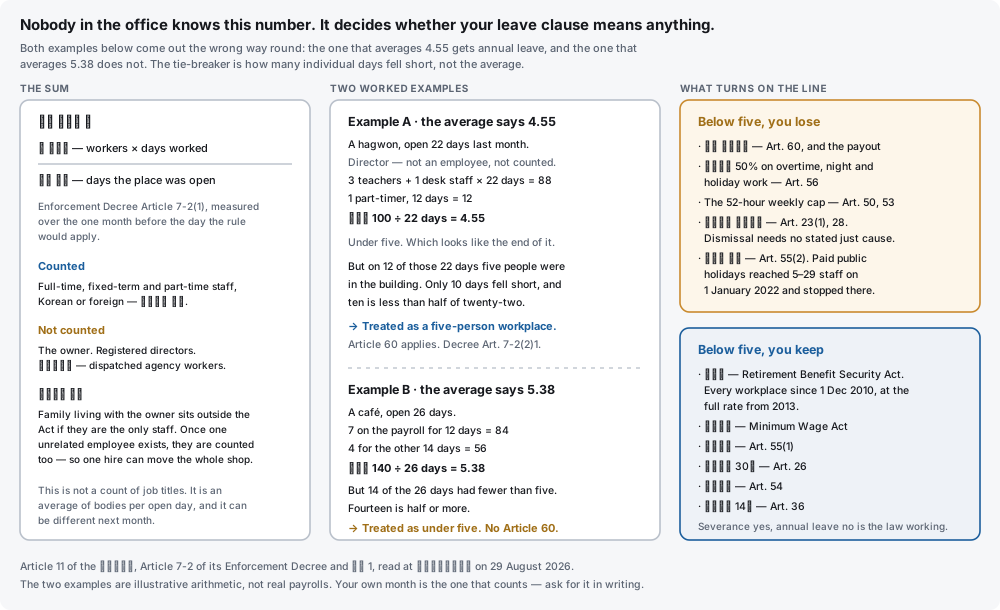
Read the two examples in the middle column together. The hagwon averages 4.55 and gets annual leave. The café averages 5.38 and does not. Anyone who tells you "we're four people, so no 연차" has answered a question they were not asked — they gave you a payroll count, not a calculation.
You can ask for the underlying numbers. Staff, days, days open. It is arithmetic, not a state secret, and a labour inspector will ask for exactly the same thing later.
What survives below the line
The confusing part of a small workplace is not that everything falls away. Most things don't.
Severance is the big one. 퇴직금 comes from a separate statute, the Employee Retirement Benefit Security Act, which has covered workplaces of every size since 1 December 2010 — at half the standard rate through 2012, and at the full rate from 2013. One year of continuous service and an average of at least 15 hours a week, and it is owed, in a two-person shop as much as in Samsung. So is the minimum wage. So is weekly holiday pay under Article 55(1), thirty days' notice of dismissal under Article 26, rest breaks under Article 54, and the fourteen-day settlement of final pay under Article 36 — the deadline that governs an unpaid severance claim.
What goes: annual leave, the 50% premium on overtime, night and holiday work, the 52-hour weekly cap, and the unfair dismissal remedy, which is the harshest of them. Below five, an employer needs no stated just cause to let you go. Thirty days' notice, or thirty days' pay, and that is the whole procedure.
Paid public holidays are their own small history. Lunar New Year, Chuseok, the national days — these became statutory paid holidays for private employers in stages: 300 or more staff from 2020, 30 to 299 from 2021, and 5 to 29 staff from 1 January 2022, per the Ministry of Employment and Labour's own notice. The staircase stopped at five and has not moved since.
So "my severance came through but they say I have no annual leave" is not a contradiction and not a swindle. It is two different laws with two different reaches.
Your first year is eleven days, not fifteen
Assume now that you cleared the headcount gate. Five or more, Article 60 applies, congratulations.
Your first year still does not produce fifteen days.
Article 60(2) gives a worker with under a year of continuous service one paid day for each month worked in full — 1개월 개근 시 1일. Work January in full, you have a day. Miss a month through unpaid absence and that month simply produces nothing; the word is 개근, full attendance, not "showed up mostly".
Eleven is the ceiling, because the twelfth month completes at the one-year mark, and from that point Article 60(1) governs instead: fifteen days for a worker who attended at least 80% of the year. The two provisions hand over rather than stack.
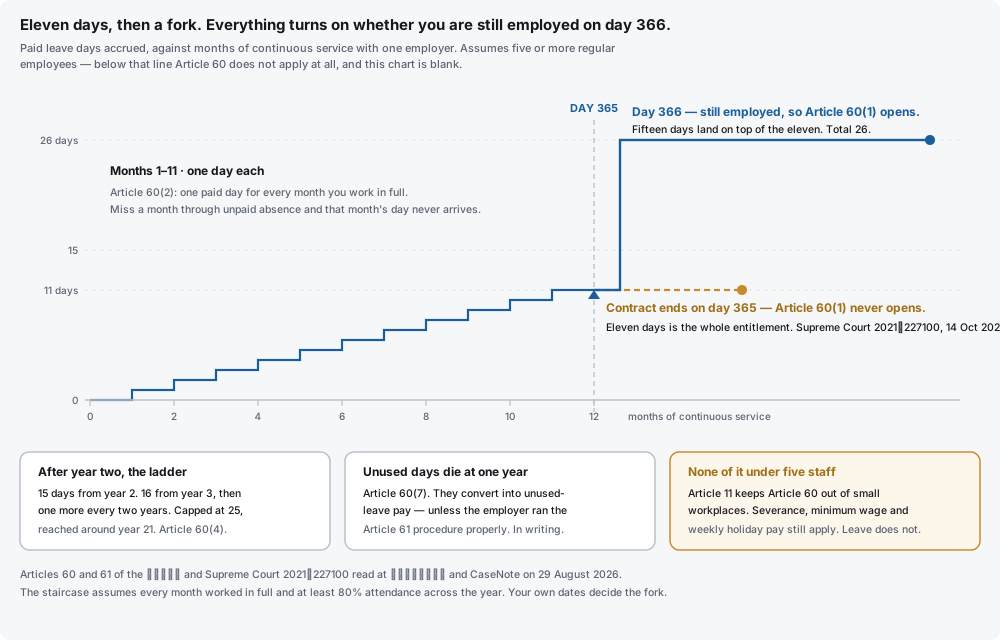
After that the ladder is slow and worth knowing anyway: fifteen days in year two, sixteen from three years of continuous service, then one extra day for every further two years, capped by Article 60(4) at twenty-five. You reach the cap somewhere around your twenty-first year, which is not a number most people reading this will need.
Day 365 and day 366
This is the one to write down.
On 14 October 2021 the Supreme Court decided 2021다227100. A worker on a fixed-term contract of exactly one year argued that both limbs applied — the eleven monthly days and the fifteen days for a full year's attendance, twenty-six in total, all payable on the way out.
The Court said no, and the reasoning is narrow and clean. Article 60(1) presupposes that the employment relationship continues into the following year. Where a one-year contract expires at the very moment the year is complete, that premise fails, so only Article 60(2) operates and eleven days is the maximum. Shin & Kim's note sets out the holding in Korean.
The Ministry of Employment and Labour changed its administrative interpretation to match on 16 December 2021. Kim & Chang's English summary puts the practical rule in one line: an employee may claim allowance for unused annual leave on resignation "only when he/she is still employed on the following day of the completion of the one year of employment".
Day 365: eleven days. Day 366: eleven, plus fifteen that accrue that morning and are paid out unused if you go. Twenty-six.
One day of work, fifteen days of pay. On a full-time schedule that is on the order of half a month's pay, and I am deliberately leaving it at that. Unused-leave pay is calculated on 통상임금, ordinary wages — which is not your gross salary, and not reliably your basic salary either, since it turns on which allowances are fixed and regular — and then on a daily rate that comes out of your contractual hours rather than out of the calendar. Two teachers on the same headline salary can end up with different totals for that reason alone. So don't walk into a payroll office holding a figure you got from an article. Ask the labour office, or pay a 공인노무사 to run your own.
Which is why the end date on a renewal offer is not a formality. If your contract runs 1 March to 28 February and you are not continuing, the fifteen days never exist. If the school asks you to stay one extra day to hand over, they have just handed you something. Employers know this rule now — it is four years old and every Korean HR blog has covered it — so end dates are often written deliberately, and there is nothing improper in that either.
The move, and it costs nothing: ask about the end date at the offer stage, in the same breath as salary and housing. Not in February, by which point the answer was decided by a date typed into a template last year. The things job ads leave out tend to be dates rather than money.
When unused days turn into money, and when they just go
Article 60(7): leave lapses if not exercised within one year — 1년간 행사하지 아니하면 소멸된다 — unless the failure to use it was the employer's fault. Lapsed days normally convert into 연차 미사용수당, unused-leave pay, calculated on ordinary wages.
Normally. Article 61 gives the employer a way to switch that payment off, and it runs on a clock most employees never see:
- Six months before the end of the leave year, within a ten-day window, the employer tells each employee in writing how many days they have left and asks them to nominate dates.
- If the employee doesn't respond within ten days, the employer picks the dates and notifies them in writing, no later than two months before the year ends.
For workers still in their first year the clock compresses. Article 61(2) puts the first prompt at three months before the first year ends, inside a ten-day window, and a second one at one month before — five days, that time — for the days that accrued after the first prompt went out. The employer's own designation has to land a month before the year ends, or ten days before for the late batch.
Do all of that properly and the unused days expire with no money attached. Miss a step — no writing, no per-person notice, a group announcement in the staff Kakao room — and the payment obligation stays where it was. The requirement is 서면, in writing, to each employee individually. That is the step that fails most often.
There is a limit to how far this can be pushed. If the employer designates your days and then has you working on them anyway, and accepts that work, the promotion procedure does not do its job and the pay survives. Which is a matter of evidence: keep the notice, and keep whatever shows you were at your desk.
Behind all of it, one outer deadline. Unused-leave pay is treated as wages, and Article 49 puts a three-year extinctive prescription on wage claims, running from the day each amount became payable. Three years sounds generous until you notice it is counted per payment, not from the day you left. If money is involved, ask the district labour office where your particular clock started — the 1350 counselling line takes the question, in Korean.
"The holidays are your leave" — Article 62
Every August and every January, a version of this sentence goes around: the academy closes for a week, and you are told the closure is your annual leave.
Sometimes that is lawful. There is exactly one route to it. Article 62 is a single sentence: 사용자는 근로자대표와의 서면 합의에 따라 제60조에 따른 연차 유급휴가일을 갈음하여 특정한 근로일에 근로자를 휴무시킬 수 있다. An employer may substitute specific working days for annual leave days by written agreement with the employee representative.
The 근로자대표 is the union where a union represents a majority of the workforce, and otherwise a person chosen by a majority of employees to represent them. In a nine-person hagwon, that person usually does not exist, has never been chosen, and cannot be conjured retroactively by the owner naming a favourite.
So the questions are short and worth asking politely, once, in writing:
Is there a 서면 합의 under Article 62? Who is the 근로자대표, and when were they chosen?
If there is no agreement, the general rule holds — Article 60(5) puts the timing of leave in the employee's hands, subject to the employer's right to move it where granting it at that moment would seriously disrupt operations. Being closed anyway is not obviously that. Meanwhile a separate mechanism, 휴일대체, deals with swapping public holidays for other days, and it needs its own written agreement; the ministry's holiday notice says so directly. Don't let one be used to justify the other.
There is a Korean-office subtlety here too, which is that asking is itself a move, and how you ask matters more than being right. The same instincts that govern everything else in a Korean workplace apply: ask early, ask once, ask in writing, don't ask in front of everyone.
What is actually moving in 2026
The five-employee exclusion has been under attack for years, and it is worth knowing exactly how far that has got — because a great deal of confident writing about it describes things that have not happened.
As of 29 August 2026, no amendment extending the Labour Standards Act to workplaces under five employees has passed the National Assembly. What exists is a statement of intent. In its work briefing to the President in early August 2026 the Ministry of Employment and Labour said it would begin social dialogue on extending the Act to workplaces under five — the announcement, and the small-business objection to it, are both set out in the Korea Economic Daily's editorial of 5 August 2026, which is opinion rather than a ministry notice and worth reading as such. Social dialogue is a long way from a statute. Phased roadmaps circulate in the Korean trade press and on HR blogs — annual leave and harassment rules in an early tranche, unfair dismissal and overtime premiums later — and none of them has a legal existence. Similar bills have come close before, including during the pandemic, without landing.
So nothing has changed for you yet, and nothing should be planned around a phase-in date that no statute contains. Check the source rather than the commentary. The current text of Article 11, and the Enforcement Decree's 별표 1 — the table listing which provisions reach small workplaces — sit at 국가법령정보센터 for nothing, and the day Article 60 turns up in that table is the day this section is wrong. There is also an English rendering of the Act from the Korea Legislation Research Institute. Read it, don't rely on it: the Korean is the law, and the translation lags amendments.
Two numbers, then, before you sign anything. How many people were on the payroll last month, counted the way the decree counts them. And what date the contract ends. The fifteen days in the leave clause are downstream of both, and the clause itself will not tell you.
Statute text for Articles 11, 49, 60, 61 and 62 of the 근로기준법 and the Supreme Court's decision in 2021다227100 read on CaseNote and 국가법령정보센터 on 29 August 2026; the public-holiday phase-in from the Ministry of Employment and Labour notice; the 2021 change of administrative interpretation from Kim & Chang. Headcount arithmetic in the diagram is illustrative. This is general information and not legal advice — for your own contract, the ministry's 1350 line and your district labour office give free answers, and a 공인노무사 gives paid ones. Corrections via contact. See terms.
Frequently asked questions
My hagwon has three teachers and a director. Do I get any annual leave?
Probably not, and that is lawful. Article 60 of the Labour Standards Act only reaches workplaces with five or more regular employees, and the director usually is not counted as one. But run the arithmetic before you accept it: the headcount is an average of bodies per operating day over the previous month, and a workplace that averages 4.55 can still be treated as a five-person workplace if fewer than half the days fell short of five.
My contract is exactly one year. How many days do I actually get paid out?
Eleven at most. The Supreme Court held in 2021다227100, decided 14 October 2021, that a worker whose fixed-term contract ends the moment one year is complete never reaches the 15 days in Article 60(1) — only the monthly days in Article 60(2). Work one more day and the position reverses: the 15 days accrue on day 366 and can be paid out on top, for up to 26.
Can my employer force me to use annual leave during the school holidays?
Only with a written agreement with the employee representative. Article 62 allows leave days to be substituted for specific working days by 서면 합의 with the 근로자대표, and nothing else does the job — not the contract, not the staff handbook, not a Kakao message in July. Ask to see the agreement. If there isn't one, the days you were told to burn are arguably still yours.
I left Korea without claiming my unused leave pay. Is it too late?
Not necessarily. Unused-leave pay is treated as wages, and Article 49 of the Labour Standards Act gives wage claims a three-year extinctive prescription running from the day the money became payable. Whether your particular claim is still inside that window is fact-specific, so put it to the district labour office or the 1350 counselling line rather than to a forum.