Reporting a Lease in Korea: The 30-Day Rule Foreigners Miss
The agent slides the contract across the desk, points at three places for your seal, says the word 신고 exactly once in a sentence you only half catch, and then everyone shakes hands. You go home with a photocopy and a receipt for the deposit.
Three weeks later a Korean colleague asks, over lunch, whether you have done the 임대차 신고 yet. You say you assumed the agency handled it. She makes the face Koreans make when they do not want to alarm you. "It's thirty days," she says. "From when you signed. Not from when you moved in."
She is right, and the distinction matters more than it sounds like it does. Korea's housing lease report (임대차 신고) has been mandatory since June 2021, but for four years nobody was fined for missing it. That grace period ended on 31 May 2025. Contracts signed from 1 June 2025 onward are live — and almost every English-language page you will find on the subject was written in 2021 and never touched again.
Two clocks, and they do not start on the same day
The lease report runs 30 days from the date on the contract. Not from the day you get the keys, not from the day the deposit clears. From the signature.
Running alongside it is a second obligation that applies to you specifically because you are a foreign resident: the change-of-residence report, 체류지 변경신고, due within 15 days of the day you actually move in. Different paperwork, different office in some districts, different clock, different starting gun.
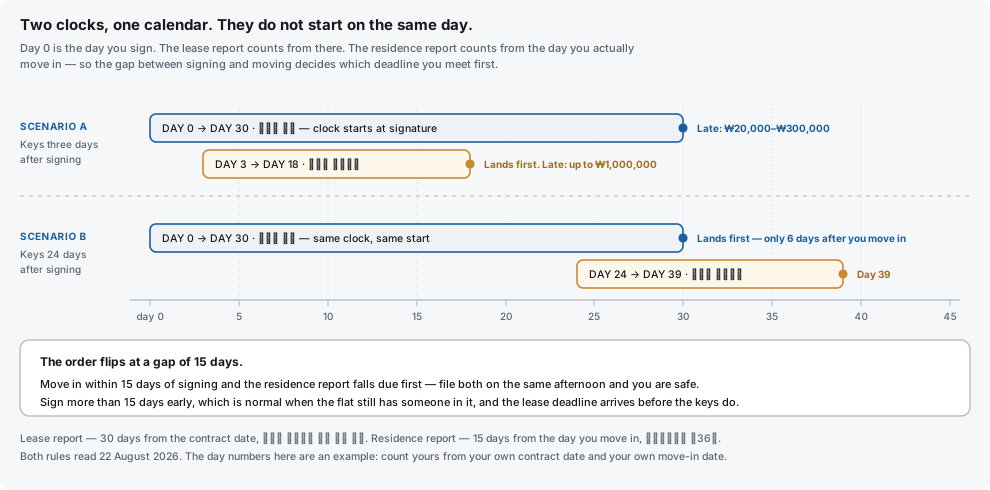
If you sign and move in the same week, the residence report comes due first and you can knock both out in one visit. If you sign a month before the previous tenant leaves — completely normal here — the lease deadline arrives while you are still living somewhere else. That is the trap. Nothing about moving day reminds you of a clock that started when you signed.
Does your contract even count?
Two things decide it — the money and the map — and the money catches nearly everybody.
A contract is reportable if the deposit is over ₩60,000,000 or the monthly rent is over ₩300,000. Or. Not and. This is the single most misread line in the rule, and it is misread in both directions — people with a ₩10,000,000 deposit assume they are far under the threshold and stop reading.
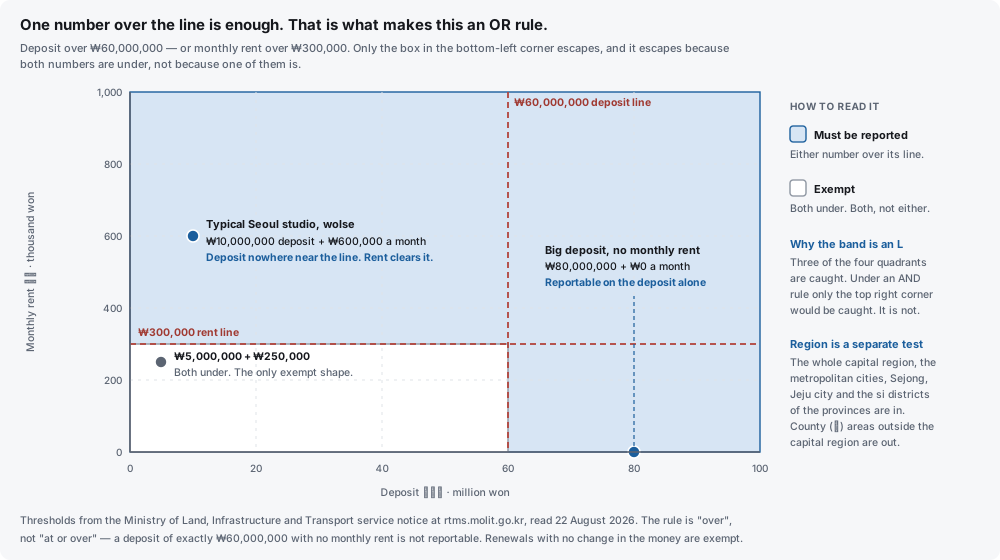
A typical Seoul studio on a monthly-rent contract runs ₩500,000 to ₩900,000 a month. Every one of those is over ₩300,000. The deposit stops mattering at that point — the rent has already put you inside the reportable band. If you are renting a room in Seoul, assume you are in scope and look for a reason you are not, rather than the other way round.
Then there is the map, which lets a much smaller number of people off. The rule covers the whole capital region, the metropolitan cities, Sejong, Jeju city, and the 시 districts of the provinces. What it does not cover is 군 areas outside the capital region — so a rural county lease is genuinely outside the scheme. The Ministry of Land, Infrastructure and Transport publishes both the money thresholds and the covered areas on its real estate transaction system, read there in August 2026, and that is also where an online filing would go.
A renewal with no change in the money is not reportable — same deposit, same rent, nothing to file. Certain short-term and dormitory arrangements are carved out as well, though I could not find the exact wording of that carve-out stated anywhere in English, so if your contract is unusually brief, ask at the 주민센터 rather than assume it covers you.
What most English guides still say about the fine
Search this in English and you will be told, confidently, that there is a grace period, that no fines are being issued, and that the maximum is ₩1,000,000. All three of those were true in 2021. None of them describe 2026.
The 2021 numbers against the ones in force now:
| Old figure, still quoted everywhere | Current, since 1 June 2025 | |
|---|---|---|
| Grace period | Running, no fines issued | Ended 31 May 2025 |
| Late filing | ₩40,000 – ₩1,000,000 | ₩20,000 – ₩300,000 |
| False filing | ₩1,000,000 | ₩1,000,000, unchanged |
The government's own policy briefing confirms the reduction — from a ₩40,000–₩1,000,000 band down to ₩20,000–₩300,000 for a late filing, with the ₩1,000,000 figure surviving only for filings that are knowingly false. Which is a fairly important distinction, because the old ceiling is exactly the number that scares people into paralysis.
Where inside that ₩20,000–₩300,000 band you land depends on the contract amount and how late you are. Nobody publishes the full bracket table in English as far as I can tell, and reconstructing one from guesswork would be worse than leaving the gap — if the exact figure matters, the statutory framework is summarised in Korean on the government's plain-language law portal, and the 주민센터 counter will tell you the actual figure before you pay anything.
The 전입신고 you are not allowed to do
This is where English guidance stops being merely out of date and starts being unusable.
Almost every guide to protecting a Korean deposit tells you to do two things: get a 확정일자, and do 전입신고. The second instruction cannot be followed. 전입신고 is a move-in notification filed against the resident registration system (주민등록), and foreign residents are not on that system — you have an Alien Registration Card and a residence status instead, which is the same identity infrastructure your visa runs on.
What substitutes for it is Article 88-2(2) of the Immigration Act, which says in one line that foreign registration and change-of-residence reporting stand in for resident registration and 전입신고. That is not a courtesy reading. The Supreme Court has confirmed twice that a foreign resident's 체류지 변경신고 satisfies the residence requirement for opposing power (대항력) under Article 3(1) of the Housing Lease Protection Act — 2015다14136, decided 13 October 2016, and again in 2015다254507 on 11 April 2019.
So the instruction that actually works for a foreign tenant is: file the lease report to get the 확정일자, file the change-of-residence report to get the 대항력. The renting guide on this site used to say "register your residence at the address" — right in substance, vague in the one detail that decides whether you are covered. It now names the 체류지 변경신고 and the 15-day clock.
While we are correcting things: several district office English pages still print that deadline as 14 days. The Act was amended in March 2016 and it has been 15 ever since — 15 days from the day you move in, under Article 36(1). You can file it at the 시·군·구 or 읍·면·동 office covering your new address, not only at an immigration office, and you take the ARC and the lease contract with you.
The penalty here is a different animal from the lease report's. A late lease report draws an administrative 과태료; failing to file the change of residence sits under Article 98 of the Immigration Act, which is a penal fine of up to ₩1,000,000. What actually gets charged for being a few days late is not published in any English source I could check, so read the million as a ceiling and not as a bill. If you want the deadline confirmed against your own status, the Immigration Contact Center answers in English on 1345 and the procedure sits on HiKorea, which also takes the filing electronically.
Filing it: the office beats the website
The 주민센터 is the dull answer and the correct one. Walk in with the signed contract and your ARC. The counter files the lease report and, because the contract came with you, grants the 확정일자 in the same transaction — no separate application, no separate fee. Almost every new arrival should be sent down this route, for a reason that has nothing to do with the paperwork itself.
It is the online route that lets you down. rtms.molit.go.kr does handle filings by foreign residents; the trouble is the front door. As of August 2026 the site's own notice says it accepts 간편인증 only and no longer takes a joint certificate. 간편인증 means one of the Korean simple-authentication apps, and those are built on a mobile line registered in your own name — the same wall you hit getting a phone number and opening a bank account in your first fortnight. Whether an Alien Registration Number passes cleanly through every provider, I cannot promise. Expect to end up at the counter in person, and be pleasantly surprised if you do not.
When the landlord would rather it went unreported
The duty is joint. On paper both sides file together.
In practice, one side can file alone — attach the contract and a single-party filing is accepted. That provision exists precisely because the two sides do not always want the same thing. A reported lease is a visible lease, and a visible lease is visible rental income. Some landlords are slow about this for reasons they will not state out loud.
You do not need their cooperation, their seal, or their blessing. You need the contract you already have. And filing it yourself is not an aggressive act — it is the only way the 확정일자 gets attached to your own deposit.
What each piece of paper actually buys you
They are not interchangeable. Nobody at the counter explains the difference, because from that side of the glass it is too obvious to say out loud.
The 확정일자 timestamps your deposit claim against the property. If the place goes to auction, your priority runs from that date — which is why a week's delay is a week of standing behind somebody else in the queue.
The 체류지 변경신고 gives you 대항력: the right to stay put and be recognised as the tenant even if the property changes hands. Without it, a new owner is not obliged to notice you exist.
You need both. Doing one and skipping the other is the most common way people end up half protected without knowing which half.
The version that goes wrong least
Book one afternoon at the 주민센터 within a week of signing — not within thirty days, within a week — and take the contract and the ARC. If the keys are not yet yours, file the lease report anyway and go back for the residence report after you move.
The mistake worth naming is not a missed deadline. It is hearing the agent's single word 신고 as "handled" when what it meant was "mentioned".
Figures and deadlines verified 22 August 2026 against the Ministry of Land, Infrastructure and Transport, the government policy briefing service, and the Immigration Act. Thresholds and penalty schedules change — if you find something here has moved, tell me. General information, not legal advice; see terms.
Frequently asked questions
Do I have to report my lease in Korea if my landlord already did?
No. The duty is joint, so one filing by either side satisfies both of you. Ask the landlord or the agent for the 신고필증 — the filing receipt — and keep a copy, because that piece of paper is the only proof you have that the deadline was met.
What is the fine for reporting a lease late in Korea?
For contracts signed on or after 1 June 2025, a late filing draws ₩20,000 to ₩300,000 depending on the contract amount and how late you are. A knowingly false filing is a separate matter and can reach ₩1,000,000.
Can a foreigner do 전입신고 in Korea?
Not as such. 전입신고 sits on the resident registration system, which foreign residents are not on. Instead you file a change-of-residence report (체류지 변경신고) within 15 days of moving in, and Article 88-2(2) of the Immigration Act treats that as standing in for 전입신고.
Does reporting my lease give me 확정일자 automatically?
Yes, if you attach the signed contract to the filing. The confirmed date is granted as part of the lease report, with no separate application and no separate fee. If you file without attaching the contract, you do not get it.