How to Book a Korean Intercity Bus Without a Korean Card
There is a particular kind of panic that happens at Seoul Express Bus Terminal about eight minutes before departure. You have a ticket, printed in Korean. You are standing inside a building called 고속터미널. Your bus is not here — it is in the other building, also part of 고속터미널, a few minutes away through a shopping arcade, and nobody mentioned that there were two.
That is the second thing that goes wrong with Korean intercity buses.
The first is the card. You find the route, pick a seat, reach the payment screen, and the transaction dies inside a Korean authentication layer your Visa has never met. No error message that explains anything. Just a failure.
Buses are still the right call for a lot of trips here. Cheaper than the train, and they go to plenty of places the train doesn't. But the friction is all front-loaded, and it sits in three questions: which system, which terminal, which seat.
Express bus or intercity bus? That split decides which site you book on
Korea runs two parallel long-distance bus networks, and they do not share a booking system.
고속버스 (gosok, "express") stays on the expressway from one terminal to the other. No stops in between. These are booked on kobus.co.kr, the joint site for the express bus companies, which has English, Chinese and Japanese modes.
시외버스 (siwoe, "intercity") uses national roads as well as expressways and picks up at towns along the way. Slower, but it reaches places the express network skips. These are booked on bustago, which also has an English site, or on txbus depending on the operator.
The trap here is quiet. You search your destination on kobus, get nothing, and conclude there is no bus. There usually is a bus — it is just a 시외 route sitting on the other site. Small coastal towns, county seats, national park gateways: check bustago before you give up and book a train.
Rough sorting rule. If the destination is a city you have heard of, start with kobus. If it is a place you found on a hiking blog, start with bustago. A few destinations, Sokcho being the classic one, exist on both.
Which Seoul terminal your bus actually leaves from
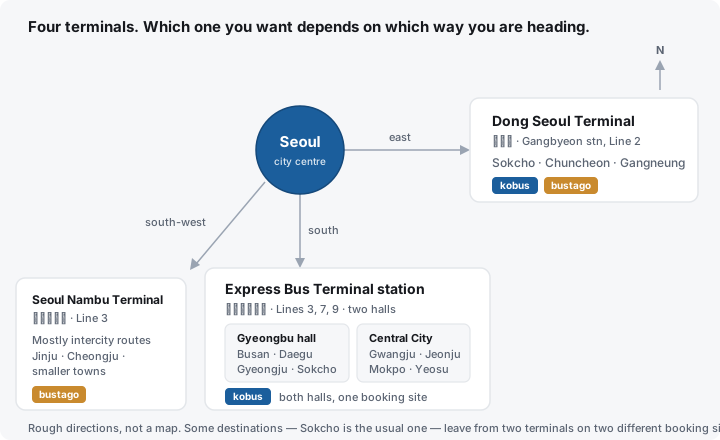
Seoul has four, and they carve up the country by direction rather than by company.
Express Bus Terminal station (고속터미널역), lines 3, 7 and 9. One subway station, two separate terminal halls. The Gyeongbu hall sends buses down the Gyeongbu corridor — Busan, Daegu, Gyeongju — and along the Yeongdong expressway to the east coast. Central City, attached to the Shinsegae department store complex, handles the Honam side: Gwangju, Jeonju, Mokpo, Yeosu. Both book through kobus, and both are signposted in English as "Express Bus Terminal", which is exactly the problem. Your ticket names the hall in Korean. Learn to spot 경부 and 호남.
Dong Seoul Terminal (동서울종합터미널), at Gangbyeon on line 2. Everything east and north-east: Sokcho, Chuncheon, Gangneung, the Gangwon mountains. It carries both express and intercity services. A large redevelopment has been announced for the site, with a temporary terminal to run during construction, so if you are reading this well after 2026, confirm the address before you set off.
Seoul Nambu Terminal (서울남부터미널), at Nambu Bus Terminal station on line 3. Mostly 시외 routes — Jinju, Cheongju, and a long list of smaller places. If your destination never appeared on kobus, there is a fair chance the bus goes from here.
Give yourself more time than the subway app suggests. Express Bus Terminal station is enormous and the shopping street underneath it is disorienting; the walk to the right hall can take longer than the ride there from Gangnam. The Seoul subway guide covers exit numbers, which matter more here than usual.
Three seat grades, and when the upgrade is worth it
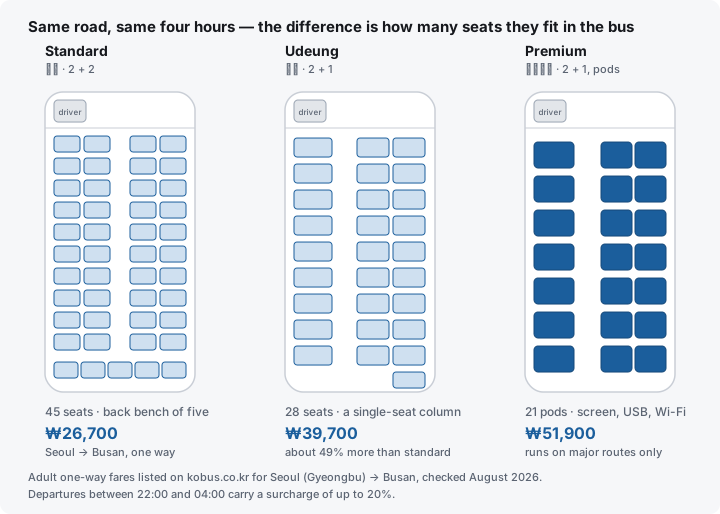
Same road, same driver, same four hours. What you are buying is floor space.
일반 (standard) is a 2+2 grid, 45 seats, including a five-across bench at the back that you should avoid if you get to choose. Fine for an hour. Long enough and you will feel every one of those 45 seats.
우등 (udeung) drops to 28 seats in a 2+1 layout, which means one column of the bus is single seats with nobody beside you. This is the default grade on most long routes now, and on some routes it is the only grade running.
프리미엄 (premium) is 21 pods with a personal screen, USB power, Wi-Fi and a recline that goes much further back. Major corridors only.
Seoul to Busan, as listed on kobus in August 2026: ₩26,700 standard, ₩39,700 udeung, ₩51,900 premium, one way, adult. Night departures cost more again: kobus prices 심야 (late-night) and 할증 (surcharge) versions of each grade separately, which is why the fare panel on the booking page lists eight numbers instead of three. Read it before you pick the 23:00 bus. Fares are revised periodically — check your own date rather than trusting this paragraph in 2028.
My rule, for what it is worth: under two hours, standard. Over three, udeung. Premium only if the plan is genuinely to sleep, because otherwise you are paying about ₩12,000 extra for a screen you won't watch.
Booking online, and where a foreign card gets rejected
The booking flow itself is not the hard part. Kobus has an English interface, you pick origin, destination, date and grade, and then a seat map opens and you tap a seat. Booking without an account asks for your date of birth as six digits (YYMMDD), which works fine with a foreign one.
Payment is where it falls apart. Korean card payment runs through domestic authentication that overseas-issued cards frequently cannot complete, and the failure is silent rather than explanatory. Travellers report this constantly, on the express side and the intercity side both. I would not call it universal — some cards go through — but plan for it rather than around it.
Three things nobody mentions until you are standing there.
Kobus's booking notes say that if you pay online and collect the ticket at a window, you have to bring the card you paid with. A ticket bought on a friend's card, with the friend at home, is a problem at the counter rather than a formality.
WOWPASS is not the workaround people claim it is. The prepaid card sold from kiosks around Seoul is built for tapping in shops and topping up transit, and travellers report it failing on Korean booking sites in much the same way a foreign Visa does. Check what it currently supports on wowpass.io before you plan a trip around it.
The Korean mobile route is T-money GO (티머니GO), which sells both express and intercity tickets and is what most people here actually use. It expects Korean payment methods too — so it solves the language problem, not the card problem.
If the card is refused twice, stop. You have not done anything wrong, and the next section is the answer.
Buying at the terminal: the counter, not the kiosk
Every terminal has both. The self-service kiosks are fast, and they are the reason foreign cards get declined in public. The staffed ticket window (매표소) sits behind them, usually with a shorter queue than you would expect, and it is the one that works.
Cash always works, and terminals have ATMs, usually clustered near the ticket hall.
What to have ready, because the exchange takes about forty seconds and neither of you wants to extend it:
- Your destination written in Korean on your phone screen. Not spoken. Hand the phone over.
- The departure time you want, or "다음 차" — next bus.
- How many people.
- The grade. Say "우등" if you want it, or you may get whatever leaves soonest.
The clerk usually turns a screen around so you can pick a seat. The front half is smoother and quieter; the back sits over the engine, next to the toilet on the buses that have one.
Arrive 20 to 30 minutes early on a weekday. On a Friday evening, a Sunday afternoon, or near a public holiday, book ahead instead — those departures genuinely sell out, and watching full buses leave is a bad way to spend an afternoon.
What actually happens on board
Boarding is by platform number, printed on the ticket, and the platform is where the confusion lives: several buses queue at adjacent bays and the destination signs are in Korean. Show your ticket to the driver. You will get waved on, or pointed at the right bus.
Most buses have no toilet. On anything over about two hours the driver stops at a highway service area (휴게소) for roughly 15 minutes, and this is where people get left behind. The announcement is in Korean. The departure time is often just said out loud, or written on a card propped in the windscreen.
Two habits fix it. Photograph the bus's number plate before you step off, and check the dashboard clock on your way out so you know what "15 minutes" means to that driver. Then come back five minutes early. The 휴게소 food is genuinely good — hotteok, corn dogs, tteokbokki — but eat it standing near your bay rather than in the seating area at the far end.
Curtains stay closed, phone calls are short and quiet, and shoes generally stay on. Nobody will say anything if you get it wrong. You will just notice you are the only one doing it.
Refunds, holiday sell-outs, and when the bus beats the train
Cancellation fees across the express bus network were restructured on 1 May 2025 and now vary by day type rather than applying one flat scale all year, per the ministry announcement:
| When you cancel | Mon–Thu | Fri–Sun, holidays | Seollal / Chuseok |
|---|---|---|---|
| 2+ days before | Free | Free | Free |
| 1 day to 3 hours before | 5% | 7.5% | 10% |
| Under 3 hours before | 10% | 15% | 20% |
Missing it outright is the expensive part. The post-departure fee is 60% in 2026 and steps up to 70% in 2027 under the same reform, and once the bus has passed its scheduled arrival time there is no refund at all. Cancel early and it costs nothing. Cancel from the back of a taxi and it costs real money.
The holiday weeks are a separate sport. Seollal and Chuseok tickets go on sale on an announced date several weeks ahead and disappear fast. Do not improvise those.
As for bus against train — on Seoul to Busan the KTX wins easily. Around ₩59,800 in standard class in 2026, for roughly two hours forty, against ₩39,700 and about four and a quarter hours on an udeung bus. The bus only makes sense on that corridor if you are taking the late-night service and treating it as accommodation.
Where the bus wins is where there is no train at all. Sokcho is the clearest case: no passenger rail line from Seoul as of 2026, and the Chuncheon–Sokcho line is still under construction. The bus takes about two and a half hours, and udeung was listed around ₩21,000 in August 2026. Same logic for most of the east coast and the smaller Jeolla towns.
The version I'd give a friend
Work out whether it is 고속 or 시외 first, because that decides the website. Try booking online, but give it one honest attempt and no more. If the card is refused, go to the terminal, walk past the kiosks, and buy at the window with your destination written in Korean on your phone. Take udeung on anything long. Get back to the bus early at the service stop.
Keep a T-money card topped up as well. You will want it the moment you step off at the other end, and the local bus outside a provincial terminal is not going to take your Visa either.
Fares, seat counts and cancellation rules checked August 2026 against kobus.co.kr, bustago and the ministry notice above; terminal details cross-checked against Visit Korea. Korean bus fares are revised periodically — confirm on the booking site for your own date. Corrections via contact.
Frequently asked questions
Can I buy a Korean intercity bus ticket with a foreign credit card?
At a staffed ticket window, almost always yes — and cash always works. Online is the unreliable part: kobus.co.kr and bustago run payments through Korean card authentication, and overseas cards are widely reported to fail at that step. Try it, but have a fallback.
Do I need to book in advance, or can I just turn up at the terminal?
On weekdays, arriving 20 minutes early is usually fine on major routes, which run every 20 to 40 minutes. Friday evenings, Sunday afternoons and the Seollal and Chuseok holiday weeks are the exceptions — those genuinely sell out, and holiday tickets go on sale on an announced date weeks ahead.
Is the 우등 (udeung) seat worth the extra cost?
For anything over about three hours, most people say yes. Udeung buses carry 28 seats in a 2+1 layout instead of 45 in a 2+2 grid, so the seat is wider and reclines further. On a short hop of an hour or two, the standard seat is fine and the money is better spent elsewhere.
Which Seoul terminal do I go to for Sokcho, Busan, or Jeonju?
Busan leaves from the Gyeongbu hall of Seoul Express Bus Terminal, and Jeonju from Central City next door — both at Express Bus Terminal station on lines 3, 7 and 9. Sokcho runs from both that terminal and Dong Seoul at Gangbyeon on line 2, so check which one your ticket says.