Shipping From Korea to the USA: What the Post Office Charges
The box weighs 2 kg, the address is in block capitals, and the EMS postage to the US is ₩68,500, roughly $49 at ₩1,400 to the dollar, before anyone has mentioned duty. Then the clerk asks what no Korean post office asked two years ago: what exactly is in it, item by item, and what is each thing worth? For anyone sending things home to the US, that question now decides the bill, because the US duty is calculated and paid in Korea, at the window, before the parcel leaves. The postage figure is from Korea Post's 2026 rate table.
Every other country still works the old way. That split is the thing to understand first.
Can you still mail a box from Korea to the US?
Yes, but it went dark twice before it came back.
The US ended duty-free treatment for low-value imports from every country on 29 August 2025, according to CBP's own fact sheet. Korea Post had already stopped accepting US-bound goods on 25 August. Plain letters and documents, which need no customs declaration, kept going. On 22 September 2025 the counter reopened with a new rule: the sender prepays the US duty, through a customs broker approved by US Customs and Border Protection (klnews report). Within days a fire at the government data centre took the system down again, and US mail only came back on 22 October 2025. Korea Post's reopening notice lists EMS, air and sea parcels, and K-Packet.
Most English guides stop there. A lot has happened since, and nearly all of it changes what you pay.
In February 2026 the US Supreme Court ruled that the emergency-powers law behind the 2025 tariffs did not let the President impose them. The duty-free suspension survived: an executive order signed the same day kept it, and a temporary 10 percent surcharge for up to 150 days covered postal goods in the meantime. Then on 24 June 2026 CBP published a rule for mail imports that took effect 30 days later, on 24 July. Under it, postal goods worth $2,500 or less are assessed for all applicable duties by their full 10-digit US tariff code, through a licensed broker or the owner, with filing and payment to CBP done monthly. Duties are no longer collected from the addressee on delivery.
Korea Post posted three notices about that change in nine days. The 20 July notice said the flat 10 percent was being replaced by item-by-item rates, and that sender-paid duty now covered parcels up to $2,500 instead of $800. The 24 July notice cited a US "forced labour" tariff announced at 6 a.m. that day. The 29 July notice listed goods the counter will refuse. The 20 and 24 July details are in PDF attachments. Open them before you go. They are the official word, and this article is a summary.
EMS, K-Packet, or the slower parcel
Prices below are the US column of Korea Post's 2026 table (checked 15 October 2026). The EMS figures are the non-document rates, which the table says already include the additional transport surcharge.
| Weight | EMS (goods) | Air parcel |
|---|---|---|
| 2 kg | ₩68,500 | ₩37,000 |
| 5 kg | ₩128,500 | ₩71,000 |
| 10 kg | ₩233,500 | ₩128,000 |
| 20 kg | ₩441,000 | ₩242,500 |
At 10 kg the gap is ₩105,500, about $75. If the box is clothes and books going home after a two-year contract, the air parcel saves real money. If it holds something with a deadline, like a signed form, it does not.
Small things have two more options. K-Packet to the US runs ₩23,430 for 1 kg and ₩45,690 for 2 kg. It is a product aimed at online sellers, so ask whether the counter will sell it to you as a walk-in. The small-packet rate (항공소형포장물) is ₩18,230 for 1 kg and ₩33,810 for 2 kg. Korea Post's December 2025 notice warned that letter post to the US is for things that are clearly documents. Photo cards, booklets and calendars sent that way were being returned by US customs as goods.
Sea parcels are the slow option. The surface-parcel table puts the US in zone 3, at ₩43,000 for 10 kg. That is about a third of the EMS price. Sea parcels were on the October 2025 reopening list, and the prepaid-duty rules apply to them just the same. Ask the counter whether they're being accepted that day and how long they're taking.
What you pay at the counter
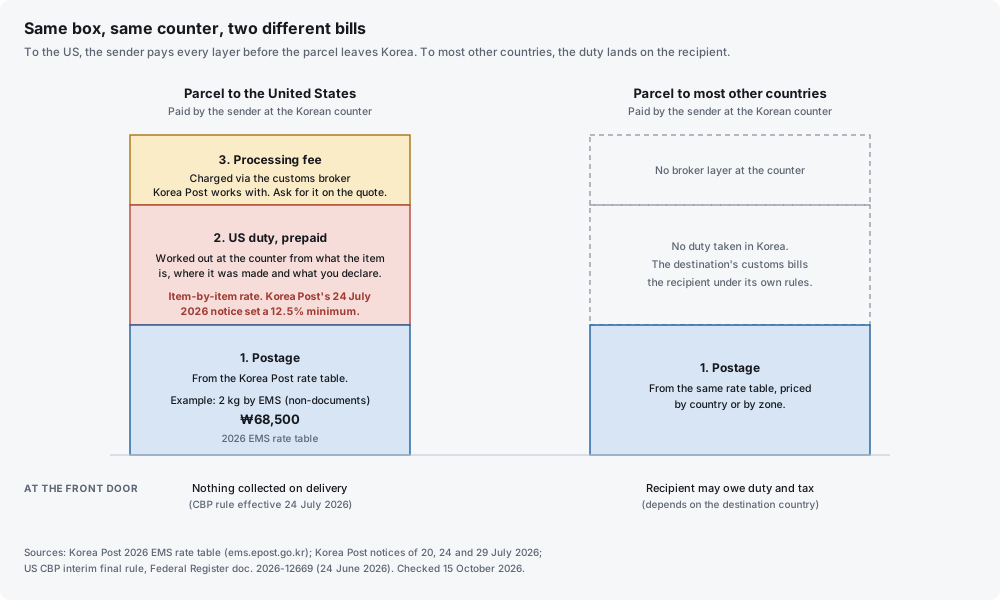
Three layers, one receipt.
Postage is the table above.
Duty has changed rate four times in a year. In October 2025 Korea Post put Korean-made goods at about 15 percent on average. In February 2026 a Korea Post notice headed "15 to 10%" marked the switch to a flat 10 percent. On 24 July 2026 it became item by item, and Korea Post's notice that day set a 12.5 percent minimum under the forced-labour tariff. Its examples were cosmetics, up from 0 to 12.5 percent, and a T-shirt at its own item rate of 16.5 percent. Treat those as July figures, not a promise. The counter calculates the real number on the day you send, from the code for each item and where it was made. The notices link to a rate lookup on kita.net, the Korea International Trade Association site, if you want to check an item in advance.
The processing fee goes to the broker Korea Post works with. Korea Post's October 2025 notice set it at $1.04 per parcel plus 10 percent of the duty, VAT extra, for parcels between $100 and $800. Gifts under $100 paid the $1.04 alone. The klnews report worked that out at about ₩3,250, VAT included, on a ₩100,000 item, against ₩15,000 to ₩25,000 at private couriers. Since July the sender-paid limit has gone up to $2,500, and brokers now do more work per parcel, so ask for the fee as a separate line on your quote rather than assuming the 2025 formula.
Payment is easier than it was at the restart. Korea Post's 8 December 2025 notice added credit cards to cash and bank transfer. It has to be the physical card, though; phone wallets like Samsung Pay were not accepted. Duty on a card is charged together with the postage.
Filling in the customs form
The CN22 or CN23 is where the duty comes from, so it is where the time goes. Korea Post wants item name, quantity, value, HS code and country of origin on every line, with values preferably in US dollars. Its own example of a bad item name is "clothes", and a good one is "men's cotton shirt". Write the rest the same way: "ceramic mug", "printed book". "Gift", "snacks" and "cosmetics" are not item names.
Then check the refused list. The 29 July notice says the counter will not accept anything whose US tariff code begins with one of a set of six-digit codes for quota goods. In plain words: sugar products, tuna including canned, some citrus and peanut products, beef, infant formula, chocolate, cheese, milk powder, condensed milk, ice cream and other dairy, and animal feed. Chemicals, nickel and zinc products also appear on its target list, along with a separate attachment of anti-dumping and countervailing duty codes. EMS Premium can still take some of these goods, but not food.
Chocolate is the one that catches people. So is soju. The CBP rule sends alcoholic drinks and tobacco to formal entry, and a gift parcel at a post office window is not set up for that.
Gifts under $100, and the company-logo trap
The US still exempts "bona fide gifts" worth $100 or less sent from someone abroad to someone in the US. The June 2026 rule says in terms that it does not touch that exemption, and Korea Post's 24 July notice repeats it. The legal wording is in 19 CFR 10.152.
Korea Post's October 2025 notice says the exemption is applied very narrowly, and lists cases that do not count as gifts:
- the sender's name is a company, or the box carries a company name or logo
- the contents are new goods, still boxed, in plastic or with clothing tags on
- one person sends the same item to several people
- the item is a freebie that came with a purchase, such as a sample or bonus gift
A gift set from your employer, still in the logo box, fails twice. Unbox and repack it. The same notice allows writing "Unsolicited Gift" in red on the outside and enclosing a short note saying it is a gift. Even a valid gift pays the small declaration fee, so the counter bill will not be zero.
What happens if you under-declare
Writing ₩30,000 on a ₩150,000 jacket lowers the duty at the counter. It also puts the parcel in exactly the category the new US process exists to catch: CBP describes the July 2026 rule as a way to "police undervaluation, evasion, and fraud."
Korea Post is blunt about the cost. Before accepting a US parcel it asks you to sign a consent form. Its October 2025 notice says that a parcel with missing or false contents information can be returned or destroyed, that US customs makes the final call, and that no compensation is paid. A return can carry a return-handling charge, and the duty, broker fee and postage are not refunded. Declare the real value, keep the receipt, and photograph the contents before you seal the box.
Shipping to countries other than the US
Everywhere else, the familiar arrangement still holds. You pay postage at the counter, the parcel travels, and the destination's customs bills the recipient for any duty and tax under its own rules. The US change didn't touch that. Guam and the other US territories are a half-way case: Korea Post's 2025 table had the recipient paying there, with Puerto Rico treated like the mainland.
What does change is availability. Check Korea Post's EMS notice board before you tape anything. In the first half of October 2026 alone it announced that acceptance to Argentina (7 October) and Saudi Arabia (12 October) had stopped, and that Venezuela had reopened on 2 October after a September suspension.
If you are packing up to leave Korea for good, the box is one item on a longer list. Check whether there is a refund hiding in your bills when you move out, and if you bought big-ticket items as a tourist rather than a resident, the VAT refund at the airport is the cheaper way to carry them home. Going the other direction, parcels coming into Korea need a working personal customs code, which now expires.
The short version, as of October 2026: weigh the box at home, list every item in English with its real value, read the July notices, and bring a physical card. The counter does the arithmetic. Your job is to give it numbers that will hold up when US customs looks at them. For anything this article leaves open, Korea Post's customer centre is 1588-1300, weekdays 9:00 to 18:00.
Frequently asked questions
Does the person receiving my parcel in the US have to pay anything?
Normally no. Korea Post collects the US duty from the sender at the counter, and its July 2026 notice says this now covers parcels valued up to $2,500 (it was $800 before). The CBP rule in force since 24 July 2026 says duties will no longer be collected when postal shipments are delivered. Two exceptions in Korea Post's October 2025 guidance: Guam and the other US territories except Puerto Rico follow separate rules, and the recipient pays there. If a bill does turn up at a US door, keep your counter receipt and call Korea Post on 1588-1300.
Can I pay the duty at the post office by card?
Yes, since December 2025. Korea Post's notice of 8 December 2025 added credit cards to cash and bank transfer, with two conditions: it has to be a physical card (Samsung Pay and other phone wallets were not accepted), and duty paid by card goes through in the same payment as the postage, not separately. Payment rules change, so if it matters, check with Korea Post on 1588-1300 before you go.
How heavy can a box to the US be?
Korea Post's 2026 rate table prices EMS to the US up to 30 kg, where the non-document rate is ₩650,000, and air parcels up to 20 kg at ₩242,500. Size limits and any country-specific restrictions sit on the EMS site's country conditions pages, so check those before you pack a box near the limit.
How long does EMS from Korea to the US take?
There is no reliable fixed number to quote, and the US entry process changed in July 2026, so an old figure from a forum is not worth much. Korea Post publishes delivery-day estimates per destination on the EMS site's delivery-time and rate lookup page (배달소요일/요금조회). Use that, and ask the counter whether US parcels are running behind.