Returning Things in Korea: The 7-Day Rule and Its Limits
There's a sign taped to the till of half the clothing shops near Mangwon Market: 교환만 가능 — exchange only. Stand in front of it with a jacket in a bag and a receipt from two days earlier, and every instinct says no country can let a shop just refuse refunds like that.
Korea can. That sign is completely legal.
Here is the stranger part: buy the same jacket from the same brand online, and the shop could print "ALL SALES FINAL" across the checkout page in red capitals and it would mean nothing. The law hands you seven days to send it back anyway.
Everything about returning things in Korea flows from that one split. Not the store's mood, not how politely you ask — where the purchase happened.
The split: online buyers get a law, in-store buyers get a sign
Distance sales — shopping malls, apps, Naver Smart Store, an Instagram seller taking bank transfers — fall under the Act on the Consumer Protection in Electronic Commerce (전자상거래 등에서의 소비자보호에 관한 법률). Article 17(1) gives you seven days to withdraw from the purchase, no reason required. The government's own English-language legal portal spells this out, and the Korean statute text is on the national law database if you want the original. An official English translation exists too — search "Act on the Consumer Protection in Electronic Commerce" at elaw.klri.re.kr.
Crucially, Article 35 of the same act voids any contract term that treats you worse than the statute does. That is why the red-capitals scenario fails: a "no refunds" clause in an online seller's terms is not a policy you agreed to, it is dead text.
Walk into a physical shop and all of this evaporates. There is no cooling-off statute for over-the-counter purchases. If the owner says exchange only, that is the rule. If the receipt says refunds within three days, that is the rule. Department stores taking things back for weeks? Custom — good custom, reliable custom, but custom.
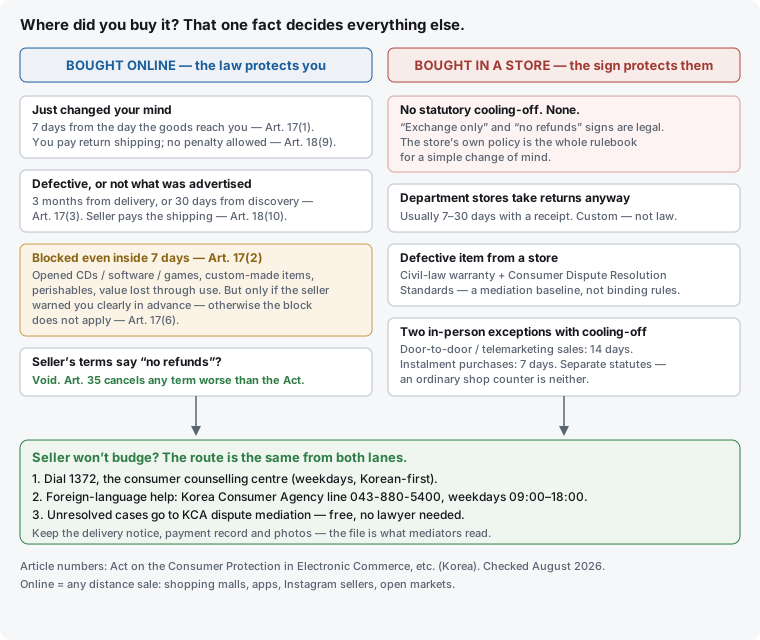
There are two in-person exceptions worth knowing, mostly so you don't misapply them. Door-to-door and telemarketing sales carry a 14-day withdrawal right under a separate statute (the one that protects people signed up for water purifiers in their own living rooms), and instalment contracts carry 7 days under the instalment transactions act. A normal shop counter is neither.
How the seven-day clock actually runs
The period runs from the day the goods reach you — technically from the written contract details, but since delivery almost always comes later, delivery is the day that matters in practice (Article 17(1)).
Three pieces of fine print decide the close cases.
Weekends stretch the deadline. Korean period-counting follows the Civil Act, and Article 161 pushes any deadline landing on a Saturday or public holiday to the next working day. A parcel delivered on a Monday before Chuseok week can effectively buy you extra days. Don't plan around this — couriers and seller systems don't always count generously — but if a seller rejects you on day eight after a holiday weekend, you may not actually be late.
Missing seller info restarts the clock. If you never received the contract details, or the seller's address wasn't in them, the seven days run from the day you found out — or reasonably could have found out — the seller's address (Article 17(1) item 2). This is the clause that matters with sketchy Instagram sellers who vanish behind a business name.
Withdrawal costs nothing but shipping. For a change-of-mind return the seller cannot charge a penalty or claim damages (Article 18(9)). Restocking fees, "open-box fees" on an unopened box, cancellation charges — none of it survives the statute. Once your goods arrive back, the refund is due within three business days, with statutory interest accruing if the seller sits on it.
One correction to something you'll read in English-language forums: there is no general three-month extension just because the seller failed to mention your withdrawal rights. That rule belongs to the door-to-door sales act. For online purchases the extension mechanism is the address rule above — narrower, but real.
Seven days is not seven days for everything
Article 17(2) carves out goods where a return would gut the product's resale value. The list is short and mostly intuitive:
- Sealed media you've opened — CDs, DVDs, games, software. Breaking the shrink wrap ends it.
- Goods made to your order. That custom name-stamped ring is yours now.
- Perishables and anything whose value collapses with time. Meal kits, cut flowers.
- Items damaged or visibly used by you — though opening the packaging just to inspect the item is explicitly not "damage."
- Digital content once streaming or download has begun.
But the carve-outs come with a catch that works in your favour: Article 17(6) requires the seller to have warned you clearly — on the packaging, in the listing — that the item is non-returnable, or to have offered a trial version. No clear warning, no exception. Quote 17(6) when a seller invokes an exception — most listings genuinely don't carry the required notice, and the argument tends to end right there.
Cosmetics are the grey zone: an unopened serum returns fine within seven days; an opened one is "used" and generally gone. If you're stockpiling K-beauty, check manufacture dates on the packaging before the window closes, not after.
Broken or not as advertised: the longer clock
Change of mind is the weak claim. A defect — or a product that doesn't match its listing — is the strong one, and it gets a much longer runway under Article 17(3): three months from the day you received the goods, or 30 days from the day you discovered (or could have discovered) the problem, whichever helps you.
The "not as advertised" branch is broader than people expect. Wrong colour shipped, a "cotton" shirt that's polyester, a listing photo showing four pieces when the box holds two — all of it qualifies. You are not begging for goodwill; you are exercising Article 17(3), and the shipping cost lands on the seller (Article 18(10)).
Screenshot the listing the day you order anything expensive. Sellers edit listings, and the version you bought against is the version that counts. Four seconds of effort, and it decides more disputes than any article number.
Coupang and friends: policies more generous than the law
The statutory seven days is a floor, and the big platforms build well above it. Coupang's published change-of-mind window has been 30 days — the Korea Times covered the policy and its tightening — with the predictable conditions: powered-on electronics, opened cosmetics, and de-tagged clothing can be refused. Check the current wording in the app before relying on day 29.
The mechanics on Coupang are genuinely painless for change-of-mind returns: request in the app, leave the item at your door, a driver collects it, and the return shipping fee is deducted from the refund unless the item was defective.
If you're still setting up accounts and payment on Korean platforms, the online shopping walkthrough covers the identity-verification maze that comes before any of this.
When the seller just says no
The escalation path is the same for a Gmarket seller and a neighbourhood boutique, and it is free at every step.
Start with 1372, the national consumer counselling centre (www.ccn.go.kr), weekdays only. Counsellors phone sellers, and a surprising number of disputes die right there — a call from 1372 signals that you know the article numbers. The line is Korean-first; I wouldn't count on English on a random weekday morning.
For English, the Korea Consumer Agency runs a dedicated foreign-consumer line — 043-880-5400, weekdays 09:00–18:00, advertised as covering English, Chinese, Vietnamese and more than a dozen other languages via interpretation. The number appears on Korean government pages as of 2026, but I'd double-check it on kca.go.kr before dialling, since it has been published inconsistently over the years.
If counselling fails, the case moves to KCA dispute mediation — still free, no lawyer, decided on the paper trail. Which is why the paper trail is the actual job: delivery notification, payment record, the listing screenshot, your withdrawal request with a visible date. Send the withdrawal request in writing (app message or email, not a phone call) so the date is provable. Mediation outcomes aren't court judgments, but sellers overwhelmingly comply because the alternative is small-claims court against a documented file.
In-store, play a different game
Since the law is silent, the store's incentives are the only lever. What actually works:
Ask about the return policy before paying, out loud, at the till — 환불 되나요? (hwanbul doenayo — is a refund possible?). Korean shops answer this honestly because the sign behind the counter binds them to whatever they say. Keep the receipt; without it even a department store's generous customary window slams shut.
Department stores (Lotte, Shinsegae, Hyundai) honour returns on most goods for a week or more with a receipt, and their customer-service desks will often override a brand boutique's reluctance. Use the desk, not the boutique. But know what you're invoking: house policy, maintained because refund generosity sells luxury goods — not a right you can insist on.
Small shops and markets are exchange-only country, and arguing statute at a Dongdaemun stall will get you nowhere, because the stallholder is correct.
One consolation for tourists: an in-store purchase you can't return may still shed its 10% VAT on the way out of the country — the tax refund process works regardless of the store's return policy.
The habit that ties all of this together: decide where to buy based on how sure you are. Confident about size and colour? The Mangwon shop is fine, and often cheaper. Any doubt at all? Order it online — even from the same brand — because seven days of statutory regret is worth more than a marginal discount. As of 2026 the article numbers above are current; statutes move, so for anything expensive, confirm against the English legal portal before you rely on my summary.
Frequently asked questions
Can I return something I bought in a physical store in Korea?
Only if the store's own policy allows it. Korean law has no cooling-off period for ordinary over-the-counter purchases, so an 'exchange only' or 'no refunds' sign is fully legal. Defective goods are a different matter — you still have warranty claims under general contract law, and the Consumer Dispute Resolution Standards give mediators a baseline to work from.
How long does Coupang give you to return something?
Coupang's own published window has been 30 days for change-of-mind returns — far more generous than the statutory 7 — but with real conditions: electronics that have been powered on, cosmetics that have been opened, and clothes without tags can all be refused. The 7-day statutory right under Article 17 of the e-commerce act sits underneath as a floor no seller can go below.
Who pays for return shipping in Korea?
It depends entirely on why you are returning. If you simply changed your mind, you pay the return shipping and the seller may not add any penalty on top (Article 18(9) of the e-commerce act). If the item is defective or doesn't match the listing, the seller pays (Article 18(10)). Sellers routinely deduct return shipping from refunds, so check which case you filed under.
What if a Korean online store's policy says 'no refunds'?
The clause is void. Article 35 of the Act on the Consumer Protection in Electronic Commerce cancels any contract term that puts the consumer in a worse position than the Act itself, so the statutory 7-day withdrawal right survives whatever the terms and conditions say. Quote the article number when you push back — it usually ends the argument.