Tax Refunds in Korea: How to Actually Get Yours
Korea refunds value-added tax to departing short-term visitors, and the scheme is genuinely worthwhile — enough to change what a shopping trip costs. It is also easy to lose, almost always for procedural reasons rather than eligibility ones.
Here is how the two routes work and where people forfeit the money.
Who qualifies
Short-term foreign visitors, on goods being taken out of the country, bought at participating stores above the minimum per-receipt amount.
Two exclusions worth stating plainly:
- Residents and long-stay visa holders generally do not qualify. If you hold an alien registration card, the scheme is largely not for you.
- Services do not qualify. Meals, hotels, and transport are not refundable. This is a refund on goods you are exporting.
The two routes
Immediate refund, in store
Participating shops — larger Olive Young branches, department stores, many tourist-facing retailers — deduct the refund at the till.
- Show your passport at the point of payment. Not a photo of it; the physical passport.
- There are per-purchase and cumulative caps on this route.
- Once you exceed the cumulative cap, further purchases go through the airport route.
This is the easy path, and if all your shopping fits under the cap it is the only thing you need to do.
Airport refund
For purchases above the immediate-refund cap or made at stores that do not offer it.
The mechanics:
- Ask for a tax refund receipt at the time of purchase, showing your passport.
- Keep the goods, the receipts, and the passport together.
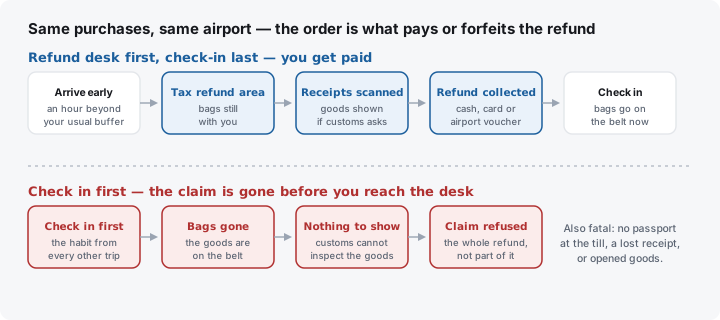
- At the airport, before checking in, go to the customs or refund area.
- Scan the receipts at a self-service kiosk, or queue at a manned desk.
- Collect the refund — cash, card, or airport voucher depending on the kiosk.
Where people lose the money
Almost every failure is one of these five.
Checking bags first. Customs may want to inspect the goods, and once your bag is on the belt you cannot show them. Process the refund before you check in. This is the single most common and most expensive mistake.
No passport at the till. The refund receipt has to be issued against your passport at the moment of purchase. It cannot be added later, and a photo of the passport is often not accepted.
Arriving too late. The refund area at Incheon has real queues at peak departure times. Add an hour beyond your normal airport buffer. Missing the desk because you cut it fine means forfeiting the whole claim.
Using the goods. The refund is on exported goods. Opened, used, or partly consumed items can be refused at inspection.
Losing a receipt. No receipt, no refund, and reprints are not available after the fact. Keep them in one envelope in your hand luggage, not distributed through your bags.
Practical sequencing at the airport
If you have anything to claim, work backwards from your flight:
- Arrive earlier than you otherwise would
- Go to the tax refund area first, with bags unchecked
- Scan receipts / present goods if asked
- Collect the refund
- Then check in
Incheon has refund facilities in both terminals; confirm which terminal your airline uses before planning the route, since moving between them takes time.
The scheme is administered under the Korea Customs Service, which publishes the current thresholds and participating-store rules in English.
Is it worth the effort?
For a small souvenir purchase, no — the paperwork costs more time than the refund is worth.
For a substantial shopping trip, clearly yes. Skincare hauls in particular add up fast, and the refund on top of Korean pricing is what produces the price gap people talk about — see buying Korean skincare in Korea for where to buy it in the first place.
The rule of thumb: if you are buying enough that you are thinking about luggage weight, you are buying enough to claim.
A few details worth knowing
The refund is not the full VAT. It is a percentage of the purchase price after the operator's handling fee. The figure on the shelf label is not what lands in your hand.
Thresholds change. Both the minimum per-receipt amount and the immediate-refund caps are adjusted periodically. Confirm the current numbers at the till rather than relying on any figure you read online, including this page.
Downtown refund kiosks exist. Some districts have refund machines outside the airport. They are convenient, and they still require you to leave the country within a set period with the goods.
Card refunds take time. Cash is immediate; card refunds can take several weeks to appear.
If you are still planning the trip that all this shopping happens on, the four-day Seoul itinerary covers where the shopping districts sit relative to everything else.
Verified August 2026. Thresholds, caps, and participating stores change. This is general information, not tax advice — see terms. Corrections welcome via contact.
Frequently asked questions
Who can claim a tax refund in Korea?
Short-term foreign visitors who are leaving the country, on goods bought at participating stores above the minimum purchase amount. Residents and long-stay visa holders generally do not qualify.
What is the minimum purchase for a Korean tax refund?
There is a per-receipt minimum, and the refund is a percentage of the purchase rather than the full VAT. Thresholds are adjusted periodically, so check the current figure at the till.
Do I need to show the goods at the airport?
Sometimes. Customs may ask to inspect purchases before you check your bags, which is why you should process the refund before checking in rather than after.
Can I get the refund immediately in the shop?
Yes, at stores offering immediate refund, subject to per-purchase and total caps. Above those caps you have to use the airport route.