Your Korean Customs Code Now Expires: The 2026 Renewal
The code is thirteen characters. One letter and twelve digits — the customs service's own example is P240123456789 — and for most foreign residents it lives in a screenshot buried three hundred photos deep, dug out twice a year and pasted into a checkout box next to the word 개인통관고유부호.
Until now that was the entire relationship. Issue it once, use it until you leave the country.
That has changed. Korea attached a one-year validity period to personal customs clearance codes, and the codes that already exist — including the one in your screenshot — have been given an expiry date too. There is no renewal reminder built into the process. The way most people are going to find out is a parcel that stops moving.
What the code actually is, and why your ARC number is not one
A Korean import declaration wants an identity number. For citizens that used to mean the resident registration number, handed to a courier, then to a customs broker, then into whatever database each of them keeps. After enough leaks, the customs service built a throwaway substitute: a code that identifies you for imports and does nothing else. Free to issue, thirteen characters, and if it leaks the damage stops at your parcels.
Foreign residents are inside this system, not outside it. The Korea Customs Service page written specifically for foreigners states that when foreigners import e-commerce goods the personal customs clearance code must be entered, and that a "Foreign Registration Number" and a "Passport Number" are not allowed (checked 5 September 2026). Your ARC number is not a substitute. Neither is your passport number.
The confusion does have a source, and it is not only forums. Your ARC number genuinely appears in the process: the customs service's own English issuance FAQ tells applicants to type it into the 주민등록번호 field while the site works out who you are (page 3). That is identity verification, not the code. One number proves you are you; the other one travels with the parcel. The practical test settles the argument anyway — checkout forms and courier declaration screens validate that box as one letter plus twelve digits, and an ARC number does not fit it.
Getting one, with an ARC and with only a passport
Issuance is free, and the address for it moved recently. The link the customs service still publishes points at Unipass and works, but it now redirects to a newer e-commerce clearance portal, ecos.customs.go.kr, where all the personal-code menus live: new issuance, lookup, changing your details, reporting misuse, and — new this year — renewing the validity period. The English toggle is top right. You get the code on screen and by email, usually inside a few minutes. Nobody should ever pay an agent for this (checked 5 September 2026).
The realistic path for a resident is mobile-phone authentication, which is why this whole procedure quietly depends on something else you did months earlier. If you are still assembling the basics, the Korean phone number walkthrough covers the part that has to come first, and the wider online shopping guide explains why identity verification gates almost everything on Korean sites.
If you have a passport but no alien registration card and no Korean phone line in your name, the online route is closed to you. The customs service's English FAQ card news directs those applicants to visit a nearby customs office in person (page 4). Bring the passport. The new portal also carries a pre-application form for counter issuance (개인통관고유부호 방문발급 사전신청), better filled in at home than discovered at the window. That counter is also where you end up when the online check has refused you three times and you have run out of ideas.
One trap that is entirely the website's fault: arriving at the issuance page through a link inside a shopping mall can leave the secure virtual keypad dead, so you type and nothing appears. The same leaflet tells you to open the customs site directly instead of following the shop's link. If your keyboard seems broken, it probably is not.
Where applications actually die, which is spelling
Two names have to agree, character for character: the English name printed on your alien registration card, and the subscriber name on the mobile line you are authenticating with. The customs service puts it in exactly those terms — if the two differ, the fix is changing the phone contract, not the card.
That first one catches more people than it should. Lines opened through a shop, a friend, an employer or a prepaid reseller are a common failure point, and if the line is not in your own name, identity verification fails without saying so. It just refuses.
Then there is how you type it. Korean identity systems store foreign names as an unbroken string in capitals, so the customs service's own worked example is a person named COI ZHUNA who has to enter COIZHUNA — uppercase, no space, no hyphen. A middle name on your ARC belongs in the string too. People try their passport spacing, get rejected, and conclude the system is broken when it is looking for one missing space.
When the real-name check keeps failing on the identity side, the customs service's FAQ material hands you off to the credit bureau that runs it: KCB, 02-708-1000, ARS menu 4 then 3 then 0, which is the path for releasing an identity-theft protection lock you may not remember switching on. For mobile authentication failures it points to KMC, 1644-1863. Both sit on page 4 of the same English FAQ rather than in a phone directory, which is the good news; check them anyway before you spend an afternoon on hold, because leaflet phone numbers age badly.
New in 2026: the code expires
The notice announcing this is in Korean, and the customs service's English pages have not caught up with it.
An amendment to the customs notification governing personal codes, in force since 18 June 2025, introduced a one-year validity period along with the authorities' power to suspend or cancel a code on their own initiative. The stated purpose is keeping the personal details behind each code current rather than letting a 2019 registration with an old address drift on forever.
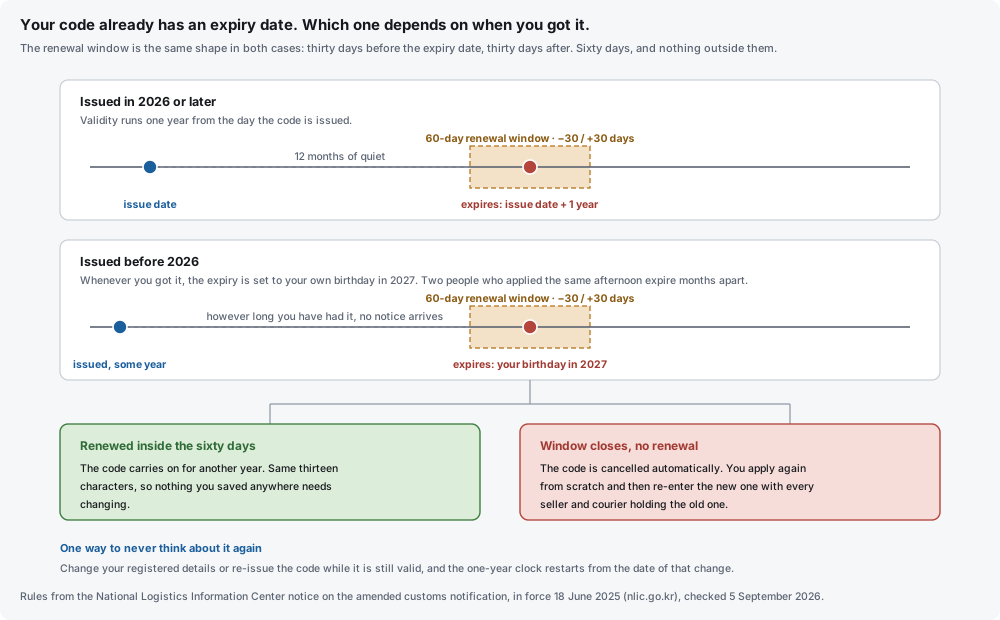
How your own expiry date is calculated depends on when you got the code, and the split is clean. Issued in 2026 or later: one year from the issue date. Issued at any point before 2026: your expiry is your own birthday in 2027 (checked 5 September 2026). Two colleagues who applied on the same afternoon in 2022 will expire months apart, which is exactly why word of mouth is not going to warn you.
The renewal window is the sharp edge. It is 60 days wide — 30 days before the expiry date and 30 days after — and outside it there is no renewal button at all. Miss the whole window and the code is cancelled automatically. You are not renewing at that point, you are applying again, and the code you get back is a different thirteen characters that has to be re-entered everywhere the old one was stored.
One genuinely useful detail sits in the same notice: if you change your registered details or re-issue the code while it is still valid, the validity period restarts for a year from the date of that change. Updating your address after a move is therefore also a renewal, for free, on your own schedule.
One more thing rides along with the same amendment, and it is the one worth acting on. The application form got longer: English name, nationality and more than one address are now collected in full. More of your details on file means more of them available to compare against a parcel — the direction of travel here is more fields being checked, not fewer.
So if your deliveries go to a friend's flat, an office, a hotel or an Airbnb, none of those addresses is on file unless you put it there.
The USD 150 line is not the price on the invoice
The other half of the confusion around personal codes is money, and it is confusing for one specific reason: the figure compared to the limit is not the figure you paid at checkout. Everything below comes off the Korea Customs express-cargo page.
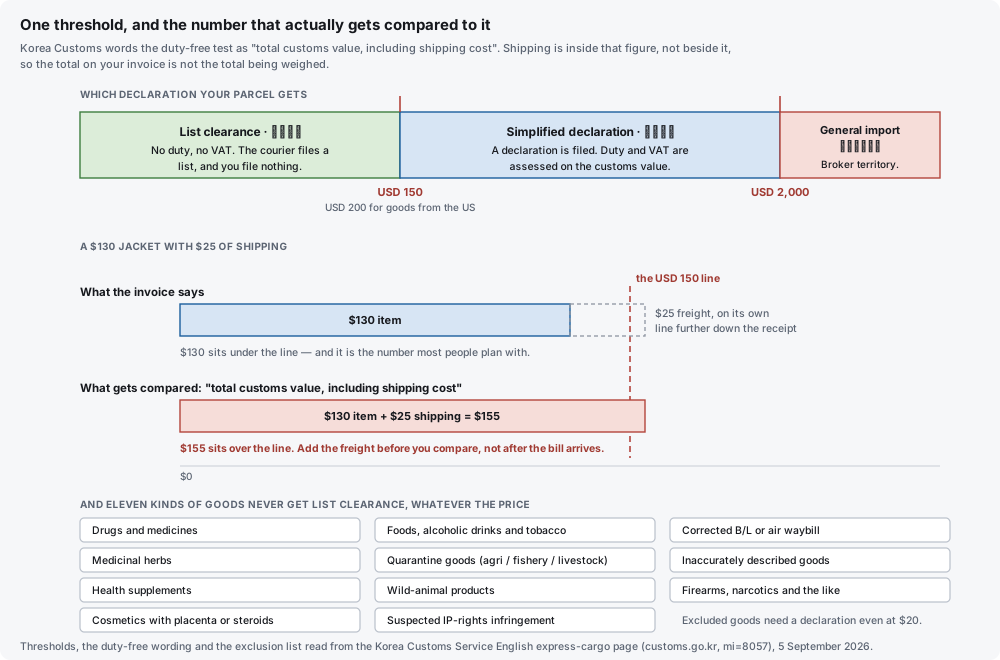
The structure is three lanes. Up to USD 150 — USD 200 for goods shipped from the United States — a personal parcel clears by list declaration: no duty, no VAT, nothing for you to file. From that line to USD 2,000 it needs a simplified import declaration, with duty and VAT assessed on the customs value. Above USD 2,000 it becomes a general import declaration, which is broker territory (thresholds read 5 September 2026).
Now the part that costs people money. The page grants the exemption to personal-use goods whose "total customs value, including shipping cost, is no more than USD 150". Shipping sits inside that figure, not beside it. A $130 jacket with $25 of freight is a $155 parcel by the sentence that decides whether you pay, and the $130 printed on your invoice is not what gets weighed.
The same page also defines "the price of goods" in its own paragraph, in language different enough that you can find people online arguing both ways about freight. There is no point refereeing that here, because the safe rule lands in the same place either way: if an order comes anywhere near USD 150 once shipping is added, plan as though it is over. The cheerful version of the arithmetic — item price only — is how someone ends up surprised by a customs bill on a $140 order.
I am deliberately not putting a tax rate in this article. The customs service's English pages describe duty plus VAT calculated on the customs value without publishing the rates in the same place, and a wrong percentage here would be worse than no percentage. If you need the number, get it from the assessment notice the courier sends you, not from a blog.
The price is not the only test, either. Eleven categories never get list clearance whatever they cost: drugs and medicines, medicinal herbs, health supplements, certain cosmetics containing placenta or steroids, foods, alcohol and tobacco, quarantine goods such as agricultural and livestock products, wild-animal products, goods suspected of infringing intellectual property, goods whose bill of lading was corrected, goods described inaccurately on the clearance list, and anything needing customs confirmation — firearms, swords, gunpowder, narcotics. A $30 bottle of vitamins is not a small parcel in customs terms. It is a declaration.
When the parcel stops moving
The symptom is always the same and it is always vague: tracking sits on customs clearance for days, or a text arrives asking you to confirm something, in Korean, with a link.
Work through it in this order, because the causes are ranked by how common they are rather than how dramatic they sound. First, the code itself — expired, cancelled, or one digit off from what you pasted. Second, the name, which is the spacing-and-capitals problem from earlier. Third, the phone number registered against the code, which is stale for anyone who has changed carriers since applying. Fourth, the delivery address, if the parcel went to a building you never registered. Fifth, and only fifth, the goods: something in that eleven-category list, or a value over the line.
Log in and look at your own code before you phone anyone. Half the time the answer is sitting on that screen and the call is unnecessary. If it is genuinely a customs question rather than a data-matching one, the courier's customs team is the right contact, not the overseas seller, who cannot see any of this.
One expectation to reset while you wait. The seven-day withdrawal right that makes returning things bought online in Korea so straightforward comes from a Korean statute, and it does not reach a seller in California or Shenzhen. Cross-border orders run on whatever the foreign platform promises, plus the practical problem of shipping the thing back. Being stuck at customs and being protected by Korean consumer law are two different situations that happen to feel identical from your sofa.
Five minutes, today
Open the personal-code portal, log in, and read your code's expiry date. That is the whole job, and it is the only way to learn the date, because the date was assigned to you without an announcement. Anyone holding a pre-2026 code is looking for a birthday in 2027; anyone who applied this year, for a date twelve months after they applied. Put it in your calendar with a reminder three weeks early, which lands you comfortably inside the 60-day window rather than arguing with a closed one.
While you are in there, check that the registered phone number is the line you actually use now, and that the English name matches your ARC exactly, capitals and all. If anything needs updating, update it — remember that the change restarts your year. And since the form now holds more than one address, add the places your parcels actually go, not only the one printed on your registration card.
The shift worth making is in how you file the thing mentally. Stop treating the code as a password you look up when needed. It is closer to a driving licence now — it sits in a drawer being valid until one day it is not, and the moment you find out is the moment it is least convenient. A birthday present held at Incheon. A laptop charger you needed on Tuesday. Five minutes on the customs site today buys the whole year.
Frequently asked questions
Can I use my ARC number instead of a personal customs code?
No. The Korea Customs Service page written for foreign residents says plainly that a 'Foreign Registration Number' and a 'Passport Number' are not allowed, and that the personal customs clearance code must be entered when foreigners import e-commerce goods. Checkout forms enforce this anyway — they expect thirteen characters beginning with P.
Does my personal customs code expire?
Yes, and this is new. Codes issued from 2026 onward expire one year after the issue date. Codes issued before 2026 expire on your own birthday in 2027. Renewal is possible only in the 60 days around that date — 30 before, 30 after — and a code left unrenewed is cancelled automatically.
Is the USD 150 limit per item or per shipment?
Per shipment. The threshold applies to the parcel being cleared, not to each item inside it, so two $90 items in one box put you over. Korea Customs words the duty-free test as 'total customs value, including shipping cost', so add the freight before you compare — the number printed on your invoice is not the number being measured.
Can I get a code without a Korean phone number?
Not online, realistically. The issuance page verifies you through a Korean mobile line registered in your own name or a Korean digital certificate, and both assume you already hold an alien registration card. Korea Customs tells foreigners holding only a passport to apply in person at a customs office instead, and that counter is also the fallback when the online identity check keeps refusing you.