How Old Is Your Korean Skincare? Reading the Package
제조 2025.06.14. On a Korean tube that is the manufacturing date, not an expiry. Article 10(1)6 of the Cosmetics Act asks for a use-by date or a period after opening, and a brand taking the second option prints 제조 and a small open-jar symbol.
So hunting a box for 까지 turns up a date on some products and comes back empty on others.
Dates are the small half of it. The same article splits the information across surfaces, which is where an ordinary habit gets expensive: the carton goes in the hotel bin on day one, taking the ingredient list, the country of manufacture and the functional mark with it.
The date is a fork, not a field
Our skincare shopping guide says to check the box for an expiry date. That works — right up to the products never given one.
Article 2(5) defines 사용기한 as the minimum period from the date of manufacture over which a product keeps its characteristics in appropriate storage, and the English reference translation kept at the Korea Legislation Research Institute agrees. Manufacture is the anchor, so 제조 plus a run of months is the term doing its job.
What the Act never supplies is the number. No statutory default exists — not 24 months, not 30, and certainly not the "three years unopened" figure that circulates in English.
Take the second route and Article 10(1) demands 제조연월일 alongside, in a parenthesis whose "hereafter the same shall apply in this Article" carries the condition across the provision. A tube reading 제조 2025.06.14 with a 12M jar beside it is missing nothing.
Annex 4 fixes the wording, in the Rule in force since 2 April 2026 (Ordinance No. 2109, hung off Rule 19(7)). A use-by date reads 사용기한 or 까지 with a year, month and day — year and month alone only where that does not overshoot. A period after opening reads 개봉 후 사용기간 with ○○월 or ○○개월, or a symbol with the period beside it, and the annex draws that symbol on a product good for 12 months. The 12M on your tube comes from that line. 찾기쉬운 생활법령정보 says it in plainer Korean.
Three strings to hunt for, then: 까지, 제조, and the little jar.
The bottle and the box are not carrying the same list
Article 10(1) is the long list: ten items, the last a catch-all that the Enforcement Rule fills at 19(4) with the barcode, the efficacy wording as reviewed or reported, and the country of manufacture for imports. Read its opening line, though — those ten belong to the outer package, so a product shipped without a carton carries all ten on the bottle itself.
Once a carton exists, Article 10(2) governs the 1차 포장, the container touching the contents. Four items: product name, trade name (the address drops off), manufacturing number, and use-by date or period after opening. For a boxed bottle, tube, jar or pump, that is the entire legal minimum.
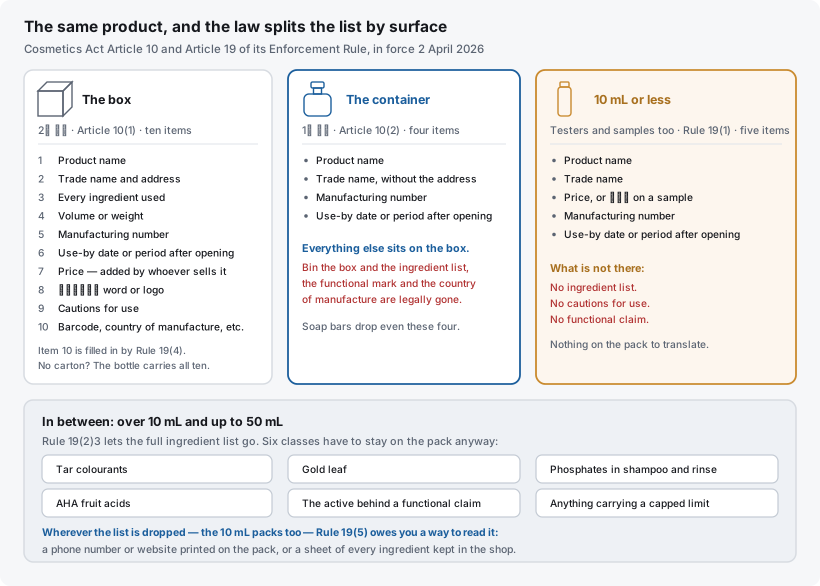
Set the lists side by side and the consequence is blunt: throw the carton away and, so far as the law is concerned, the ingredient list, the cautions for use, the 기능성화장품 mark and the country of manufacture are no longer on your product.
One proviso. Article 10(2) excuses 고형비누 등 — solid soap, whose primary package you peel off to use — and Rule 19(6) narrows 등 to 화장비누.
One item was never the manufacturer's job. Article 11 hands the price to "a person who directly sells cosmetics to consumers", the legal reason the same serum wears one sticker in Olive Young and another in Daiso.
10 mL and 50 mL: two numbers that delete the ingredient list
Both sit in Rule 19, and neither reaches products the MFDS lists as needing special care in use.
10 mL or 10 g and under. Rule 19(1) sends these to the short list in the proviso to Article 10(1): name, trade name, price, manufacturing number, use-by date or period after opening. Testers and samples too, where the rule reads "price" as the words 견본품 or 비매품. Nothing for a translation app to work on.
Over 10 mL and up to 50 mL. Rule 19(2)3 lets the full list go, pinning six classes in place regardless: tar colourants, gold leaf, the phosphates in shampoo and rinse, AHA fruit acids, the active behind any functional claim, and anything carrying a use limit the MFDS has published. That band holds much of Korean skincare: the 30 mL serum, the 50 mL essence, the travel minis.
Rule 19(5) covers both cases and is the part you can act on: where the list has gone, you are owed a route back to it — a phone number or website on the pack, or a book of every ingredient kept in the shop. An obligation, not a courtesy. (Food packs have their own edges — what the food label legally covers.)
What the 기능성화장품 mark actually certifies
Not "tested and approved", and not one single thing either.
Rule 2 opens the Act's five headings into eleven categories: two for whitening, then wrinkles, tanning, UV protection, hair colour, hair removal, hair-loss symptom relief, acne-prone skin, skin barrier recovery and stretch marks. Sunscreen belongs here; so does a chemical depilatory, since category 7 excludes physical hair removal, and category 9 reaches acne only in wash-off cleansers.
There are two ways in. Article 4(1) lets a company either pass a 심사, a review, or file a 보고, a report for items exempt from review, and the box does not say which. Nor does any one database: the MFDS — 식품의약품안전처 — keeps reviewed products and reported ones in separate searches.
Categories 8 to 11 carry a tell. Rule 19(4)7 makes them print 질병의 예방 및 치료를 위한 의약품이 아님 — not a medicine for preventing or treating disease. Your anti-hair-loss shampoo saying that is the rule working, not hedging.
The sunscreen number stops at 50 by rule
Sun protection is category 5, so a Korean sunscreen has been through the functional-cosmetic process, and the figure on the front is a display value, not a raw test result.
The notice governing that review, 기능성화장품 심사에 관한 규정 (MFDS Notice 2023-61, in force since 21 September 2023), settles it at Article 13(2)1: the figure shown is an integer no more than 20% below the measured mean, decimals dropped from that mean first. Its own example puts a mean of 23 anywhere from 19 to 23. Then the clause that changes how you shop — 50 and above is all labelled SPF50+.
SPF50+ is a band with no ceiling. Two Korean bottles showing it may have tested nowhere near each other, and holding one against a foreign SPF70 sets a display rule against a measurement. The Korean product is not weaker. It is capped.
When the label itself is the illegal part
Korean is the default, and that comes from the Act. Article 12 puts the Article 10 and 11 statements somewhere more visible than surrounding text, in 한글 that is easy to read, with 한자 or a foreign language allowed alongside; Rule 21(1) restates it and adds the export exception. The Korean sticker over an imported jar is that being obeyed, not laziness.
Three prohibitions in Article 16 point at things people buy secondhand. 16(1)3 bans selling a sample — anything made or imported for consumers to try in advance — where the sale is to a consumer. 16(1)4 covers anything whose packaging or labelling has been damaged, forged or altered. 16(2) bars selling contents divided out of a container, carving out only custom-cosmetics sellers working through a certified compounding manager and products made to be sold in portions.
That puts the decant trade outside the law, and nothing here could be applied to one anyway — no manufacturing number, no date. For the secondhand and overseas-order side, see online shopping as a foreigner.
Read on 20 August 2026 at 국가법령정보센터, law.go.kr: the Cosmetics Act (No. 20901, in force 2 April 2026), its Enforcement Rule (Ordinance No. 2109) and Annex 4. English wording follows the KLRI translation linked above, which trails the Korean in places. Nothing here is legal advice; for a specific product, ask 식품의약품안전처, the MFDS. Send a correction if a rule has changed since.
Frequently asked questions
What does 제조 mean on Korean cosmetics?
제조 is short for 제조연월일, the manufacturing date — not an expiry. It is there because Article 10(1) of the Cosmetics Act requires the manufacturing date to be printed whenever a brand labels a period after opening instead of a use-by date. If there is also a small open-jar symbol with a number and an M beside it, add that many months to the 제조 date.
My Korean skincare has no expiry date. Is that legal?
Yes. Article 10(1)6 asks for a use-by date or a period after opening, not both, so a bottle carrying only 제조 and a 12M jar symbol is fully labelled. The thing you should not find is neither of them. Korean law also sets no default shelf life, so the 'three years unopened' figure that circulates in English has nothing behind it.
Why doesn't my 30 ml Korean serum list its ingredients?
Article 19(2)3 of the Enforcement Rule lets packages over 10 mL and up to 50 mL drop the full ingredient list. Six classes still have to appear: tar colourants, gold leaf, phosphates in shampoo and rinse, AHA fruit acids, the active behind a functional claim, and anything carrying a capped limit. Where the rest has been dropped, Article 19(5) requires a phone number or website on the pack, or a printed sheet of every ingredient kept in the shop.
Does 기능성화장품 mean the MFDS tested this product?
Not necessarily. Article 4(1) of the Act offers two routes into the category — 심사, a review, and 보고, a report covering items exempt from review — and the mark on the box does not distinguish them. The Ministry of Food and Drug Safety publishes the two in separate databases, so searching one covers half the field.