Food Allergies in Korea: What the Label Legally Covers
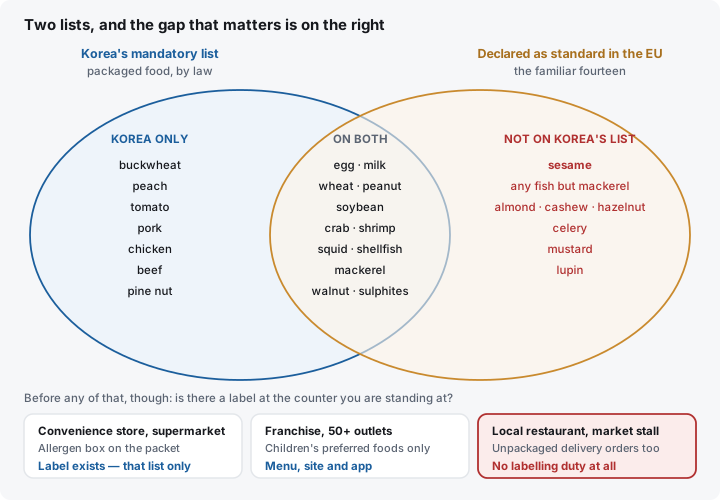
Search Korea's allergen labelling rules in English and you will be told, repeatedly and with great confidence, that twenty-two foods must be declared. The annex that actually creates the duty lists nineteen. Both numbers are describing the same schedule, and neither of them includes sesame.
Sesame has been a required declaration in the United States since the FASTER Act took effect on 1 January 2023, and it is item 11 of the fourteen in Annex II of Regulation (EU) No 1169/2011. Korea puts sesame oil on almost every vegetable side dish and requires nobody to mention it.
So there are two questions, answered by different laws: is your allergen on the list, and is there a label at that counter at all?
Two laws, and only one of them touches restaurants
Korean allergen labelling comes from two separate statutes that people routinely blend into one.
Packaged food is governed by the Act on Labeling and Advertising of Foods and its Enforcement Rule, whose Annex 2 (a PDF, in Korean) sets out the consumer-safety items. That is where the allergen list lives, and it binds manufacturers. Anything sealed in a packet — the triangle rice ball, the ramyeon cup, the sauce bottle — falls here.
Food cooked and sold to you sits under a different law entirely: Article 11-2 of the Special Act on Safety Management of Children's Dietary Lifestyle. And it is much narrower than it sounds. Article 11-2 leaves the question of who is actually covered to the Enforcement Decree, and Article 8 of that Decree — the wording in force since 12 May 2026 — draws the line at snack bars, restaurants and bakeries that are franchises under the Fair Franchise Transactions Act, where the company-owned and franchised outlets together number 50 or more. The government's plain-language legal portal sets the same rule out in a table, last revised 15 July 2026. Even then it reaches only what the Act calls children's preferred foods, which in the cooked-food category means bakery and confectionery, burgers, pizza and ice cream. Skip the labelling and Article 29(3) of the Act allows an administrative fine of up to ₩3,000,000.
Everything else is outside both. The gimbap shop on your corner, the tent stall at Gwangjang Market, the forty-outlet chain, the pojangmacha: no allergen labelling obligation whatsoever.
The list is shorter than the internet says
Annex 2 runs to three pages and the allergen list is the first thing on it, in this order:
eggs (poultry only), milk, buckwheat, peanut, soybean, wheat, mackerel, crab, shrimp, pork, peach, tomato, sulphites (where the finished product contains 10 mg/kg or more of sulphur dioxide), walnut, chicken, beef, squid, shellfish (including oyster, abalone and mussel), pine nut.
Nineteen entries, in the schedule Article 5(1) of the Enforcement Rule points to. You get to twenty-two by counting the oyster, abalone and mussel named inside the shellfish entry as three further items on top of it. Same nineteen lines, counted a second way. The Ministry of Food and Drug Safety also keeps a consumer explainer if you want the shopper's version.
Two of those entries do far less than they look. Nuts means walnut and pine nut — that is the whole category. No almond, no cashew, no hazelnut, no pistachio, so a packet containing almonds is under no obligation to flag them as an allergen. Fish means mackerel, and nothing else: anchovy, pollack, tuna and sand lance never trigger the duty.
Sesame is absent, along with celery, mustard and lupin.
Where the list does apply, it applies hard. Declaration is quantity-independent — a listed allergen used as an ingredient at all goes in the box, with no minimum threshold — and the box has to sit near the ingredient list on a background you can tell apart from it. What gets printed is one short line ending in 함유, meaning contains; the annex's own worked example reads 달걀, 우유, 새우, 이산화황, 조개류(굴) 함유. One exemption: a single-ingredient product whose name already is the allergen — a tray of 돼지고기, a bag of 땅콩 — may leave the box off, the name having done the work.
Cross-contact has its own prescribed wording. A product made on shared equipment carries a line such as 이 제품은 알레르기 발생 가능성이 있는 메밀을 사용한 제품과 같은 제조 시설에서 제조하고 있습니다 (made in a facility that also handles buckwheat), or the shorter 메밀 혼입 가능성 있음. That short one is the phrase to memorise. It is set in small grey type and it is very easy to read straight past.
Where the unlisted ingredients actually live
In Korean cooking, the ingredients that fell off the list are not obscure. They are structural.
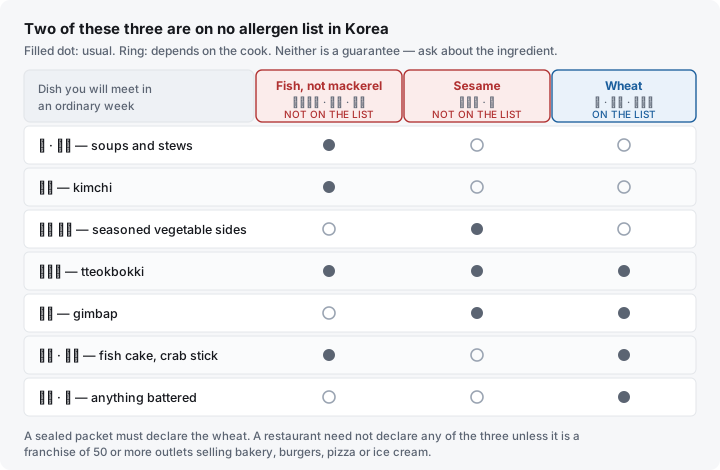
Anchovy stock is the base layer. 멸치육수 — dried anchovies simmered with kelp — underpins a large share of soups, stews, noodle broths, and the sauce that 떡볶이 cooks in. Fish sauce made from anchovy or sand lance goes into most kimchi. A dish can look entirely fish-free on the menu and be built on fish underneath, and no label anywhere is required to say so.
Sesame oil finishes almost everything. The 나물 side dishes that arrive unasked, the dressings, the rice bowls, the seaweed. Toasted sesame seed gets scattered over the top. If sesame is your allergen, the free banchan is the sharpest edge in the country, precisely because you did not order it and nobody will think to mention it.
Wheat is the one common allergen where the law and the kitchen line up. Brewed Korean soy sauce is made with wheat, and so, in turn, is most of what soy sauce goes into — but wheat is on the list, so a bottle in a shop has to declare it. If a packet carries 무글루텐 there is a number behind the claim: the same annex allows it only at 20 mg of gluten per kilogram or less. Traditional 국간장 is closer to soybean and salt, though that is not a guarantee you can extract from a restaurant. Batter is wheat too, which at least makes 튀김, 전 and fried chicken predictable.
어묵 and 맛살 are both mostly something else. Fish cake is pollack surimi bound with wheat starch; crab stick frequently contains no crab at all. Both turn up in stews, on skewers, inside gimbap and in lunchboxes.
Ask about the ingredient, not the allergy
Saying 알레르기 있어요 — I have an allergy — tends to land as a preference, filed alongside people who dislike coriander. It also asks a busy stranger to hold your entire medical situation in their head while they work a lunch rush.
Ask about one ingredient instead. That is a question a kitchen can answer without stopping:
- 이거 멸치 들어가요? — Does this have anchovy in it?
- 참기름 들어갔어요? — Was sesame oil used?
- 간장 썼어요? — Was soy sauce used?
- 빼주세요 — Please leave it out.
If the answer needs weight, add the consequence rather than the label: 먹으면 응급실 가요, if I eat it I go to the emergency room. Short and concrete, and much harder to file under fussy. The ordering guide covers the rest of the counter vocabulary.
The counter you are standing at decides the answer
A packet from a convenience store or supermarket. The strongest position you can be in — that allergen box is legally complete for the nineteen. Point a translation app at the box rather than at the whole label. The convenience store guide has the rest of the packet-reading basics.
A franchise with 50 or more outlets, selling children's preferred foods. Bakery chains, burger chains, pizza chains, ice cream. Allergens go near the product name or the price on the menu, or into a booklet or poster kept somewhere visible with a sign saying it exists; the same information has to appear near the product name online or in the app; and phone orders are supposed to arrive with a leaflet or sticker carrying it.
An independent restaurant, a market stall, or unpackaged food ordered for delivery. No labelling duty, and therefore no reliable document to read. You are back to asking about single ingredients, and to your own map of where the unlisted ones live. When staff give you a vague answer, that is not indifference and it is not a language barrier. Nobody ever required them to hold the information.
If it goes wrong
Call 119 for an ambulance — the same number as the fire service — rather than getting yourself to a hospital by taxi. Ask for 응급실, the emergency department. Work out which hospitals near you run one while nothing is happening; the hospital guide explains how the tiers work.
Bring your own auto-injector. The Jext pre-filled pen — 젝스트프리필드펜주, licensed here in December 2017 and distributed by BC World Pharm — sits in the Ministry of Food and Drug Safety's drug product database classified as 전문의약품, prescription-only, as of August 2026. That means a Korean prescription, not a foreign one produced at a pharmacy counter. Carry what you need, carry a doctor's letter for customs, and check the expiry date before you fly.
Allergen list read off the PDF of Annex 2 to the Enforcement Rule of the Act on Labeling and Advertising of Foods, and cross-checked against the easylaw plain-language summary on 19 August 2026. Restaurant scope from Article 11-2 of the Special Act on Safety Management of Children's Dietary Lifestyle and Article 8 of its Enforcement Decree (in force 12 May 2026); the fine from Article 29(3). Decrees change quietly, so before you rely on any single item here, check it against Food Safety Korea or the Ministry of Food and Drug Safety. None of this is medical advice — if your reactions are severe, talk to an allergist before you travel, and take questions about medicines to a Korean doctor rather than to a blog. Spotted something out of date? Tell me.
Frequently asked questions
Is sesame labelled as an allergen in Korea?
No. Sesame does not appear anywhere on the mandatory allergen list in Annex 2 of the Enforcement Rule of the Act on Labeling and Advertising of Foods, checked in August 2026. That is a real difference from the United States and the EU, where sesame must be declared, and it matters in Korea because sesame oil and sesame seed are used across side dishes and dressings.
Do restaurants in Korea have to list allergens?
Most do not. The duty comes from Article 11-2 of the Special Act on Safety Management of Children's Dietary Lifestyle, and Article 8 of that Act's Enforcement Decree — the text in force on 12 May 2026 — limits it to franchise businesses whose company-owned and franchised outlets together number 50 or more. It then bites only on the foods the Act calls children's preferred foods. An independent restaurant, a market stall or a small chain has no labelling obligation at all.
Is Korean soy sauce gluten-free?
Usually not. Standard brewed Korean soy sauce is made with wheat, and because wheat is on the mandatory list a bottle sold in a shop has to declare it. In a restaurant nobody has to tell you, so treat soy sauce, gochujang and most marinades as wheat-containing unless the specific product says otherwise.
Can I get an epinephrine auto-injector in Korea?
Not over the counter. The Jext pre-filled pen listed in the Ministry of Food and Drug Safety's product database is classified as 전문의약품, prescription-only, when checked in August 2026 — which means a Korean prescription rather than a foreign one shown at a pharmacy. Bring your own supply and a doctor's letter, and put any question about dose or substitutes to your allergist or to the Ministry rather than to a blog.