Korean Convenience Store Food: What to Buy
Korean convenience stores are not the sad afterthought that the phrase suggests in most countries. They are a functioning part of how people eat here — open around the clock, on nearly every corner, and stocked with food that ranges from decent to genuinely good.
Learning to use one properly is one of the highest-value things a visitor can do in their first week, and it will save a substantial amount of money over a longer stay.
The four chains
CU, GS25, 7-Eleven, and Emart24 dominate. Quality across them is broadly comparable, and each has exclusive products and its own promotion cycle. In practice you use whichever is nearest, which will usually be within two minutes' walk.
What is actually worth buying
Gimbap (김밥). Rice rolls with fillings, wrapped in seaweed, sold chilled. Cheap, filling, and the most reliable quick meal on the shelf. The tuna and the plain vegetable versions are the safe defaults.
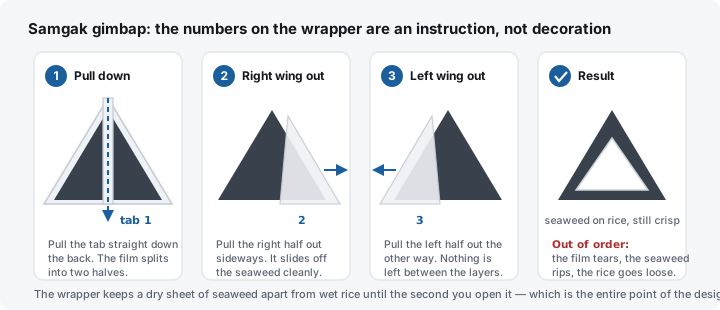
Samgak gimbap (삼각김밥). Triangular rice parcels with a filling in the middle. There is a three-step numbered wrapper designed to keep the seaweed crisp until the moment you open it — follow the numbers, in order, and it works. Ignore them and you get a torn parcel and loose rice, which is a rite of passage.
Dosirak (도시락). A full lunchbox — rice, a main, several side dishes. Heat it in the store microwave. This is a proper meal for the price of a coffee, and it is the single best-value item in the shop.
Instant noodles, prepared in-store. See below; this deserves its own explanation.
Bread and pastries. Better than you would expect, particularly the cream-filled varieties.
Bananas and boiled eggs. Sold everywhere, and the practical answer to breakfast.
Drinks. An enormous range — barley tea, corn silk tea, coffee in every format, banana milk. Banana milk in a rounded plastic bottle is a national institution and worth trying once for that reason alone.
The hot water machine
Every convenience store has one, and it is the whole point of the noodle aisle.
The routine: buy a cup noodle, take it to the counter area, peel the lid to the marked line, fill to the line from the hot water dispenser, close the lid, wait the stated time, eat with the disposable chopsticks provided. Bins are beside the counter.
There is also a microwave, free to use, for lunchboxes and anything else chilled. Nobody supervises either; you simply use them.
Eating in is entirely normal. Many stores have a window counter with stools, and at lunchtime they fill up with office workers.
How the deals work
Convenience store promotions are aggressive and worth understanding, because they change the effective price substantially.
- 1+1 — buy one, get one free
- 2+1 — buy two, get one free
The offers are marked on the shelf label, apply to specific products, and rotate monthly. Two practical points: you must take the free item at the same time, not on a later visit; and the offer is usually per product line, so a 2+1 on a drink means three of that drink, not two of one and one of another.
Each chain runs its own promotions, which is the one real reason to prefer a particular chain — if you buy the same drink daily, the chain running 1+1 on it that month is worth the extra minute of walking.
What to skip
Sandwiches. Serviceable, rarely good, and usually poor value against a lunchbox.
Anything imported. The markup is steep. Buy Korean products in Korean shops.
Fresh fruit. Convenience stores sell it, and it is expensive even by Korean standards, which are already high — see the Seoul cost-of-living breakdown on why fruit is a genuine budget line here. Traditional markets are far cheaper.
Reading the labels without Korean
Three things are worth being able to find on a package.
The spice marking. Anything with 매운 (maeun) or a red pepper illustration is spicy, and Korean spicy is not a decorative claim. 불 (bul, fire) in a product name means it is aggressively so — the fire-noodle products that circulate as internet challenges are sold on every shelf here at ordinary prices.
The date. Two labels appear: 유통기한 is the sell-by date and 소비기한 is the use-by date, the latter being the one that actually matters. Discounted chilled items are usually discounted because one of these is close.
The weight or volume, printed in grams or millilitres, which is the only reliable way to compare two lunchboxes whose photographs both look generous.
Food labelling standards are set by the Ministry of Food and Drug Safety, and allergen information is required on packaging — though it is printed in Korean, so a translation app pointed at the ingredient panel is worth the thirty seconds if you have an allergy.
Beyond food
Convenience stores in Korea handle a surprising amount of ordinary life:
- T-money cards — bought and topped up here, and balances refunded here too. See the T-money guide.
- Parcel drop-off and collection
- Bill payment and ATMs
- Phone charging cables, umbrellas, basic toiletries at the moment you need them
A note on the Han River
The most common way visitors discover all this: buy noodles, a lunchbox, and drinks at a convenience store near a subway station on the river, then eat them on the grass at sunset with everyone else doing exactly the same thing. Yeouinaru station is the classic spot. It costs almost nothing and is on most people's list of best evenings in Seoul.
Written August 2026. Product ranges and promotions change monthly. Corrections welcome via contact.
Frequently asked questions
Is convenience store food in Korea actually good?
Much of it is genuinely good and it is treated as a normal meal option rather than a fallback. Rice rolls, lunchboxes, and instant noodles prepared in-store are the strongest categories.
Can you eat inside a Korean convenience store?
Yes. Most have a counter or seating area with a microwave, hot water dispenser, and bins. Eating in is completely normal and there is no purchase minimum beyond what you bought.
What does 1+1 mean in Korean convenience stores?
Buy one, get one free. 2+1 means buy two, get one free. The offer applies to specific marked products and rotates monthly, and you must take the free item at the same time.
Which Korean convenience store chain is best?
CU, GS25, 7-Eleven, and Emart24 are broadly similar in quality. Each has its own exclusive products and its own promotions, so the practical answer is whichever is closest.