Korean Food Expiration Dates: Use-By Isn't What It Was
The carton of Seoul Milk in my fridge says 유통기한 2026.09.05. The tub of yogurt next to it says 소비기한 2026.09.14. Same fridge shelf, same dairy aisle, two different words in front of the expiration date — and they do not mean the same thing. One of them has a hidden safety margin baked in. The other means exactly what it says.
For years the answer to "can I still eat this?" in Korea was usually yes, because the printed date was a deadline for the store, not for you. That changed on January 1, 2023, and most English-language advice floating around online was written before the change. So here is the current system, label by label.
Read the date first: the year comes before everything
Korean packaging prints dates as YYYY.MM.DD. So 2026.11.05 is November 5th,
not May 11th. If you grew up with day-first or month-first dates, this is the
single most common misreading, and it can swing your estimate by half a year.
Some smaller packages drop the year to save space — 11.05 — in which case
month-day order still holds.
The word 까지 ("until") often follows the date: 2026.10.15까지 means good
until October 15. Convenience store lunch boxes, gimbap, and sandwiches go one
step further and add an hour: 10.15 22시까지 means until 10 p.m. that day. Those
hour-level dates are real, not decorative — staff pull the stock once the hour
passes. There's more on how the chains handle short-life
food in the convenience store food guide.
And some products carry no expiry date at all, only 제조일자 — the date it was
made. Soju is the famous example. A bottle stamped 2025.03.12 was bottled in
March 2025 and that is all the label will ever tell you.
The 2023 switch: from sell-by to use-by
Until the end of 2022, the standard Korean date label was 유통기한 (yutong-gihan), literally "distribution deadline". It told retailers how long they could sell a product. Regulators set it at roughly 60–70% of the point where the food actually becomes unsafe, so food that "expired" yesterday was, in most cases, nowhere near dangerous. That 60–70% figure isn't folklore — it comes from the Korea Herald's coverage of the switch and from the Ministry of Food and Drug Safety itself.
On January 1, 2023, that label was replaced with 소비기한 (sobi-gihan), a genuine use-by date, set at roughly 80–90% of the safety limit. The stated goal was cutting food waste: people were binning safe food because the old dates cried wolf. A one-year grace period ran through 2023, and stock printed with old labels was allowed to sell through — which is why shelves mixed both labels for a long while (ChemLinked has the full regulatory rundown).
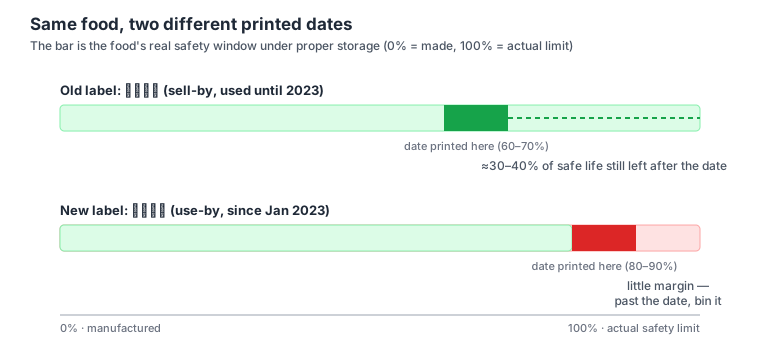
The practical consequence is blunt. The new dates are longer on the package — the same sausage might have gained a week or two of printed life — but the date itself became harder. Under 유통기한, eating a day past the date was a shrug. Under 소비기한, the date is the end of the line.
The four labels you'll actually see
Every date on Korean food is one of these four. The word in front of the date decides everything, so it is worth learning the characters by shape.
제조일자 (jejo-ilja) — manufacture date. Not an expiry at all; it points backward, not forward. Common on soju, salt, sugar, and some frozen goods. If this is the only date, the product either barely spoils or the shelf life is stated separately in the fine print. Korean cosmetics work on the same manufacture-date logic, which trips up the same people — the skincare label guide covers that side.
유통기한 (yutong-gihan) — the old sell-by. Mostly gone from new production, but you will still see it on milk (next section) and occasionally on long-shelf-life stock made years ago. Built-in margin: real safe life extends comfortably past the date.
소비기한 (sobi-gihan) — the current use-by. This is what nearly everything in a 2026 grocery run carries. Minimal margin. Storage instructions on the label are part of the deal — the date assumes you followed them.
품질유지기한 (pumjil-yuji-gihan) — "quality maintenance date", Korea's version of best-before. Applied to foods that essentially don't become unsafe: jam, canned goods, retort pouches, fermented sauces like gochujang, beer, honey, kimchi, flour. Past this date the product may taste or look worse, but eating it is not a safety question. Exporters abbreviate it BB or BBE on English-facing packaging.
One label the system does not cover: allergens follow entirely separate rules, with their own gaps — see what Korean allergy labels legally cover.
Milk is the exception until 2031
Here is the trap in the dairy aisle. Refrigerated milk keeps the old 유통기한 system until January 1, 2031. The dairy industry argued that Korea's cold chain — the trucks, loading docks, and store fridges between plant and shelf — wasn't uniformly reliable enough for a tight use-by date, and regulators granted an eight-year exemption (as of 2026; the ChemLinked article above documents it).
So in 2026 your milk carton is the one product in the basket where the printed date still has the old-style cushion. Kept properly cold, milk is normally fine for several days past its 유통기한 — while the yogurt beside it, dated under 소비기한, is not supposed to get that grace. The two words look similar at a glance. The last character block is the giveaway: 유통 vs 소비.
So the date passed. Can you eat it?
Depends entirely on which word was in front of the date. There's no single answer, which is exactly why the label matters:
- 소비기한 passed — throw it out. That is the design of the label. The old "it's just a sell-by date" folk wisdom no longer applies to this word.
- 유통기한 passed (milk, old stock) — usually still fine for a stretch if storage was right. Smell and look remain your tools. This is the label the folk wisdom was built on.
- 품질유지기한 passed — a quality suggestion, not a safety line. That jar of jam is almost certainly fine; it just may have peaked.
- 제조일자 only — the date tells you age, not safety. Check the package for a separately stated shelf life.
The caveat that Korean regulators repeat, and that deserves repeating here: the 소비기한 assumes the storage conditions printed on the pack. A use-by date on tofu means nothing if the tofu rode home in a hot car and sat out for an afternoon. When in doubt about a specific category, the MFDS English site is the official source — thinner than the Korean side, but it is the regulator itself.
Near-date discounts are real money
Because 소비기한 is a hard stop, stores move near-date stock aggressively. Supermarkets sticker discounts onto same-day and next-day items in the evening — the yellow or red 할인 stickers on meat, sushi, and banchan. How deep the cut goes depends on the store and the hour; no chain publishes a fixed schedule, so the only way to learn your local pattern is to show up at closing time a few nights running. Convenience store chains run their own near-expiry deals through their apps. Given that the date now sits at 80–90% of actual safe life rather than 60–70%, a tonight-dated discount item you eat tonight is a genuinely rational buy, not a gamble.
The one-sentence version to carry into the store: read the word, not just the date. 소비기한 means the date is final, 유통기한 means there's slack, and 품질유지기한 means it's about taste. And the year comes first.
Frequently asked questions
Is the date on Korean food a sell-by or a use-by date?
Since January 2023, most packaged food carries 소비기한, a use-by date — once it passes, you should throw the food out. Before 2023 the standard label was 유통기한, a sell-by date with a built-in safety margin. Milk still uses the old sell-by system until 2031.
Why does milk in Korea still use the old sell-by date?
Refrigerated milk was given an eight-year exemption, until January 1, 2031, because regulators judged Korea's cold-chain distribution wasn't uniformly reliable enough for the tighter use-by system. So a carton marked 유통기한 typically stays drinkable for several days past the printed date if it has been kept properly cold.
What does 까지 mean next to the date on Korean packaging?
까지 means 'until'. So '2026.10.15까지' reads 'good until October 15, 2026'. Convenience store meals often add an hour as well, like '10.15 22시까지' — until 10 p.m. on that day.
How do I read the date format on Korean food?
Korean dates run year-month-day: 2026.11.05 is November 5, 2026, not May 11. Some products skip the expiry date entirely and print only 제조일자, the manufacture date — soju is the classic example.