Drinking Age in Korea: Birth Year, Not Birthday
The cashier turns the passport over twice before finding the photo page. Then a thumb along the date of birth, a glance at the two bottles on the counter, a glance back at the passport — and a piece of arithmetic that has nothing whatsoever to do with your birthday.
She is subtracting. Not counting forward to a birthday, not working out how old you are this afternoon. Subtracting one four-digit number from another. Korean law, on this one narrow question, does not care what day you were born. It cares what year.
Every English-language page on the subject gets to "the drinking age in Korea is 19" or "it's 20 in Korean age" and stops there, which is about forty per cent of an answer. The rest of the rules — who has to check your ID and what happens if they get it wrong, why soju cannot be posted to your flat but can arrive with fried chicken, whether the beer on the grass by the Han River is technically an offence — are spread across three statutes, a tax-office notice and a city ordinance, and almost nobody has bothered to open any of them.
The drinking age in Korea is 19 — and the clock is your birth year
The definition sits in Article 2, subparagraph 1 of the 청소년 보호법, the Youth Protection Act, in the version in force since 1 July 2026:
- "청소년"이란 19세 미만인 사람을 말한다. 다만, 19세가 되는 해의 1월 1일을 맞이한 사람은 제외한다.
A youth is a person under 19 — except a person who has reached 1 January of the year in which they turn 19.
Read the exception slowly, because it does all the work. It does not say the year in which they turned 19. It says the year in which they turn 19, which for anyone with a birthday still ahead of them is this year. So on 1 January, everyone born nineteen calendar years ago stops being a youth at the same instant, in one annual cohort, regardless of whether their birthday falls in February or the week before Christmas.
Through 2026, that means born in 2007 or earlier. Subtract, do not count.
Note also what is missing from the Korean: the character 만. Korean statutes that mean international age say 만 19세. This one does not, and it did not change when Korea standardised on international age in 2023 — that reform swept through administrative practice and left a handful of provisions, this one among them, still running on year age. Nor is it an oversight nobody got round to fixing. A shop cannot be expected to work out whether today falls before or after a stranger's birthday, and a rule that switches once a year for everybody is a rule a tired cashier at 1 a.m. can actually apply.
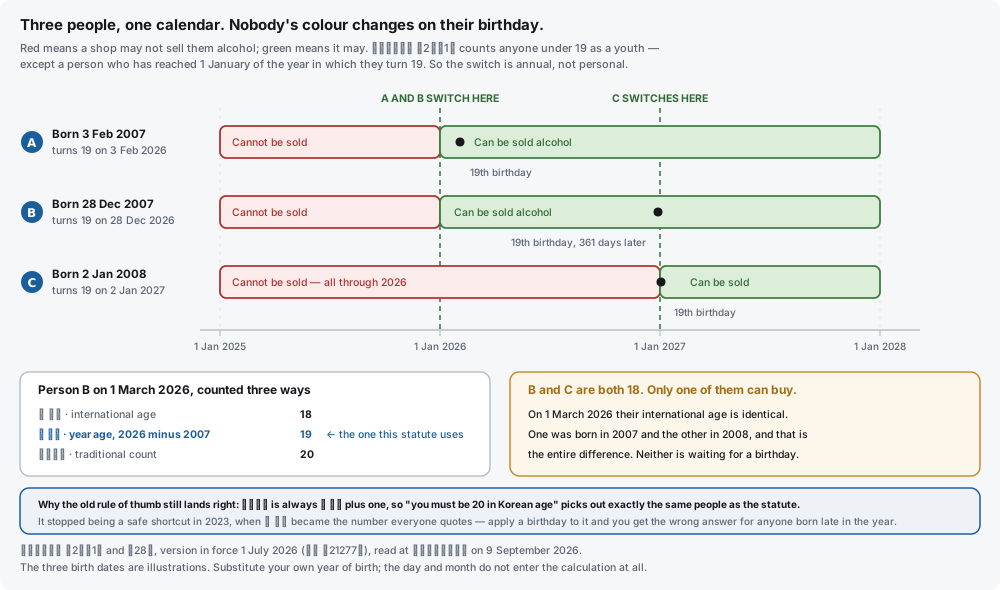
Here is the part that makes the old guides interesting rather than simply wrong. The folk rule — you have to be 20 in Korean age — picks out exactly the right people. Traditional counting is always year age plus one, so "20 세는나이" and "born nineteen years before this year" describe the same set of human beings, every year, without exception. The advice has been correct by arithmetic accident for decades.
What killed it was 2023. Ask a Korean their age now and you will usually get 만 나이, the international number, and the moment a birthday gets applied to that number the answer goes wrong for anybody born late in the year. Two people can both be eighteen on the first of March and only one of them can buy a beer.
One thing worth fixing in your head before reading further: the prohibition in Article 28(1) is aimed at the person selling, not the person drinking. There is no offence in this statute committed by a nineteen-year-old who buys soju. The exposure sits behind the counter — and once that lands, the rest of the shop's behaviour stops looking arbitrary.
Can foreigners buy alcohol in Korea? What ID actually works
Article 28(4) is one sentence long, and in its current form it is remarkable for what it leaves out:
④ 청소년유해약물등을 판매ㆍ대여ㆍ배포하고자 하는 자는 그 상대방의 나이 및 본인 여부를 확인하여야 한다.
Anyone selling must confirm the other party's age and identity. That is the whole of it. No list of documents, no procedure, no standard. The statute imposes a duty and then says nothing at all about how to discharge it.
That absence is the most useful thing on this page, because it explains something every foreign resident has run into and no guide accounts for: why the answer changes from shop to shop. There is no national list of acceptable ID for buying alcohol. There is a shopkeeper with a legal duty, no prescribed method, and personal criminal exposure if they get it wrong. Under Article 59, subparagraph 6, selling alcohol to a youth carries up to two years' imprisonment or a fine of up to ₩20,000,000. Faced with a document they cannot read, refusing costs them one sale and accepting could cost them the shop. They will refuse.
There is exactly one list of acceptable documents anywhere in the enforcement decree, and what it is for turns out to be the interesting part. Article 27(1) names five — the resident registration card including the mobile version, a driving licence, a passport, an alien registration card, a disability registration card — and then defines them as the identity documents a machine has to be able to read. The machine in question is the age-verification equipment an accommodation business must install under Article 29(3) of the Act, which is about who may walk into premises that are off limits to minors. It says nothing about the fridge at the back of a convenience store, and it is not the rule at the counter you are standing at. Read it at 국가법령정보센터 rather than taking this page's word for the scope.
This is changing, on a date you can put in a diary. The amendment of 7 April 2026 inserts 대통령령으로 정하는 방법에 따라 — by the method prescribed by Presidential Decree — into Article 28(4), and the statute carries its own commencement note: [시행일: 2027. 4. 8.] 제28조제4항. From 8 April 2027 there will be a prescribed method where today there is a vacuum. What that method will contain is not yet public, and guessing at it would be worse than useless.
There is a second provision, added on 22 April 2025, that almost no English source mentions. Article 49-2:
…나이를 확인할 수 있는 증표의 제시 등을 요청받은 사람은 특별한 사유가 없으면 그 요청에 협조하여야 한다.
A person asked to show proof of age must cooperate, absent special reason. The obligation now runs both ways. Being asked for ID in Korea is not a customer-service failure to push back on; it is the other half of a duty the law puts on the shop.
Practically: carry the passport or the alien registration card, and carry the original. A foreign driving licence is named nowhere in the rules that govern alcohol, so whether a given shop takes it is entirely that shop's call, and the incentives above point one way. A photograph of your ARC on your phone is not a document. It is a photograph.
Convenience store alcohol, and the self-checkout problem
The everyday shape of buying alcohol in Korea is a fridge at the back of a CU or a GS25, and the law anticipated the machines before most countries did. Article 28(1) prohibits sale to a youth and then, in a parenthesis, extends that to sale 자동기계장치ㆍ무인판매장치ㆍ통신장치를 통하여 — through automatic machines, unmanned sales devices and communication devices. Article 28(5) requires a liquor retailer to display the no-sale-to-youths notice in the premises, and says in brackets that the premises include the unmanned machines.
So an unstaffed convenience store is not a loophole. It is the same offence with the same ceiling, committed by whoever operates the machine, which is precisely why the machine is built to be awkward. In practice a self-checkout will not ring alcohol through by itself and something has to give — a staff member walking over, an ID scanner, a reader that will not take your ARC. Standing at a self-checkout at midnight holding a four-pack, waiting for a human being to appear, is the statute working exactly as designed.
Nothing in the rules behind this page puts a clock on the hours — not the Youth Protection Act, not the tax office's mail-order notice, not the Health Promotion Act. Which is a narrower statement than "Korea has no restriction on when you can buy alcohol." That one is a claim about every rule in the country, and three of them will not carry it.
Prices are deliberately absent from this page. A soju figure written in September is wrong by spring, and the shape of the thing is steadier than the numbers anyway: a convenience store costs more than a supermarket, and both are a fraction of what the identical bottle costs sitting on a table in a restaurant, where the markup is really the price of the room and the side dishes. Anyone startled by the drinks line on a Korean barbecue bill has met that gap already.
Can you buy alcohol online in Korea? Only one kind
"You can't buy alcohol online in Korea" is repeated everywhere and it is about half true. The governing text is the National Tax Service's 주류의 통신판매에 관한 명령위임 고시, the notice delegating the rules on mail-order liquor sales, in force since 1 January 2025.
Article 3 lists who may sell alcohol by distance channels at all, subject to approval from the district tax office, and the list is short and specific: holders of national or provincial intangible-heritage designations in the liquor field, makers designated 대한민국식품명인 in the liquor field, and agricultural or fishery producers making liquor from local crops on a provincial governor's recommendation under the traditional liquor industry legislation. That is 전통주 — traditional liquor. Mass-market soju and beer appear nowhere on it.
Article 4 then names the seven channels those makers may use, and the list tells you a lot about how the exception was built: the post office, the maker's own website, the government procurement mall 나라장터, the trade association's export mall kmall24, ordinary e-commerce sites and apps, the website of the county the distillery sits in or of an approved traditional liquor association, and 고향사랑e음, the hometown-donation portal run by the Ministry of the Interior and Safety.
Article 5 does the housekeeping. The label has to carry the words 「미성년자에게 판매할 수 없음」, not for sale to minors — and then, for these sales and no others, the notice finally says how a buyer may prove their age. Subparagraph 6 lists certificates under the Digital Signature Act, i-PIN, a signature provider's adult-verification service, and the mobile versions of the resident registration card, the driving licence, the veterans' card and the alien registration card. That last one is the only place in any of this where a foreign resident's document is named outright, and it is describing a website rather than a cashier.
So the truthful version is: yes, you can buy alcohol online in Korea, and it will be a bottle of makgeolli or a regional soju from a small distillery. Which is not what the person asking the question had in mind.
A second route is not online sale at all, but it solves the same problem. Article 3-2, subparagraph 2 lets a liquor retailer take an order by phone or app and hand the bottles over 판매영업장 안에서 직접 대면하여 — in person, inside the shop. Order on the app, walk in, collect. Entirely legal, and it is why some retailer apps let you reserve alcohol and never deliver it. Subparagraphs 3 and 4 do the same trick for downtown duty-free shops and for airlines and shipping lines, where you order ahead and swap a voucher for the bottles at the departure hall or on board.
Alcohol delivered with food: the 50% rule
This is the one that catches people, because it is a real exception with a real number in it and almost no English page mentions it exists.
Article 3-2, subparagraph 1 of the same notice lets certain businesses sell alcohol through distance channels without tax-office approval:
- 전화, 휴대전화 앱(app) 등 통신판매 수단을 통해 주문받아 직접 조리한 음식과 함께 주류(1회 총 주문금액 중 주류 판매금액이 50% 이하인 주류에 한한다)를 배달하는 음식업자
A food business delivering alcohol together with food it cooked itself, where the alcohol is no more than 50% of the total value of a single order. The business has to be a 일반음식점 — a general restaurant licence under Article 21 of the Food Sanitation Act Enforcement Decree — which is why the bar down the road delivers and the bottle shop does not.
Three consequences follow, and people bump into all of them without knowing why.
Chicken and beer works, obviously, and always has; that combination is most of the reason the exception exists at all. But the ratio is computed on the order, not on the item, so one small side dish and four bottles of soju will not clear the bar. And when a delivery app quietly drops a bottle from the basket or nudges you to add more food, it is not being difficult — it is a restaurant staying inside a threshold that belongs to them and not to you. The duty is on the seller again. The customer is not the one committing the offence.
One more constraint under the same heading that the ratio tends to distract from: the food has to be cooked by the business delivering it. Alcohol delivered on its own, by anybody, sits outside this route entirely.
Can you drink in public in Korea?
Two wrong answers circulate about this, and they contradict each other, which is usually the sign that both sides are describing a different corner of the same law.
The English-language version is "you can drink anywhere in Korea." The version written by people who have read one Korean news headline is "drinking in parks carries a ₩100,000 fine." Neither is right, and the gap between them is worth mapping, because the four kinds of space involved have four different answers.
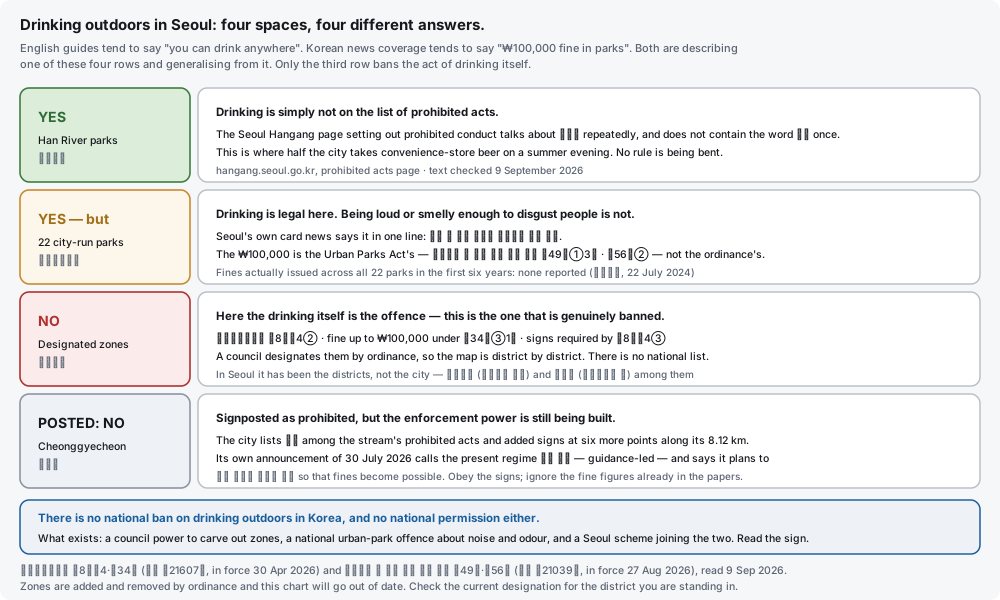
Start from the default. Korea has no general prohibition on drinking in public, which is why the photograph of people eating and drinking on the grass by the river is not a photograph of a crime. That is the baseline the English guides are describing, and as a baseline it is correct.
What sits on top of the baseline is a power. Article 8-4 of the 국민건강증진법, the National Health Promotion Act, added at the end of 2020, lets a local authority designate places within its area as 금주구역 by ordinance. Paragraph 2 prohibits drinking inside a designated zone, paragraph 3 requires signs, and Article 34(3), subparagraph 1 attaches an administrative fine of up to ₩100,000 to the person who drinks there.
So the ₩100,000 in the headlines is a real number in a real statute. It is simply not attached to parks. It is attached to a zone somebody had to designate, sign and publish, and because designation happens by ordinance there is no national map of them — in Seoul it has been individual districts rather than the city that moved, with 동대문구 designating the plaza at Cheongnyangni station and 광진구 designating several small parks.
Seoul's better-known scheme is an older and much milder thing, and it gets confused with the above constantly. The 서울특별시 건전한 음주문화 조성에 관한 조례 was made in May 2017, came into force that November and was last amended in January 2021 (current text at 국가법령정보센터). Under it 22 city-run parks were designated 음주청정지역, "alcohol-clean zones," with enforcement from 1 April 2018. The prohibited conduct there is not drinking. The city's own card news spells it out: the offence is 음주하여 심한 소음 또는 악취가 나게 하는 등 다른 사람에게 혐오감을 주는 행위 — drinking and thereby making severe noise or odour so as to disgust other people — and the same page carries the line ※ 공원 내 음주 자체가 금지되는 것은 아님. Drinking inside the park is not itself prohibited. That material dates from 2018, so treat the list of 22 as the position then and check your own park if it matters to your evening.
The ₩100,000 in that scheme, though, is not the ordinance's to give. Article 10 says the Mayor may impose it 「도시공원 및 녹지 등에 관한 법률」 제49조제1항3호와 제56조제2항 및 제3항에 따라 — under the Act on Urban Parks and Green Areas. Open that Act and Article 49(1)3 turns out to prohibit, in any urban park or green space in the country, 심한 소음 또는 악취가 나게 하는 등 다른 사람에게 혐오감을 주는 행위 — causing severe noise or odour and thereby disgusting other people. Article 56(2) prices it at up to ₩100,000.
Which means the noise rule was never about the 22 parks and was never about alcohol. It has applied in every urban park in Korea for years. What the ordinance adds on top is a name for the zones, a sign at the entrance, a duty on the Mayor under Article 4(5) to 권고 — to recommend — that people not drink in them, and the authority to collect. A recommendation is not a prohibition, which is exactly why the card news can say what it says.
How hard is any of it enforced? 경향신문 reported on 22 July 2024, citing city figures, that across those 22 parks not a single fine had been imposed for breaching that ordinance in six years. Two had been issued in a district-designated 금주구역, both in 장독골공원 in Gwangjin-gu, and a district official told the paper that both came from residents ringing in rather than from an inspection. That is the honest picture: a behavioural rule that mostly exists so an official has something to point at when a group gets loud, and a zone rule that is occasionally used.
The Han River parks sit in the first category and it is not close. Seoul's page listing prohibited acts in the Hangang parks does not contain the word 음주 anywhere, while it discusses 과태료 throughout for other things. Buying dinner at the convenience store by the station and eating it on the grass with a drink is, legally, the most boring activity described on this page.
Not for want of trying, mind. The same 경향신문 piece describes an amendment the city put to the council in 2023 that would have swept the Han River parks, other city parks and the streams into the 금주구역 net. The council declined to table it for lack of public consensus, and it was still sitting there unheard when the article ran in July 2024. A council survey the same year found 60.1 per cent of a thousand Seoul adults against the idea — while 72.1 per cent named abandoned food and rubbish as the thing that had actually spoiled a riverside evening for them. The question is live. Read the sign if it has been a while.
The exception in central Seoul is the Cheonggyecheon, and it needs handling carefully because the reporting has run ahead of the law. Drinking is on the city's list of prohibited acts for the stream, and in July 2026 signs and banners went up at six more points along its 8.12 km. But its own announcement of 30 July 2026 describes the present arrangement as 계도 중심 — guidance-led — and says it plans to 관련 법령과 조례를 정비 so that fines can be imposed, which is not how you describe a regime that can already impose them. Obey the signs. Do not repeat the fine figures already attached to that stretch in print.
Buying it for someone underage is the crime
Everything above concerns your own purchase. The provision most likely to actually land a foreign resident in trouble concerns somebody else's, and it is the one no English guide covers at all.
Article 28(2):
② 누구든지 청소년의 의뢰를 받아 청소년유해약물등을 구입하여 청소년에게 제공하여서는 아니 된다.
Nobody may, at the request of a youth, buy alcohol and provide it to them. Article 59, subparagraph 7 makes that the same offence as selling to a minor: up to two years' imprisonment, or a fine of up to ₩20,000,000. Not an administrative penalty. The same ceiling as the shop's.
Read the trigger. 청소년의 의뢰를 받아 — at a youth's request. This is proxy purchasing, and it requires no commercial element and no profit whatsoever. Subparagraph 7-2 covers the neighbouring case, persuading or inducing a youth to buy for themselves, and that one does require a commercial purpose.
Why it matters more to foreign residents than to anyone else: the situation arrives disguised as ordinary politeness. A university student who looks twenty-two and was born in 2008. A younger colleague at a company dinner where somebody is topping up glasses without asking anyone's year. School leavers are eighteen and nineteen in international age and do not look like children. And the check the law expects is one that is socially almost impossible to make — nobody is going to ask a colleague for their birth year across a table.
The 찾기쉬운 생활법령정보 page on youth-harmful substances, the government's plain-language service for the general public, states the proxy-purchase penalty in the same terms. If one thing here is worth remembering that is not about your own passport, it is that one.
If you are going to the shop tonight
Work out your year, not your age. Anyone born in 2007 or earlier can be sold alcohol in Korea for the whole of 2026, and the day and month never enter it.
Carry the passport or the ARC, and the original. Until 8 April 2027 there is no prescribed method for checking, which means the shop decides, and a shop facing two years' exposure decides conservatively. Being asked is not rudeness; since April 2025 there has been a matching duty on you to cooperate.
If you want it delivered, order food with it and keep the drinks under half the bill — or order on the app and collect in the shop. The bottle cannot come on its own.
And if you are taking it outside, look for a sign before assuming anything. The default is that you are fine. The exceptions are local, small, and posted.
Read at 국가법령정보센터 on 9 September 2026: Articles 2, 28, 49-2 and 59 of the 청소년 보호법 (법률 제21277호, in force 1 July 2026) and Article 27 of its 시행령 (대통령령 제36412호); Articles 8-4 and 34 of the 국민건강증진법 (법률 제21607호, in force 30 April 2026); Articles 49 and 56 of the 도시공원 및 녹지 등에 관한 법률 (법률 제21039호, in force 27 August 2026); the 주류의 통신판매에 관한 명령위임 고시 (국세청고시 제2024-41호, in force 1 January 2025); and the 서울특별시 건전한 음주문화 조성에 관한 조례 (서울특별시조례 제7849호, in force 7 January 2021). Seoul's card news on 음주청정지역 dates from 2018 and the 22-park list should be treated as the position then. The Cheonggyecheon material is the city's announcement of 30 July 2026. The enforcement figures, the shelved council amendment and the survey numbers are 경향신문's reporting of 22 July 2024, not an official publication. Prices, the contents of the 2027 decree and the acceptability of any particular foreign document are deliberately absent. Rules and designations change; check the current text before relying on any of this. General information, not legal advice. Corrections via contact. See terms.
Frequently asked questions
What is the legal drinking age in Korea?
Nineteen, but the count is unusual. Article 2(1) of the Youth Protection Act defines a youth as a person under 19 and then excludes anyone who has reached 1 January of the year in which they turn 19. Your birthday never enters it. Through 2026 that means anyone born in 2007 or earlier can legally be sold alcohol, whatever month they were born in.
Can I buy alcohol in Korea with a foreign driver's licence?
Treat it as unreliable. Article 28(4) of the Youth Protection Act obliges the seller to confirm your age and identity, and until 8 April 2027 it prescribes no method for doing so, which leaves the choice with the shop. A cashier who cannot read the document has every reason to refuse, because selling to a minor exposes them personally to up to two years in prison. A passport or an alien registration card in the original is the version that does not start a conversation.
Can you buy soju online in Korea?
Not from an ordinary shop. Under the National Tax Service notice on mail-order alcohol sales, only approved makers of certain traditional liquors may sell by distance channels, and mass-market soju and beer are not on that list. Two things do work: ordering through an app and collecting the bottles in person at the shop, and having alcohol delivered alongside a restaurant meal where the alcohol is no more than half the order.
Is it legal to drink in a park in Korea?
Usually, yes. There is no national ban on drinking outdoors. A local council may designate a 금주구역 by ordinance, and drinking inside one is prohibited by Article 8-4(2) of the National Health Promotion Act with an administrative fine of up to ₩100,000. Seoul's 22 'alcohol-clean' parks are a separate and milder scheme: drinking there is legal, and the offence is causing severe noise or odour, which the Act on Urban Parks and Green Areas already forbids in every urban park in the country. Read the sign in front of you.