Tipping in Korean Restaurants: Why the Menu Price Is Final
A ₩9,000 bowl of kimchi jjigae, a ₩2,000 bottle of cola, and the card terminal at the counter reads ₩11,000. No tax line, no service line, no tip screen. So do you tip in Korea? At an ordinary restaurant the menu has already answered that. The number printed next to the dish is supposed to be the whole amount, VAT and all, and since 1 January 2013 that has been a legal requirement rather than a polite habit.
That's the short version. The longer one matters in three situations: a hotel menu with small print at the bottom, a barbecue place where the price is per 100 grams, and the bill that somehow comes out higher than the menu. The last one got a lot more expensive for restaurants on 1 September 2026.
What Annex 17 actually requires
The rule doesn't live in the main Food Sanitation Act. It sits in a schedule: Annex 17 of the Act's Enforcement Rule (식품위생법 시행규칙 [별표 17]), which lists what food-service operators and their staff must do. In the version in force from 1 September 2026, item 7, sub-item 아 says the operator must post a price list where customers can easily see it, and defines that list as one showing "the price the customer actually has to pay, including value-added tax and the like" (my translation). The same sentence then closes the loophole: the business has to charge according to that list.
You can read the current Enforcement Rule on the National Law Information Center and the Annex 17 PDF itself, both in Korean, checked October 2026.
Look closely at the wording and something is missing. The word for service charge, 봉사료, does not appear in the current text. "VAT and the like" is as specific as the law gets.
Service charge comes in through the government's own explanation. On 17 December 2012, two weeks before the rule took effect, the Ministry of Health and Welfare's press release said every food-service business except contract caterers had to show a final price "including VAT, service charge and so on". It came with a before-and-after. Note what it shows: an old menu that printed ₩20,000 with "service 10%, VAT 10% separate" underneath had to be relisted at ₩24,000, so the menu itself now says what the till will say.
| Before 2013 | From 1 January 2013 |
|---|---|
| Drink ₩10,000 | Drink ₩12,000 |
| Dish ₩20,000 | Dish ₩24,000 |
| "Service charge 10%, VAT 10% separate" | (no footnote) |
The rule started on 1 January 2013 after a six-month grace period. The government's policy briefing of 11 July 2012 had flagged it months earlier, under a headline announcing that separate VAT and service-charge notation would be banned.
So the careful version goes like this. The law says the posted price is what you actually pay, with VAT included. The ministry that wrote the rule said service charge belongs in there too. For you, at the counter, both lead to the same place: the menu number is the bill.
For the rest of the restaurant routine, from calling staff over to paying, the ordering guide walks through it.
When the bill adds 10% + 10%: service charge in Korea after 2026
At a restaurant following the rule, tax is included and service charge isn't a separate amount. What changed in 2026 is what happens when a restaurant doesn't follow it, and the jump is steep.
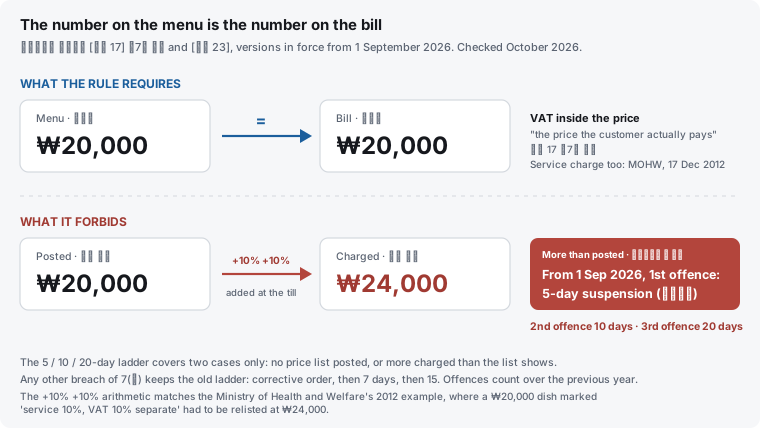
The penalties sit in another schedule, Annex 23. Its revised version, in force from 1 September 2026, splits breaches of item 7(아) three ways:
- No price list posted at all. 1st offence: 5-day business suspension. 2nd: 10 days. 3rd: 20 days. The annex excuses cases the operator isn't responsible for, such as a computer error.
- Charging more than the posted price. Same ladder, 5 then 10 then 20 days.
- Anything else under 7(아). The old ladder stays: a corrective order first, then 7 days, then 15.
Offences are counted over the previous year. The Annex 23 PDF has the full table, and the Ministry of Food and Drug Safety's 1 September 2026 press release spells out what it replaced: until then, even overcharging started with a corrective order, then 7 days, then 15. In 2012 the health ministry had described the first-offence penalty the same way. A July 2026 joint government release puts the change in the context of the overcharging crackdown announced in February.
One grey area deserves honesty. Say a menu is printed with "VAT separate" at the bottom. The menu itself doesn't meet 7(아). But a non-compliant list isn't, on the face of the annex, one of the two 5-day cases. If the till then adds 10% on top of the printed figure, that does look like charging more than the posted price. That's my reading of the schedule. The district office decides real cases, not me.
Is tax included in Korea more widely? For restaurant prices, yes, by this rule. Getting VAT back on things you buy is a separate matter, covered in the tax refund guide.
Korean BBQ and the 100-gram line
Barbecue has its own sub-item, 7(퍼). Meat such as bulgogi and galbi has to be priced per 100 grams, and where it's cooked before serving, the menu may show the weight before cooking. A per-portion (1인분) price is optional. But if the restaurant shows one, it has to show the portion's weight next to it. The annex even gives the format:
불고기 100그램 ○○원 (1인분 120그램 △△원) 갈비 100그램 ○○원 (1인분 150그램 △△원)
Sub-item 7(터) then says the main ingredient and weight you're served can't differ from what that list shows.
Why care? Because 1인분 isn't a standard unit. Two places can charge the same for a portion and serve different amounts. The 100-gram figure is the one you can actually compare along a street of barbecue restaurants, and the grams in brackets tell you what you're getting when you order the usual two portions. The BBQ guide explains that two-portion minimum and how the grill side of the meal runs.
Scope is narrower than "anything with meat in it". The Seoul Metropolitan Government's food safety guidance (a city explanation, not the annex itself) applies the 100-gram price to raw meat you grill at the table, to marinated galbi or bulgogi you cook yourself, and to extra meat ordered on top of shabu-shabu or dakgalbi. It leaves out dishes that arrive ready to eat, listing tang, jjim, jjigae, bossam, jokbal, yukhoe, steak, tonkatsu and barbecue among them, and chicken or duck served by the whole bird. So a samgyeopsal place should show grams; a jokbal place doesn't have to.
Hotel restaurants and the 10% line
This is the fuzzy part.
The rule covers "food-service operators", with only contract caterers carved out. Nothing in Annex 17 excludes hotels, and the 2012 health ministry release said "all food-service businesses". When the rule was announced, JoongAng Ilbo and Daily Tomorrow both reported it as applying to hotel restaurants by name, the latter describing the old "ten-ten" pricing (10% service plus 10% VAT) that had to be folded into the menu price.
What I couldn't confirm: whether every restaurant inside a hotel operates under the kind of licence the annex covers, and whether a "service charge 10%" line you may see on a hotel menu today means 10% added on top or 10% already inside the printed figure. Those are different things. The second is just a breakdown. The first is exactly the separate-charge pricing the rule was written to end, the reason that 2012 example had to raise its printed price to ₩24,000 in the first place.
Practical answer until someone shows a ruling: read the small print before you order, check the total before you tap your card, and ask "봉사료 포함이에요?" (Is service included?). If the bill is higher than the menu, ask at the counter rather than afterwards.
Leaving money anyway
The law has nothing to say about it. Annex 17 controls what a business may charge you. It doesn't touch what you decide to leave, so a tip is neither required nor prohibited.
What happens when you try is a matter of custom, and custom varies by place.
What doesn't vary is the arithmetic. Because the menu already is the bill, there's no tip line written into the price, and no 15% for you to work out on top. Paying the printed figure is paying in full.
If the bill comes out higher than the menu
Check before you pay, not after. Once the card has gone through, you're arguing from a receipt instead of standing at a counter with the menu in front of you.
- Compare at the counter. Menu figure times quantity, against the screen on the card terminal.
- Ask plainly. "메뉴판이랑 금액이 달라요" (The amount is different from the menu).
- Keep evidence. A photo of the menu or wall price board, and the card receipt.
- Know who decides. Under Article 75 of the Food Sanitation Act, business suspensions are imposed by the Minister of Food and Drug Safety, or by the mayor of a special self-governing city or governor of a special self-governing province, or a city mayor, county head or district head (식품의약품안전처장 또는 특별자치시장·특별자치도지사·시장·군수·구청장). In practice that points at the city, county or district office where the restaurant is, though that's my inference from who holds the power, not a published complaint procedure.
Phone numbers are where most English guides go wrong. 1399 is listed by Food Safety Korea as the line for fraudulent or substandard food; I didn't find any official statement that it takes price-list complaints. The government mentioned 120 and the tourist complaint line 1330 in a 28 May 2026 government release, but about accommodation problems around concert venues, not restaurant bills. 110 is the government's general civil-complaint call centre (listed on mfds.go.kr). Numbers and routing change, so treat this as of October 2026.
Outside the door: the 150 m² rule
One more thing you'll start noticing. Under the same sub-item, a general or rest restaurant (일반음식점·휴게음식점) with a declared floor area of 150 m² or more has to post its price list outside as well as inside. The 2012 release put that at roughly 45 pyeong, about 12% of restaurants, some 80,000 places. The outside board shows final prices and main dishes, with five or more recommended rather than required. That part began on 31 January 2013.
A smaller place with no board outside isn't breaking anything. It still owes you a price list inside.
Rule text from Annex 17, items 7(아), 7(퍼) and 7(터), and Annex 23, of the Food Sanitation Act Enforcement Rule in the version in force from 1 September 2026 (Prime Ministerial Decree No. 2150), checked against law.go.kr in October 2026. Service charge and the ₩10,000→₩12,000 / ₩20,000→₩24,000 example from the Ministry of Health and Welfare release of 17 December 2012. The penalty change from the Ministry of Food and Drug Safety release of 1 September 2026; the 100-gram scope examples from the Seoul Metropolitan Government's food safety pages. Corrections go through the contact page.
Frequently asked questions
What if a Korean menu says 'VAT separate'?
That notation has not been allowed since 1 January 2013. Item 7(아) of Annex 17 to the Food Sanitation Act Enforcement Rule says the posted price must be what the customer actually pays, VAT and the like included. If the till adds 10% on top of the printed figure, ask about it at the counter before you pay. Checked October 2026.
How is Korean BBQ meat priced on the menu?
Per 100 grams. Sub-item 7(퍼) of Annex 17 requires a 100-gram price for meat such as galbi and bulgogi; a per-portion (1인분) price is optional, but if shown it must state the portion's weight. Seoul's food safety guidance applies this to meat you grill yourself and to extra meat ordered with shabu-shabu or dakgalbi, not to finished dishes like stews, bossam or steak.
Who do I complain to if the bill is higher than the menu?
Business suspensions under Article 75 of the Food Sanitation Act are imposed by the Minister of Food and Drug Safety or by the local mayor, county head or district head, so the restaurant's city, county or district office is the usual route. 110 is the government's general civil-complaint call centre. Keep a photo of the menu and the receipt. Since 1 September 2026, a first overcharging offence carries a 5-day suspension.