Korea Minimum Wage 2027: ₩10,700 and Weekly Holiday Pay
A café near a university posts a weekend job: Saturday and Sunday, seven hours each, 14 hours a week. The shop next door wants someone for three five-hour evenings, 15 hours. At Korea's 2027 minimum wage of ₩10,700 an hour, that one extra hour is worth ₩42,800 a week to the worker. Not ₩10,700.
The gap is the weekly holiday allowance, and it is the reason 14-hour shifts are so common on Korean job boards. The gap falls straight out of the Labor Standards Act. The hourly figure is only the first of the two.
So this page starts with the rate itself, then spends most of its length on that 15-hour line, because that is where a part-timer's week is won or lost. Probation pay, foreign workers and what to do about a short payslip come after.
The 2027 rate: ₩10,700 an hour, one rate for everyone
The Ministry of Employment and Labor fixed the rate in notice No. 2026-60 (PDF), dated 5 August 2026: ₩10,700 an hour for all industries, applying from 1 January to 31 December 2027 (as of October 2026). The same notice gives a monthly equivalent of ₩2,236,300, for someone working 40 scheduled hours a week, based on 209 hours a month "including 8 hours of paid weekly holiday". The commission's notice page repeats the date and number.
There is no cheaper rate for convenience stores, restaurants or farms: the notice sets one rate for every workplace regardless of the type of business, and it does not set a separate rate for piece-rate workers.
The Minimum Wage Commission's English page still shows the 2026 figures (checked October 2026), which makes the comparison easy:
| 2026 | 2027 | |
|---|---|---|
| Hourly | ₩10,320 | ₩10,700 |
| Daily, 8 hours | ₩82,560 | ₩85,600 |
| Monthly, 209 hours | ₩2,156,880 | ₩2,236,300 |
That is ₩380 more an hour, 3.7%, and ₩79,420 more on the monthly figure. The 3.7% is from the commission's July 2026 press material on the proposal it voted through; the binding figure is the August notice. The 2027 daily number is my own 8 × ₩10,700, not a published one.
Notice that the monthly figure isn't 40 hours times four weeks. It is 209 hours, because it already contains hours you are paid for and don't work.
Weekly holiday allowance and the 15-hour line
Korean payroll calls it 주휴수당, juhyu sudang, usually translated as weekly holiday allowance. Article 55(1) of the Labor Standards Act says an employer must guarantee at least one paid holiday a week on average. Paid holiday means a day's pay without a day's work.
Two conditions decide whether you get it.
Hours. Article 18(3) switches Article 55 off for anyone whose scheduled hours (소정근로시간), averaged over four weeks, come to less than 15 a week. It switches off Article 60 at the same time, and Article 60 is annual leave, so the same line decides whether you earn any annual leave days at all. What counts is scheduled hours, the ones in your contract or rota, averaged over four weeks (or over the whole job if it lasted less than that).
Attendance. Article 30(1) of the Enforcement Decree gives the paid holiday to a worker who attended every scheduled working day of that week. Skip a shift and that week's allowance can go with it.
How many hours? Someone on 40 hours gets 8, the figure built into the official 209-hour month. For part-timers, Article 18(1) says a short-time worker's conditions are set in proportion to the hours of a comparable full-time worker in the same job. Applied to a 40-hour comparison that gives scheduled hours ÷ 40 × 8: 20 hours a week earns 4 paid holiday hours, 15 hours earns 3. If the full-timers at your workplace work some other week, the proportion changes.
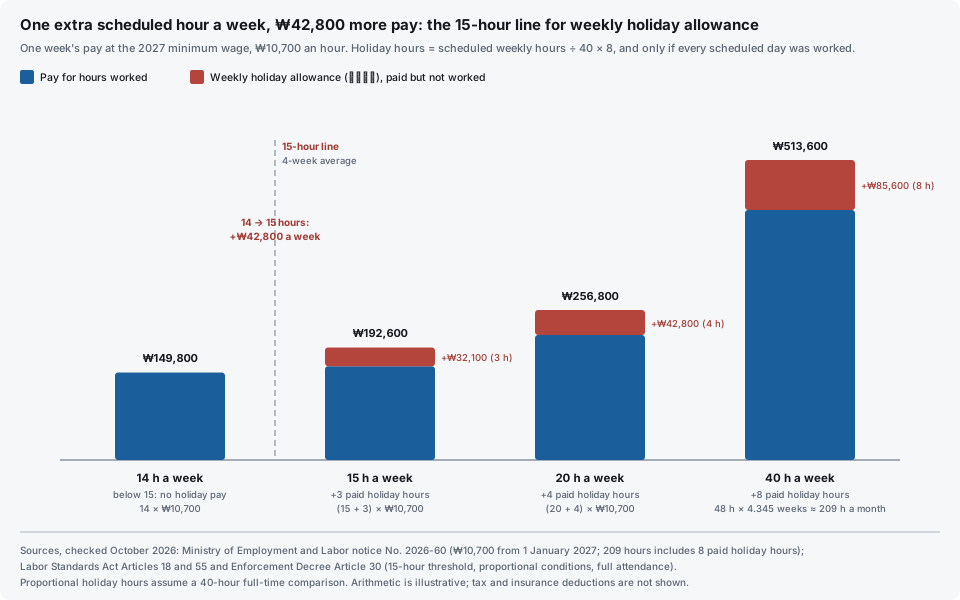
Look at the jump between the first two bars. Moving from 14 to 15 scheduled hours adds ₩10,700 of work pay and ₩32,100 of holiday pay together. From the employer's side, a 14-hour rota is cheaper than a 15-hour one by far more than one hour's wage, which is why you'll see shifts advertised at exactly 14 hours, or someone's week split into pieces that each stay under the line.
If your contract says 15 hours or more and the payslip shows no holiday line, ask. Some employers say the allowance is already built into a higher hourly rate. Do the division before you accept that: at 20 hours a week, a rate that really included the allowance would have to be at least (20 + 4) ÷ 20 × ₩10,700 = ₩12,840 an hour. That sum won't tell you whether a combined rate is allowed in your contract, but it does tell you whether the total is short.
From ₩10,700 to a monthly wage
Where does 209 come from? A full-time week is 40 hours worked plus 8 paid holiday hours, 48 paid hours in all. A year has 365 ÷ 7 ≈ 52.14 weeks, which is about 4.345 weeks a month. 48 × 4.345 = 208.56, rounded up to 209, and 209 × ₩10,700 = ₩2,236,300, the notice's figure exactly.
The same method works for part time. These are my calculations, not official numbers, and they are gross pay before tax or insurance:
| Scheduled hours a week | Paid hours a week | Paid hours a month (× 4.345) | Monthly at ₩10,700 |
|---|---|---|---|
| 14 | 14 | 60.83 | about ₩650,900 |
| 15 | 18 | 78.21 | about ₩836,800 |
| 20 | 24 | 104.28 | about ₩1,115,800 |
| 40 | 48 | 209 (rounded) | ₩2,236,300 |
If you are paid weekly or per shift, a five-week month will look bigger than a four-week one. That is the calendar, not a raise.
One more payslip check. If the shop deducts 3.3% and calls you a freelancer, that's a tax arrangement for self-employed income, and you may be able to get the 3.3% back in May. Whether someone working fixed shifts on a rota is really a freelancer at all is a different matter.
Probation: when 90% is allowed, and when it isn't
Employers like the word 수습 (probation), and job ads sometimes say "probation 90%". The law allows it, narrowly. Article 5(2) of the Minimum Wage Act permits a different minimum during probation, and Article 3 of its Enforcement Decree sets that at the hourly minimum minus 10%. In 2027: ₩10,700 × 0.9 = ₩9,630 an hour.
All three of these have to be true at once:
- the contract is for a fixed term of one year or more;
- you are within three months of the day probation started;
- the job is not one of the simple manual labour occupations (단순노무업무) the Minister has designated by notice.
So a six-month café contract cannot use the reduction at all, and nobody can use it from month four. Many entry-level part-time jobs are exactly the kind of simple work the exception is aimed at, which means a "probation 90%" line in a counter or kitchen job deserves a second look. Which occupations the Minister's list actually names is something this page doesn't settle.
Foreign workers, students and very small shops
The Minimum Wage Act's Article 3 applies it to every business that employs workers. It names three exceptions: a business employing only relatives who live with the owner, domestic workers (가사 사용인), and seafarers covered by the Seafarers' Act. Nationality is not among them. Separately, Article 6 of the Labor Standards Act bans discriminatory treatment in working conditions on grounds of nationality, religion or social status. Read together, a foreign passport or a particular visa does not move you onto a lower rate. Workers without valid status are a harder case, covered below.
Size doesn't matter for the minimum wage itself. Article 3 says "every business that employs workers", with no headcount, so a shop with one part-timer is covered. The weekly holiday allowance is a Labor Standards Act rule, though, and that act's Article 11 applies in full only to businesses with five or more regular workers; for four or fewer, only the parts listed by Presidential Decree apply. Whether the weekly holiday rule is on that list decides the question for a shop with four or fewer staff.
Students on a D-2 visa have their own hours cap. A Ministry of Justice release dated 23 June 2023, in its attached PDF, raised the weekly part-time work limit for associate and bachelor's students from 20 to 25 hours from 3 July 2023, with 5 more for students with good grades and Korean ability. That is the 2023 rule; check the current limit for your course with HiKorea or your university's international office. At 25 hours you are well over the 15-hour line, and the holiday allowance rules above apply in the normal way.
What counts toward the minimum
Your hourly figure for minimum wage purposes isn't always the headline rate. Under Article 6(4), wages paid regularly at least once a month count. Since 2024, the addendum to the 2018 amendment lets monthly bonuses and monthly cash welfare payments (a meal or transport allowance paid in money) count in full. Bonuses paid quarterly or once a year still don't count, because they aren't monthly, and benefits given in kind, like free staff meals, don't count either.
Article 6(4) also takes some money out. Its first item excludes pay for anything beyond your scheduled hours and days, so overtime, night and holiday-work premiums are excluded from the comparison even though they arrive in the same transfer.
The practical check, then: add up what you are paid in money every month for your scheduled hours (base pay, the weekly holiday allowance, monthly cash allowances), leave the overtime, night and holiday-work premiums out, divide by the paid hours from the table above, and compare with ₩10,700.
Paid less? 1350 and the e-people petition
Paying below the minimum is a criminal offence. Minimum Wage Act Article 28(1) sets a penalty of up to three years in prison or a fine of up to ₩20 million.
Call 1350 first. It is MOEL's labour counselling line, no area code needed, weekdays 09:00 to 18:00, and the call is charged. Its ARS menu lists option 5 as foreign language counselling, in English and Chinese; other languages aren't on that page. From abroad the ministry's English Q&A page gives +82-52-702-5089 (all checked October 2026).
Then file a petition if needed. MOEL's English application page says unpaid wages and allowances can be raised through the e-people service, which passes it to the National Labor Consultation Center and then your local Employment and Labor office. The ministry's Korean complaints site (minwon.moel.go.kr) is the other route.
What to ask 1350 rather than take from here. A few points above depend on documents this page doesn't reproduce: the Minister's list of simple manual occupations, the decree list for workplaces with four or fewer staff, and a direct official statement on workers without valid status. I also couldn't load minwon.moel.go.kr when checking in October 2026, so its current menus aren't described here. Put these to the counsellor if any applies to you:
- whether your job is on the simple manual labour list, if your contract has a probation clause, and how the one-year condition works if the contract has no end date;
- how holiday hours are prorated if full-timers at your workplace don't work 40 hours;
- whether a rate that "already includes" the holiday allowance is acceptable in your contract;
- whether a fixed-rota job taxed at 3.3% is really freelance work;
- whether the weekly holiday allowance applies at an employer with four or fewer staff;
- where you stand on pay if your residence status has lapsed.
Before you call, gather the contract, your rota or shift records, payslips, the bank transfers, and any messages about hours. Scheduled hours are the thing in dispute in most holiday allowance cases, and screenshots of the rota settle that faster than memory does. If the job has already ended and severance is also unpaid, our guide to the 14 days before you can file covers that claim.
Figures and legal text were checked in October 2026 against MOEL notice No. 2026-60, the Minimum Wage Commission and the Labor Standards Act and Minimum Wage Act articles on law.go.kr, all linked above. Monthly and part-time amounts are my own arithmetic. This is general information, not legal advice; for your own case, call 1350. See terms. Corrections via contact.
Frequently asked questions
What is the minimum wage in South Korea in 2027?
₩10,700 an hour for every industry, from 1 January to 31 December 2027, under Ministry of Employment and Labor notice No. 2026-60 dated 5 August 2026. The official monthly equivalent is ₩2,236,300 for a 40-hour week, based on 209 hours a month including 8 paid weekly holiday hours. The 2026 rate is ₩10,320, so it rises by ₩380 (checked October 2026).
Do part-time workers in Korea get weekly holiday allowance?
Yes, if your scheduled hours average 15 or more a week over four weeks and you work every scheduled day that week (Labor Standards Act Articles 18 and 55, Enforcement Decree Article 30). Below 15 hours there is no weekly holiday allowance and no annual leave. For part-timers the paid hours are usually worked out in proportion to a 40-hour week: 20 hours a week earns 4 paid holiday hours.
Does the Korean minimum wage apply to foreigners?
The Minimum Wage Act covers every business that employs workers, and its Article 3 excludes three categories: businesses employing only relatives living together, domestic workers and seafarers. Article 7 separately lets the Minister authorise exclusions for named individuals, such as someone whose disability markedly limits their working capacity. Nationality is not one of these, and the Labor Standards Act bans discrimination in working conditions on grounds of nationality. If your residence status is unusual, ask the 1350 labour helpline, which has English and Chinese options.
Can my employer pay 90% of the minimum wage during probation?
Only if all three conditions hold: you signed a fixed-term contract of one year or more, you are within the first three months of probation, and the job is not one of the simple manual labour occupations the Ministry designates. In 2027 the reduced floor would be ₩9,630 an hour. A contract shorter than a year cannot use the reduction.